India Wins T20 Series
Sanju Samson's Explosive Knock Secures India's T20 Series Win Over Afghanistan
Anonymous
Key Points
1
Vaibhav Sooryavanshi became the youngest cricketer to represent India when he debuted against England in Manchester in July, and he had also led India’s scoring with 151 runs in a 3-0 T20I series sweep against Zimbabwe.
2
Samson’s 57 came after a difficult run of form: he had scored 5, 0, 1, 27 and 10 in his previous five T20 internationals before India chased 160 in 14.5 overs.
3
Samson said competition should not create resentment within the squad: “We may be competitors to the outside world, but we are a team and we are playing for a country and we want to win the game first.”
4
India’s recent white-ball difficulties included a 0-2 T20I series defeat in Ireland followed by losses in both the T20I and ODI series in England, but Abhishek Sharma argued that “one or two series won’t define our team as a batting unit.”
5
Sunil Gavaskar cautioned that Samson’s measured start is most useful when the chase is modest; when India are pursuing 190 or 200, Gavaskar said there may be “no option” but to attack from the first ball.
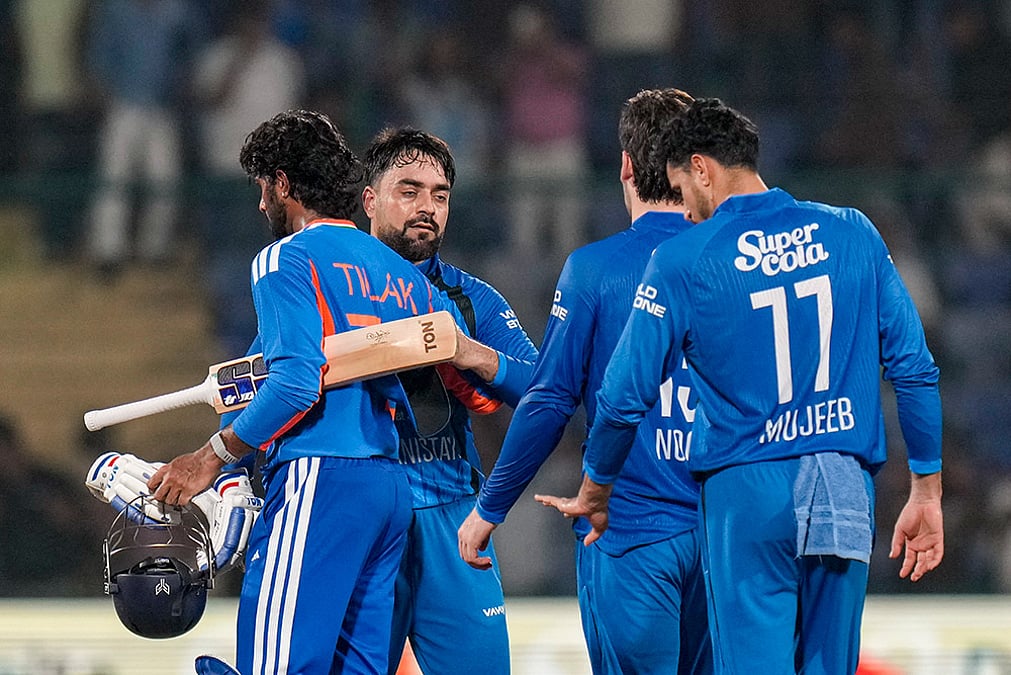
Sanju Samson blasted 57 runs off just 22 balls to power India to a seven-wicket victory over Afghanistan in the second T20I, clinching the series with one match remaining. Times of India reported that Samson, fighting for his spot against younger rivals like Vaibhav Sooryavanshi, started cautiously before accelerating into an explosive assault. India chased down Afghanistan's 160 in just 14.5 overs, showcasing the aggressive batting style that defines the team's approach.
Samson's half-century came after a rough patch: he had scored just 5, 0, 1, 27, and 10 in his previous five T20 internationals. Telegraph India noted that Samson credited a clear mindset with helping him block out external criticism and focus on India's success over personal rivalries.
Samson Silences Doubters with Explosive Fifty
After months of scrutiny over his aggressive approach, Samson delivered when it mattered most. The 31-year-old began his innings with restraint before unleashing a barrage of boundaries. Daily Hunt reported that his powerful hitting took Afghanistan's bowlers apart, transforming a potentially tight chase into a comfortable romp. Samson's strike rate of 258 demonstrated India's willingness to attack from the start, even against quality spin.
Samson told reporters he refuses to let outside noise affect his game. "If I was affected by the noise, I wouldn't play how I do," he said, emphasizing that competition within the squad should strengthen, not fracture, team unity. He added: "We may be competitors to the outside world, but we are a team and we want to win the game first."
Young Sooryavanshi Pushes Samson for Opening Spot
Vaibhav Sooryavanshi, India's youngest-ever international cricketer, is applying serious pressure on established batters. Khel Ja noted that the teenager made his debut against England in Manchester last July and recently scored 151 runs in a 3-0 T20I sweep of Zimbabwe. His emergence has forced selection conversations about who deserves India's limited batting slots in the format.
Samson embraces the challenge rather than resenting it. He stressed that difficult selection decisions are part of professional cricket and that players must accept them gracefully. "Not a robot, but used to tough calls," he explained, refusing to complain about rotation or tough competition for his spot.
India's Aggressive Approach Rebounds After Recent Losses
India's white-ball form has been shaky. The team lost a T20I series 0-2 in Ireland, then suffered defeats in both T20I and ODI series in England. Yet rather than abandoning aggression, players like Abhishek Sharma doubled down. Abhishek struck 82 off just 32 balls in the opening match against Afghanistan, proving that bold attacking can work.
Abhishek defended attacking from the first ball against both pace and spin bowlers, insisting recent series losses won't define India's batting unit. Samson agreed, and ex-captain Sunil Gavaskar praised Samson's measured approach—though Times of India reported Gavaskar cautioned that when chasing 190 or 200, there may be "no option" but to attack immediately rather than start slowly.
Mindset Shifts Help India's Batting Find Consistency
Several Indian batters credited improved mental clarity for recent performances. Ishan Kishan said a calmer approach had sharpened his batting decisions and execution. This psychological shift complements India's tactical evolution, blending calculated aggression with measured thinking depending on match situation and bowling type.
Samson's comeback reinforces that India's aggressive philosophy remains intact despite setbacks. With the series already secured and one match left to play, the team enters the final T20I with momentum and renewed confidence in their white-ball plans.
Sentiment
Mostly NegativeNEGATIVENEUTRALPOSITIVE
Publishers
15
Articles
18
Reach
33
A
AnonymousAuthor


