Construction Purchasing Power Report
Midwestern States Offer Best Construction Purchasing Power Despite Lower Nominal Wages
Anonymous
Key Points
1
The employment rebound was attributed to large-scale infrastructure investments and new manufacturing developments, following a 2025 slowdown linked to high interest rates and cost pressures.
2
Construction Coverage’s analysis combined wage data from the U.S. Bureau of Labor Statistics with regional price data from the Bureau of Economic Analysis, covering all 50 states and more than 350 metropolitan areas.
3
The report specifically identified San Jose, Boston, Seattle and San Francisco as high-cost coastal metropolitan areas where strong nominal construction wages may not produce the highest purchasing power.
4
The analysis emphasized that regional price differences can substantially reduce the real value of workers’ take-home pay, meaning that nominal wages alone are an incomplete measure of economic advantage.
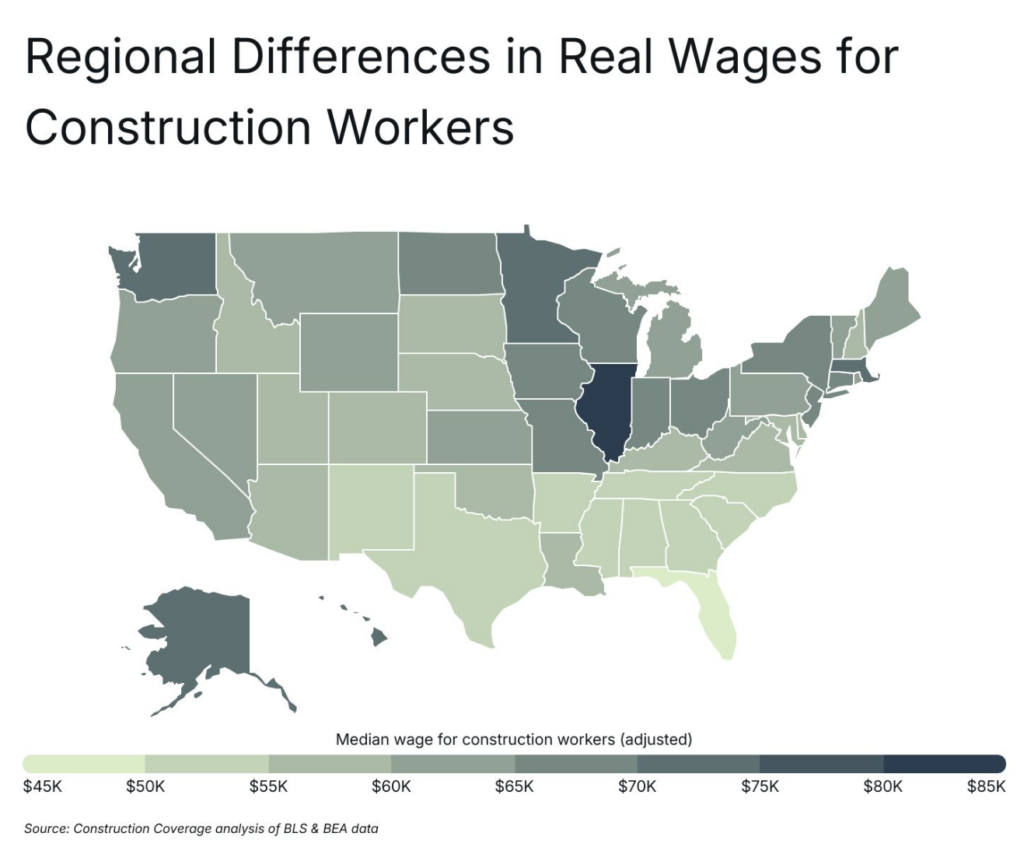
U.S. construction employment surged to 8.34 million workers in mid-2026, rebounding sharply from a 2025 slowdown. Construction Coverage's analysis shows the median construction wage hit $59,540—about 17% above the national median—but real purchasing power varies dramatically by region. After adjusting for local living costs, Midwestern states dominate, with Illinois leading at $80,604 in adjusted earnings.
The surprising finding: high nominal wages in expensive coastal cities like San Jose and San Francisco don't translate to the strongest purchasing power. Construction Coverage combined wage data from the U.S. Bureau of Labor Statistics with regional price information from the Bureau of Economic Analysis, analyzing all 50 states and over 350 metropolitan areas.
Infrastructure Spending Drives Job Rebound After 2025 Stagnation
After construction employment flatlined in 2025 due to high interest rates and rising material costs, large federal infrastructure investments and new manufacturing facilities sparked a dramatic turnaround. Fox21Online reports that by mid-2026, the industry hit a record high of 8.34 million workers—driven by AI data centers, energy projects, and semiconductor facilities. According to the Associated General Contractors of America, nonresidential construction specifically grew 2.6% year-over-year.
Midwest States Beat Coastal Cities in Real Purchasing Power
While San Jose, Boston, Seattle, and San Francisco pay strong nominal wages, their high cost of living erases much of that advantage. Construction Coverage's analysis found Illinois leads the nation with cost-adjusted earnings of $80,604. Minnesota ranks fourth at $73,605, and Washington ranks sixth at $70,552. Midwestern states occupy 8 of the top 15 positions nationwide because union-backed prevailing wage enforcement pairs with low regional price levels.
Alaska ranks third nationally with adjusted earnings of $73,877. Wyoming earned $64,461 after cost adjustment, while Colorado came in at $59,378. Construction Coverage emphasized that regional price differences substantially reduce what workers can actually buy with their paychecks.
Southern States Cluster at Bottom of Purchasing Power Rankings
Southern states hold 9 of the 10 lowest cost-adjusted wage positions nationwide. Indiana ranks 14th from the top at $66,282 adjusted earnings, Oregon earns $63,980, and Idaho comes in lowest measured at $58,810. Oklahoma ranks 11th from the bottom, while South Dakota ranks 13th from the bottom. The regional disparities highlight how nominal wages alone mask true economic opportunity.
Trade Workers May Shift Toward Midwest for Better Living Standards
The data suggests construction workers seeking maximum purchasing power should target Midwestern and inland states rather than expensive coastal metros. Construction Coverage's benchmark report implies that real earnings—not nominal wages—determine middle-class living standards. As Associated General Contractors of America CEO Jeffrey Shoaf stated, "Construction firms continue to add workers where demand remains strongest." Migration toward high purchasing-power regions could reshape labor availability patterns across the industry.
Sentiment
Mostly NegativeNEGATIVENEUTRALPOSITIVE
Publishers
45
Articles
102
Reach
147
A
AnonymousAuthor


