VAR Protocol Error
IFAB Confirms Embolo's World Cup Red Card Unlawful, Citing VAR Protocol Misuse
Anonymous
Key Points
1
VAR official Guillermo Pacheco reviewed the incident and signaled that Leandro Paredes did not commit a foul, leading to Breel Embolo's second yellow and sending him off for simulation.
2
The World Cup quarter-final was played in Kansas City, and Embolo was sent off in the 72nd minute, shortly after Switzerland equalised, a sequence that shifted momentum before Argentina won 3-1 after extra time.
3
Observers from opponents' camps, including supporters of earlier opponents such as Egypt, questioned whether refereeing calls were biased in favour of Lionel Messi's Argentina during the tournament.
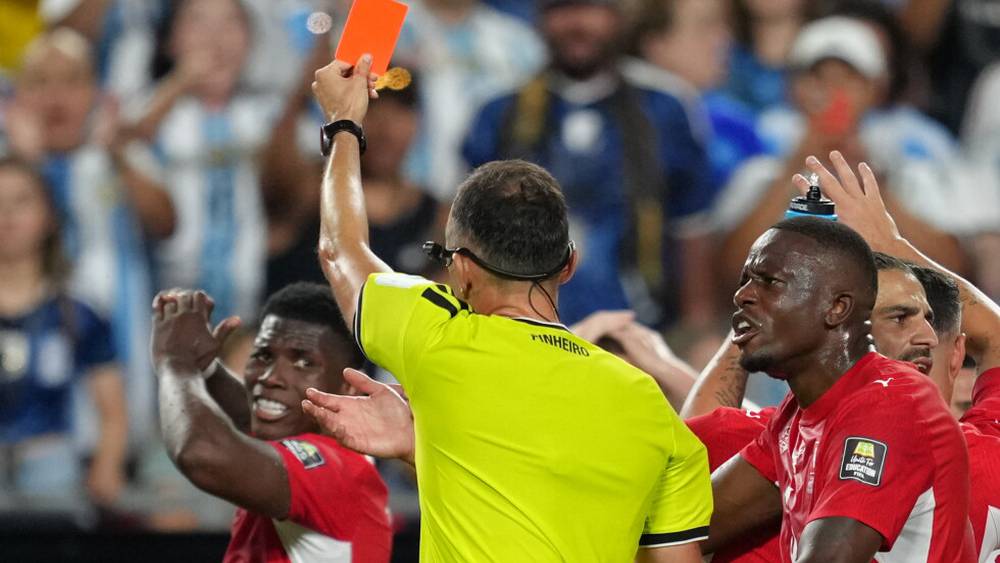
Soccer's rule-making body IFAB has confirmed that Breel Embolo's red card in the World Cup quarter-final against Argentina was wrong. The VAR review that led to his second yellow card was not permitted under the rules, according to Reuters and ESPN.
Embolo was sent off in the 72nd minute in Kansas City — just moments after Switzerland had equalised. Argentina went on to win 3-1 after extra time, ending Switzerland's tournament run.
What the VAR Official Did Wrong in Kansas City
VAR official Guillermo Pacheco reviewed the incident and signaled that Leandro Paredes did not foul Embolo. That review led to Embolo's second yellow card for simulation and his immediate dismissal. But IFAB says that review should never have happened, according to Lancaster Online.
The rule Pacheco used is called the "mistaken-identity" protocol. It exists only to correct a card shown to the wrong player — for example, booking Player A when Player B committed the foul. It is not meant to review whether an offense actually happened. IFAB confirmed the offense itself cannot be changed under this rule, according to ESPN.
Switzerland Coach Says the Red Card Ruined Their Campaign
Switzerland coach Murat Yakin did not hold back after IFAB's announcement. He said the referee's ruling was wrong and called it a "season-changing" call that derailed his team's World Cup. The dismissal came at a pivotal moment — Switzerland had just leveled the score at 1-1 before going down to ten men.
Argentina scored twice more in extra time to win 3-1 and advance. Whether Switzerland would have held on with eleven players remains unknown, but the timing of the red card clearly shifted the game's momentum in Argentina's favor, according to Reuters.
IFAB Has Been Reviewing VAR Rules Since March
IFAB has been reviewing VAR protocols since March. Officials acknowledged that Embolo's case is part of broader scrutiny aimed at aligning technology with on-field judgment, according to TSN. The mistaken-identity clause is one area being examined for future use — it was not officially active at this World Cup.
El Botola noted that the confirmation from IFAB intensified debates about VAR's consistency in high-stakes matches. Supporters of earlier opponents, including Egypt, questioned whether refereeing calls favored Lionel Messi's Argentina during the tournament. No formal action has been taken against any officials involved.
Will VAR Rules Change Before the Next World Cup?
IFAB indicated the mistaken-identity protocol could be expanded or clarified in future competitions. But no specific timeline has been set. The Embolo case has become a reference point for why clearer VAR guidelines are needed, according to Lancaster Online.
For now, the ruling stands. Embolo's red card cannot be reversed. Switzerland's quarter-final exit remains on the books. The debate over whether VAR helps or hurts the game is unlikely to fade before the next major tournament.
Sentiment
Mostly NegativeNEGATIVENEUTRALPOSITIVE
Publishers
50
Articles
132
Reach
182
A
AnonymousAuthor


