Fly brain connectome complete: 166,000 neurons mapped
Fly brain connectome complete: 166,000 neurons mapped
Anonymous
Key Points
1
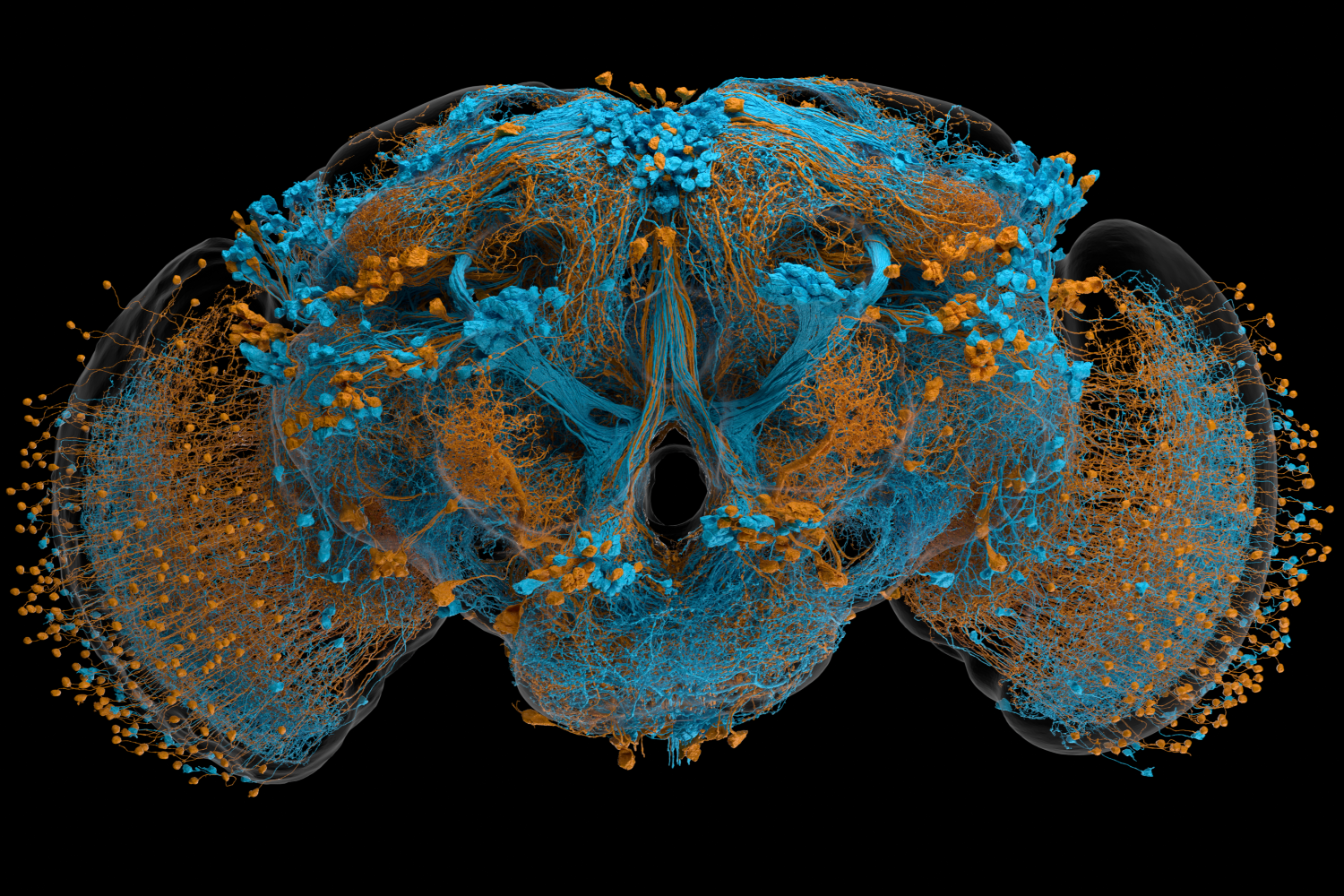
The male fruit fly brain connectome includes the ventral nerve cord and totals 166,700 neurons with about 124.2 million synapses, completing the wiring diagram for the fly’s central nervous system.
2
Direct sex-based comparison of the two connectomes shows that sex differences are concentrated in higher brain centers, while sensory and movement circuits are largely shared between male and female flies.
3
The mapping relied on enhanced focused ion beam scanning electron microscopy to image the entire nervous system, followed by machine-learning-based tracing to reconstruct neurons in 3D.
4
The female fly connectome was published in 2024, and the new male connectome completes the dataset by including the ventral nerve cord, enabling cross-sex analyses for the first time at this scale.
5
Historically, the project began in 2008 at HHMI’s Janelia Research Campus amid skepticism about mapping a brain with tens of thousands of neurons; organizers aimed to derive a mechanistic account of vertebrate brain function and apply those lessons to larger models.
Scientists have completed the most detailed map of any animal brain to date: a full wiring diagram of the fruit fly's 166,000 neurons and 124.2 million synapses Ars Technica. The male fly connectome joins a female brain map from 2024, giving researchers their first chance to compare how male and female brains differ at this scale UKRI. The breakthrough comes after 16 years of painstaking work at HHMI's Janelia Research Campus, proving that mapping complex nervous systems is far more achievable than scientists once believed.
This connectome is not just a static picture. It's a working blueprint. Researchers are now tracing complete circuits from sensory input through the brain to motor output, revealing how neural wiring drives feeding, mating, and aggression Tech Explorist. The fly brain's relative simplicity—compared to humans with 86 billion neurons—makes it an ideal testing ground for understanding how any brain works.
Sixteen Years to Map 166,000 Neurons
The project began in 2008 amid deep skepticism. Critics questioned whether mapping tens of thousands of neurons was even possible Ars Technica. The Janelia team pushed forward anyway, developing focused ion beam scanning electron microscopy to slice the fly brain into ultra-thin layers and image each one. Machine-learning algorithms then reconstructed every neuron in 3D, creating the connectome slice by slice.
The male connectome contains 139,000 to 166,700 neurons—sources vary slightly on the count—with over 50 million to 124.2 million synaptic connections Webpronews, Newsy Today. Earlier this year, researchers completed the female fly connectome, establishing the first whole-brain sex comparison ever done at this resolution. Together, they form a complete reference map of fruit fly neurobiology.
Male and Female Brains Share Sensory Circuits
The sex comparison reveals something striking: male and female flies use nearly identical wiring for sensing the world and moving through it Ars Technica. Their sensory and motor circuits overlap almost completely. The differences emerge in higher brain regions—areas linked to mating, aggression, and reproductive behavior. This finding suggests that basic neural building blocks are conserved across sexes, while specialized circuits diverge.
This layered architecture mirrors what neuroscientists see in larger brains. Core functions like vision and movement are hardwired similarly across individuals. But behaviors unique to each sex—like male courtship displays or female egg-laying—rely on sex-specific neural tuning in higher centers. The fly brain thus offers a molecular-level proof of this organizing principle.
From Fruit Flies to Vertebrate Brains
The real prize is methodological. Janelia researchers set out to prove that if you could map a complex brain efficiently, you could apply those techniques to vertebrates Tech Explorist. The connectome is already paying dividends: scientists are using it to decode specific behaviors by tracing complete neural pathways from stimulus to response. They can now watch aggression or feeding unfold as electrical signals crossing synapses.
Larger projects are already underway. The mouse brain connectome initiative, the zebrafish larva maps, and efforts to chart fruit fly larvae are all building on lessons learned here. The fruit fly work proved that connectomics is not just theoretically possible—it's practical and revealing. That shift has redrawn the roadmap for understanding how brains of any size produce behavior.
Sentiment
Mostly PositiveNEGATIVENEUTRALPOSITIVE
Publishers
14
Articles
1
Reach
15
A
AnonymousAuthor