Protests Disrupt Soccer Match
Pro-Palestinian Protests Disrupt Ireland-Austria Soccer Match Over Israel Fixture
Anonymous
Key Points
1
Ireland coach Heimir Hallgrimsson said the tennis-ball interruption gave his side a timely breather, adding: “You’re never happy with this, but understand it and respect it.”
2
The “Stop the Game” initiative claimed responsibility for throwing the tennis balls and said its on-field action was over, according to a statement published by RTÉ at halftime.
3
The Football Association of Ireland moved the return fixture to a neutral venue in June for “operational reasons,” according to the report.
4
Before the previous Ireland-Israel match, the Irish players decided to play after lengthy discussions about a possible boycott; the game was held in Hungary in a virtually empty stadium, and the captains did not shake hands or exchange pennants before kickoff.
5
Protester Joanne Doyle described the matches as “sports-washing a genocide,” while fellow demonstrator Mark Coomey said Ireland had “crossed the Palestinian picket line” by playing the first fixture.
Pro-Palestinian protesters twice disrupted Ireland's 2-2 Nations League draw with Austria in Dublin on Thursday, throwing tennis balls onto the pitch and later storming the field with a Palestinian flag. The demonstrations were part of a campaign urging Ireland to boycott its return match against Israel, scheduled for Sunday in Serbia behind closed doors. Hot Press reported that around 200 people gathered outside Aviva Stadium, while goalkeeper Gavin Bazunu's withdrawal from the squad over Gaza atrocities sparked wider debate within the team about whether to play.
Ireland defeated Israel 3-0 in their first Nations League fixture on September 27 in Hungary, with players wearing black armbands and refusing pre-match handshakes. Coach Heimir Hallgrímsson said the tennis-ball interruption in the 19th minute actually helped his side: RTÉ quoted him as saying, "You're never happy with this, but understand it and respect it."
Tennis Balls and Pitch Invaders Halt the Match
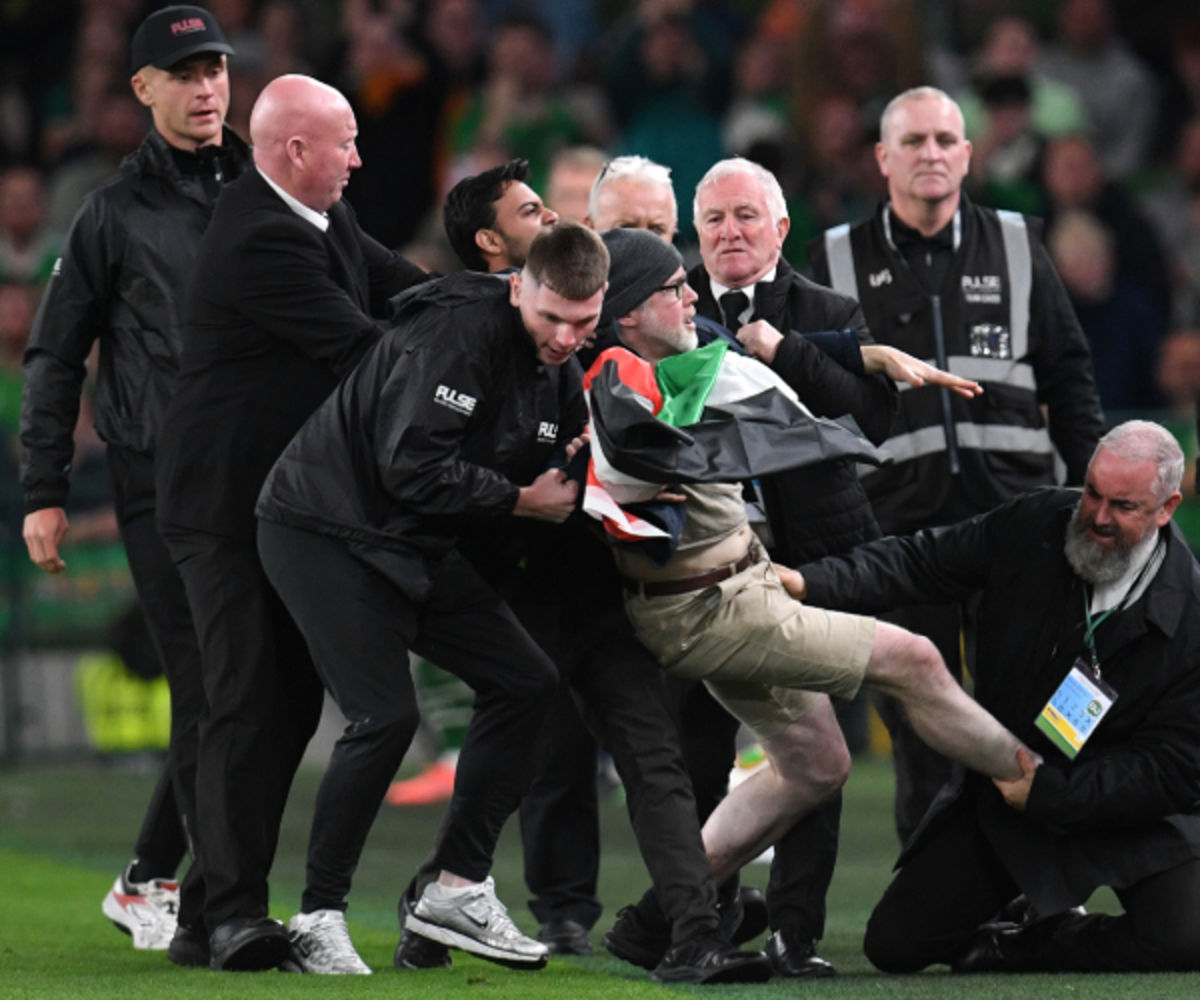
The first disruption came in the 19th minute when spectators hurled roughly 30 tennis balls stamped with Palestinian flags and "#StopTheGame" stickers onto the pitch. Daily Sabah reported the match was halted for four minutes as stewards cleared the field. A second stoppage occurred in the 35th minute when a protester carrying a Palestinian flag ran onto the field and was tackled by security. NDTV noted the disruptions marked an escalation from a May 28 precursor protest during an Ireland friendly, when fans launched tennis balls in the 11th and 20th minutes.
The "Stop the Game" initiative, organized by the Ireland-Palestine Solidarity Campaign and Irish Sport For Palestine, issued a statement at halftime declaring their on-pitch protest complete. Activist Joanne Doyle described the fixtures as "sports-washing a genocide," while protester Mark Coomey said Ireland had "crossed the Palestinian picket line" by playing the first match against Israel.
Bazunu's Withdrawal Sparked Squad Debate
Goalkeeper Gavin Bazunu withdrew from the national squad on September 26, citing atrocities in Gaza. The remaining players spent hours deliberating before voting to proceed with both Israel fixtures. Hot Press reported that Bazunu's decision forced the squad to confront whether playing would compromise their principles, but ultimately the team chose to compete rather than face UEFA sanctions and financial forfeits.
The first match in Debrecen, Hungary saw Ireland win 3-0 with players wearing black armbands and declining to exchange handshakes or pennants with Israeli counterparts. The Football Association of Ireland relocated the scheduled October home fixture to Bačka Topola, Serbia and ordered it played behind closed doors, citing "operational reasons" for the sudden neutral-venue move.
Government and FAI Defend Playing the Fixtures
Irish Taoiseach Micheál Martin argued against a boycott, stating that Ireland should not be "self-defeating" or "damage ourselves unnecessarily" by incurring UEFA penalties. The FAI passed an internal motion in November 2025 calling on UEFA to ban Israel from competitions due to the Gaza war, but UEFA refused to sanction the Israeli Football Association, forcing the FAI's hand.
Despite the FAI's principled stance against Israeli participation, officials concluded that forfeiting matches would yield neither practical gain nor alter geopolitical outcomes. The decision to play reflected competing pressures: international sporting governance rules versus domestic civil society demands for a human rights stance. UEFA is expected to fine the FAI for the pitch disruptions and invasion.
What Happens Sunday in an Empty Stadium
Ireland's return fixture against Israel is scheduled for Sunday, October 4 at an empty stadium in Serbia. The move to a neutral, closed venue was designed to minimize protests and security risks after mounting pressure from activist groups. NDTV noted that the fixture remains part of Nations League B3, where both teams are still competing for group position despite the charged political backdrop.
The empty-stadium protocol reflects how the FAI and UEFA are attempting to ringfence football from broader geopolitical conflict. However, the Thursday protests made clear that for many Irish citizens, sport cannot be decoupled from human rights concerns. The return fixture will be watched closely for any signs of further disruption or symbolic gestures by the Irish squad.
Sentiment
Mostly NegativeNEGATIVENEUTRALPOSITIVE
Publishers
26
Articles
84
Reach
110
A
AnonymousAuthor


