US Tariffs Test India
India balances US tariff pressures and strategic ties amid Russian energy purchases.
Anonymous
Key Points
1
Russia supplied around 30% of India’s crude imports in fiscal year 2025–26, making a rapid replacement of Russian volumes difficult even as New Delhi diversifies suppliers.
2
A sharp reduction in purchases by major Russian-oil buyers such as India and China could tighten global supply and push up prices, creating a contradiction in Washington’s effort to remove Russian crude from international markets.
3
India’s Act East Policy, introduced in November 2014 as an expansion of the earlier Look East Policy, places ASEAN at its core and extends beyond trade to strategic, cultural and people-to-people ties.
4
The 2026 Modi–Xi meeting followed the 2020 Galwan Valley clash, in which at least 20 Indian soldiers and four Chinese soldiers were killed; since then, both countries have maintained large military deployments along the disputed frontier.
5
The India–US Defence Framework was signed on 31 October 2025 by Defence Minister Rajnath Singh and the US secretary of war in Kuala Lumpur, while a separate maritime information-sharing arrangement between the Indian Navy and U.S. Indo-Pacific Command was renewed for five years from 26 October 2025.
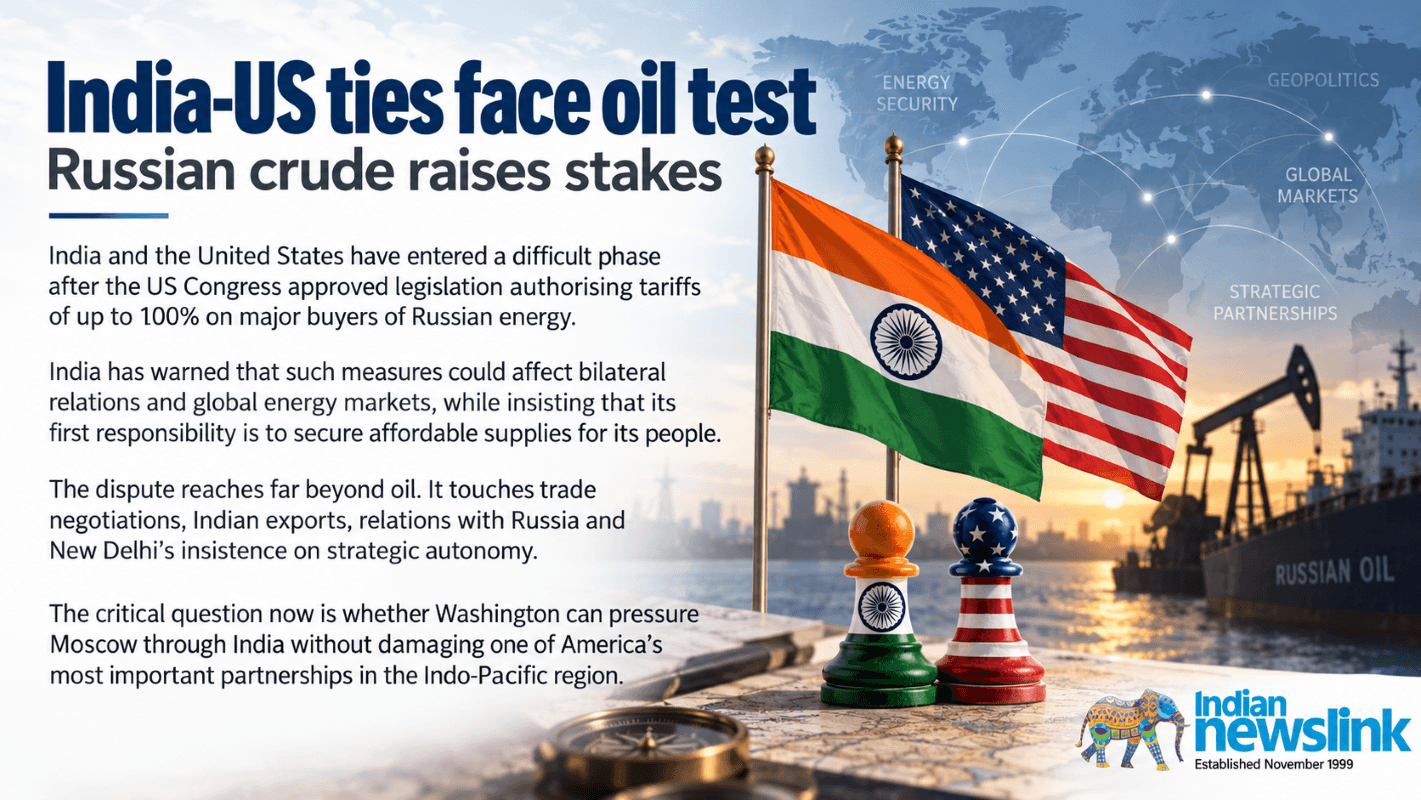
India faces a growing test of its strategic independence as US President Donald Trump gains power to impose tariffs up to 100 percent on countries buying Russian energy. New Delhi must balance cheap Russian crude—which supplied around 30% of India's oil imports in fiscal 2025–26—against losing access to American markets. Economic Times reports that former US National Security Advisor John Bolton has called for the US to abandon tariffs and instead strengthen partnership with India through the Quad alliance.
India's choice reveals a larger challenge: maintaining independence while deepening ties with both the United States and regional partners. The US-India defense relationship has grown stronger through a 10-year framework signed in October 2025, covering maritime security, cyber, space, and logistics. At the same time, India is cautiously improving relations with China, with Prime Minister Narendra Modi and President Xi Jinping meeting in September 2026—their first summit in India in seven years.
Why Russia's Oil is Hard to Replace Overnight
Russia supplies roughly one-third of India's crude oil, a relationship built on discounted prices that benefit India's economy. Suddenly cutting these purchases would force India to find alternative suppliers quickly, raising costs and straining public finances. Economic Times notes that a sharp reduction by major buyers like India and China could actually tighten global supply and push prices higher—contradicting Washington's goal of removing Russian crude from world markets.
The Tariff Threat Splits US Policy on Russia
The newly enacted Lindsey O'Graham Sanctioning Russia and Iran Act of 2026 gives the Trump administration sweeping power to punish countries buying Russian energy. Former National Security Advisor John Bolton warns that this approach backfires. Economic Times reports Bolton argues the US should instead pivot to strengthening the Quad—the alliance of the United States, India, Japan, and Australia—which would tie India closer to Washington without forcing painful economic choices.
India's Deepening Defense Ties With Washington
The US-India defense relationship has become more institutionalized and harder to unwind. In October 2025, India's Defence Minister Rajnath Singh and the US Secretary of War signed a 10-year framework covering joint operations in maritime security, cyber warfare, space, and logistics. Days earlier, the Indian Navy renewed an information-sharing arrangement with the US Indo-Pacific Command for another five years, cementing military cooperation across the region.
Balancing China, Russia, and America in Asia
India's Indo-Pacific strategy relies on staying flexible while building regional partnerships. The Act East Policy, adopted in 2014, places ASEAN nations at the core of India's vision for trade and security. Meanwhile, India is cautiously improving ties with China despite the 2020 Galwan Valley clash, which killed at least 20 Indian soldiers and four Chinese soldiers. Modi and Xi's September 2026 meeting signals both countries want to manage tensions amid their competition for influence in the Global South.
Sentiment
Mostly NegativeNEGATIVENEUTRALPOSITIVE
Publishers
15
Articles
29
Reach
44
A
AnonymousAuthor


