Border Lake Breach Risk
Overflowing Barrier Lake at Nepal-Tibet Border Raises Immediate Breach Risk
Anonymous
Trending on XNepal-Tibet Border Flash Floods
Key Points
1
Breach risk window and inflow specifics: the barrier lake at the confluence of the Chhochen Khola and Purepu Tsangpo is about 2 million cubic metres in volume and is already overflowing, with a further up to 3 million cubic metres expected to enter over the next three days, raising the potential for a breach within roughly 72 hours.
2
Missing and casualty counts vary widely between agencies but are extremely high, with Tibetan-side missing tallies reported around 558 people (including roughly 260 foreign nationals) and Nepal reporting hundreds dead and missing, including hundreds of foreigners (e.g., Nepal’s dead count around 270 with 826 missing and the Nepal Tourism Board later citing about 517 foreigners among the missing).
3
Broad international and cross-border rescue deployment: Chinese authorities have mobilized a wide-scale response, including emergency responders, People’s Liberation Army personnel, engineering teams, telecom operators, and relief organizations, with rescue teams dispatched from Beijing and Chengdu and aircraft/assets mobilized to aid operations.
4
Geographic scope and impact on rescue operations along the Nepal-Tibet border: the barrier lake is located near Gyirong Port (with Nepal’s Gyirong border region affected), and rescue access has been hampered by terrain and damage to border crossings, forcing some operations to rely on air transport or long overland routes.
A dangerous barrier lake formed near the Nepal-Tibet border is already overflowing and could breach within 72 hours, threatening a second catastrophic flood across the Himalayan region. NY Post reports the lake at the confluence of the Chhochen Khola and Purepu Tsangpo rivers holds about 2 million cubic metres of water, with up to 3 million more expected to flow in over the next three days. The Epoch Times confirms that China's Ministry of Water Resources is running flood simulations and risk assessments to prepare for potential disaster.
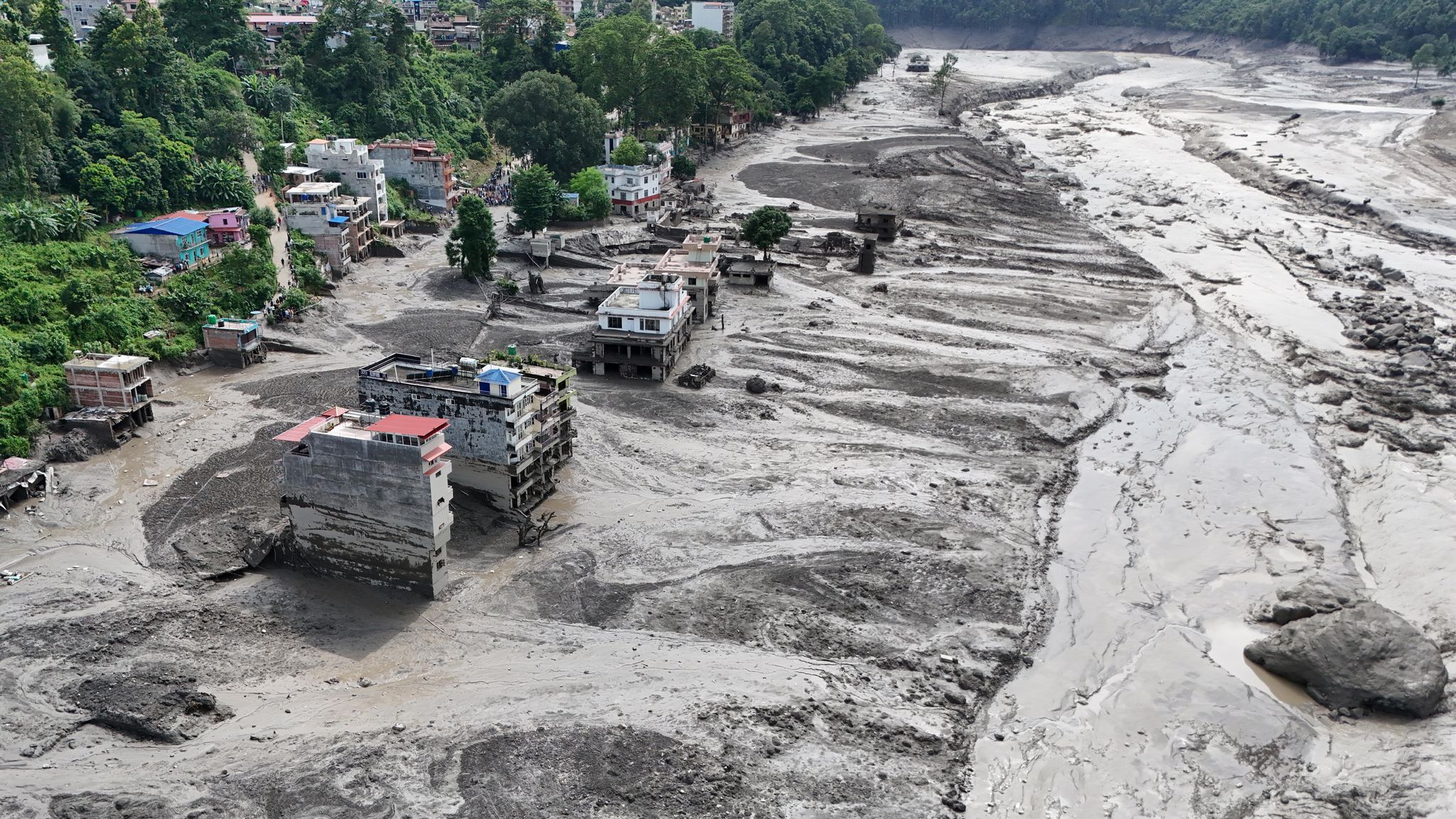
The barrier lake formed after a catastrophic glacier collapse on August 26 triggered massive flash floods and mudslides that have killed over 360 people and left more than 1,400 missing across both borders, including hundreds of foreign nationals. Tri-City Herald reports that Nepal and China are warning of fresh flooding risks as search and rescue efforts continue in difficult terrain, with entire villages buried under mud and key border access routes destroyed.
Glacier Collapse Triggers Catastrophic Floods and Missing Hundreds
A high-altitude glacier on the north face of Langtang Lirung collapsed on August 26 at roughly 5,200 meters elevation, releasing ice that blocked the Lhende River tributary and unleashed catastrophic flash floods and mudslides across the border region. The ice collapse released energy equivalent to nearly a kiloton of TNT, creating an avalanche-like wave that instantly dammed narrow river channels and buried entire communities in mud up to five feet deep.
Nepal reports approximately 270 to 360 confirmed dead with 826 to 910 missing, including 517 foreign nationals. Bellingham Herald notes that missing persons include 288 Indians traveling toward Mount Kailash, 65 Americans, 53 Ukrainians, 51 Malaysians, 35 Australians, and 33 Britons. On the Tibet side, officials confirm 3 dead and 558 missing, including 260 foreign nationals.
2 Million Cubic Metres Already Overflowing, More Coming Fast
The barrier lake at the river confluence currently holds approximately 2 million cubic metres and is already overflowing, according to China's Ministry of Water Resources. The ministry projects an additional 3 million cubic metres of water will accumulate over the next 72 hours as heavy rainfall continues and debris washes downstream, dramatically increasing the risk of a sudden breach.
A breach within three days would unleash a massive surge downstream, inundating populated districts across Nepal including Rasuwa, Nuwakot, Dhading, and Chitwan. Heavy rainfall expected through the weekend will accelerate secondary mudslides and destabilize the natural dam faster than relief teams can clear debris from the affected areas.
Massive Rescue Operation Hampered by Destroyed Roads and Terrain
The glacier collapse and mudslides destroyed key overland routes, including the critical Gyirong Port that serves as a commercial corridor between China and Nepal. Rescue teams from Beijing and Chengdu, along with People's Liberation Army personnel, engineering teams, and telecom operators, have been mobilized to aid operations across the border region.
Terrain damage has forced rescuers to rely heavily on helicopter airlifts instead of ground transport. Access routes are blocked by deep mud and debris, making overland rescue operations extremely difficult. Nepal's Department of Hydrology and Meteorology and the National Disaster Risk Reduction and Management Authority have urged residents along the Bhotekoski and Trishuli rivers to evacuate immediately.
Sentiment
Mostly NegativeNEGATIVENEUTRALPOSITIVE
Publishers
35
Articles
86
Reach
121
Topics
A
AnonymousAuthor


