AI Solves Math Prize
Justin Sun Establishes $1 Million Blockchain Math Prize Featuring AI
Anonymous
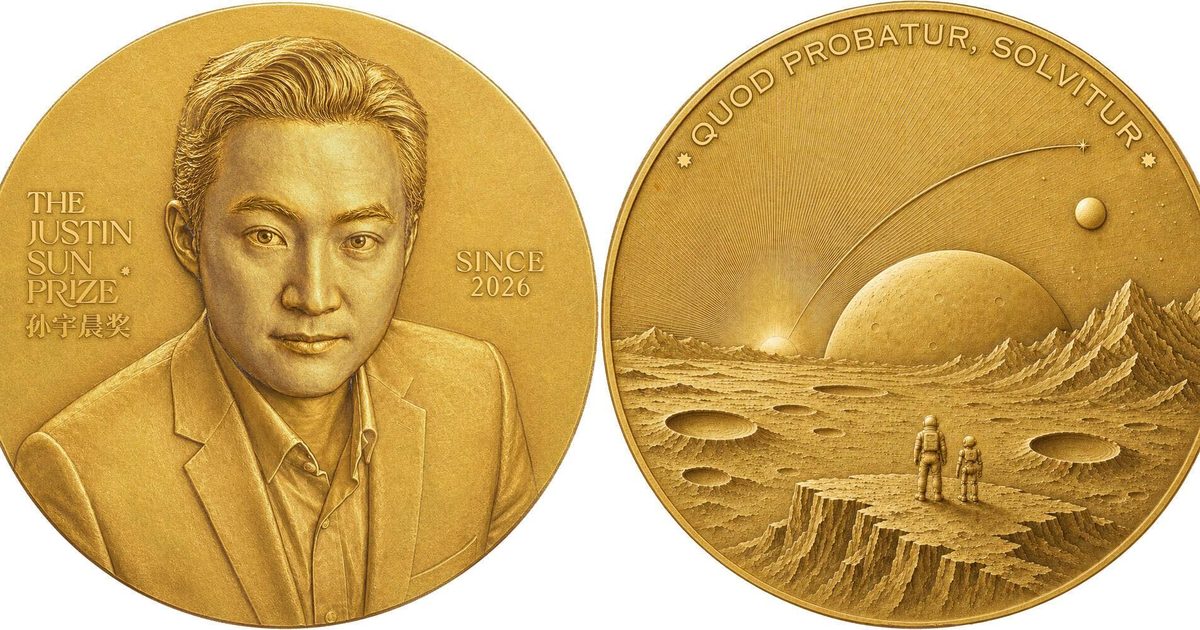
TRON founder Justin Sun announced the Justin Sun Prize, a blockchain-funded mathematics award offering up to $1 million for difficult problems and rewarding both the person who develops a proof and the person who converts it into machine-verifiable code. The system has no age, credential or ceremony requirements, accepts work by humans, artificial intelligence or collaborations, and releases payment only after a proof is verified line by line. Sun says the prize list and funds will be public and immutable, with payouts made automatically through blockchain networks. According to the announcement, 66 problems were recognized initially and the top award went to an OpenAI research team for a claimed proof of the three-dimensional Navier–Stokes existence and smoothness problem, with formalization and verification attributed to an OpenAI model. The initiative has been presented as a new model for scientific rewards in the AI era, though critics argue its structure also promotes Sun’s blockchain ecosystem because the awards are paid through networks associated with his business interests.
Key Points
1
Prize payments will be made in stablecoins: winners can choose USDT on the TRON network or USDC on Ethereum, linking the award’s payout system directly to blockchain networks associated with Sun’s business interests.
2
The prize’s initial problem list includes major unsolved questions such as the Riemann Hypothesis and Goldbach’s Conjecture, as well as the Poincaré Conjecture and problems proposed by mathematician Paul Erdős. The list is designed to be expanded but not reduced.
3
The Navier–Stokes problem is one of the seven Millennium Prize Problems identified by the Clay Mathematics Institute in 2000, which also offered a $1 million reward for its solution. The equations describe fluid motion and date back roughly two centuries to work by Claude-Louis Navier, George Gabriel Stokes and others.
4
Sun said his role would be limited to determining which problems enter the registry and how much each carries; he would not participate in proof verification, winner selection or payment processing.
5
Sun described the initiative as a way of returning wealth generated from mathematics to the field, saying, “My wealth is rooted in mathematics. It came from mathematics, and it will return to mathematics.”
Sentiment
Mostly PositiveNEGATIVENEUTRALPOSITIVE
Publishers
5
Articles
8
Reach
13
Topics
A
AnonymousAuthor


