OpenAI Copyright Appeal
Delhi High Court Seeks OpenAI Response in ANI Copyright Appeal Over AI Training
Anonymous
Key Points
1
ANI’s counsel told the appellate court that OpenAI had voluntarily agreed not to scrape or download content from ANI’s website from September 11, 2024, until the single judge issued the challenged order.
2
Because Indian courts had little or no precedent on copyright and AI training, the single judge appointed IP lawyer Adarsh Ramanujan and NLSIU law professor Dr Arul George Scaria as amici curiae to assist with the case.
3
OpenAI has challenged the suit’s maintainability in India, arguing that its models are not trained in the country and that its servers are located in the United States. It has also argued that its machine-learning process is transformative, that news facts themselves are not copyrightable, and that publishers can request placement on a blocklist.
4
Before filing suit, ANI reportedly offered OpenAI a licence covering its digital-media video, imagery, photographic and news content for $7.5 million.
5
An intervenor’s counsel, senior advocate Kapil Sibal, asked to be heard in the appeal, saying the dispute has “global implications”; the division bench accepted that the intervenor should have an opportunity to participate.
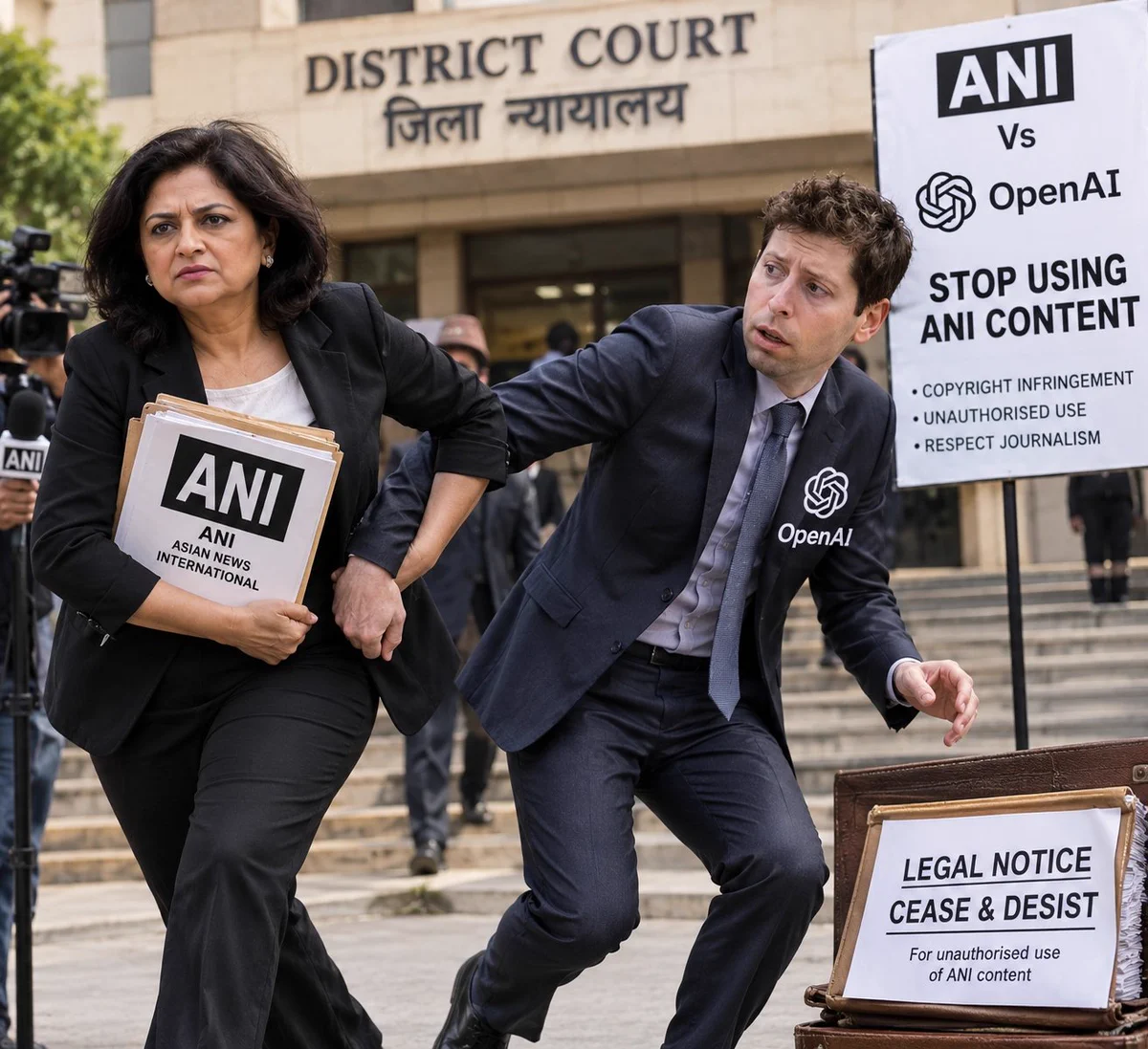
India's Delhi High Court is pressing OpenAI to explain itself in a landmark copyright lawsuit filed by Asian News International (ANI), a major Indian news agency. Delhi High Court notified the ChatGPT maker on September 15, 2026, after a lower court rejected ANI's bid to halt OpenAI's operations. ANI alleges OpenAI trained its AI models on ANI's news articles without permission and sometimes generates fake stories falsely attributed to the agency.
The case marks the first major AI copyright battle in India and could reshape how tech companies handle news content globally. A single judge ruled in July that AI training qualifies as fair research under Indian law. But ANI's legal team argues that public access to news does not mean companies can copy it for profit. The appellate court will hear both sides again in December 2026.
How OpenAI Allegedly Misused ANI's News
ANI says OpenAI scraped and used its copyrighted articles to build ChatGPT without permission or payment. The news agency claims OpenAI reproduced ANI stories in ChatGPT responses and sometimes generated made-up content falsely attributed to ANI—a practice called hallucination. Before the lawsuit, ANI offered OpenAI a licensing deal for $7.5 million covering news articles, photos, and videos. OpenAI rejected the offer.
ANI's counsel revealed that OpenAI voluntarily stopped scraping ANI's website on September 11, 2024—before the court case started. This suggests OpenAI knew the practice was problematic. By October 2024, OpenAI blocklisted ANI's domain from its training datasets. Yet ANI still filed suit, claiming the damage was already done.
The Lower Court's Controversial Fair Use Ruling
In July 2026, Justice Amit Bansal ruled that using news articles to train AI counts as fair research under Indian copyright law. Fair dealing is India's version of fair use—it permits limited copying for research without payment. The judge reasoned that AI training is transformative and does not directly compete with news articles. He also worried that blocking AI training would harm innovation and public interest.
Bansal noted that ChatGPT's outputs were not shown to substantially copy ANI's exact articles. He appointed two legal experts—IP lawyer Adarsh Ramanujan and law professor Dr. Arul George Scaria—to advise the court, since India had almost no precedent on AI and copyright. Ramanujan argued copying without consent is infringement unless justified. Scaria countered that storing data for AI is essential and non-infringing.
OpenAI's Defense: Transformative Technology and Jurisdiction Gaps
OpenAI contests the lawsuit on multiple fronts. First, it argues Indian courts lack jurisdiction because OpenAI's servers are in the United States and no model training occurs in India. Second, it contends that AI training is transformative—it converts raw text into mathematical patterns, not republished articles. Third, OpenAI claims news facts themselves are not copyrightable under law.
OpenAI also notes that publishers can request blocklisting to prevent their content from being used in future training. ANI eventually got this treatment, but the company argues the lawsuit came too late. The appellate judges must weigh whether stopping AI training imposes an unfair burden on technology companies or whether news creators deserve payment for their work.
Why This Case Has Global Implications
Senior advocate Kapil Sibal, representing an intervenor in the case, told the court this dispute carries "global implications." The Delhi High Court agreed and let him participate in the appeal. Similar lawsuits are underway in the United States—The New York Times and other publishers are suing OpenAI and Microsoft for alleged copyright infringement. India's ruling could set a blueprint for other countries.
A win for ANI could force AI companies to negotiate pay-per-content deals with publishers. A win for OpenAI could cement the right to train on public web content for free. The next hearing is scheduled for December 8, 2026. ANI is seeking ₹2 crore (about $240,000 USD) in damages if it prevails.
Sentiment
Mostly NegativeNEGATIVENEUTRALPOSITIVE
Publishers
27
Articles
21
Reach
48
A
AnonymousAuthor


