Zoox Charges Robotaxi Fares
NHTSA Grants Zoox Federal OK to Charge Robotaxi Fares for First Autonomous Fleet
Anonymous
Key Points
1
The NHTSA exemption for Zoox is issued under the Part 555 pathway, marking the first time a robotaxi service has been greenlit under this specific regulatory route.
2
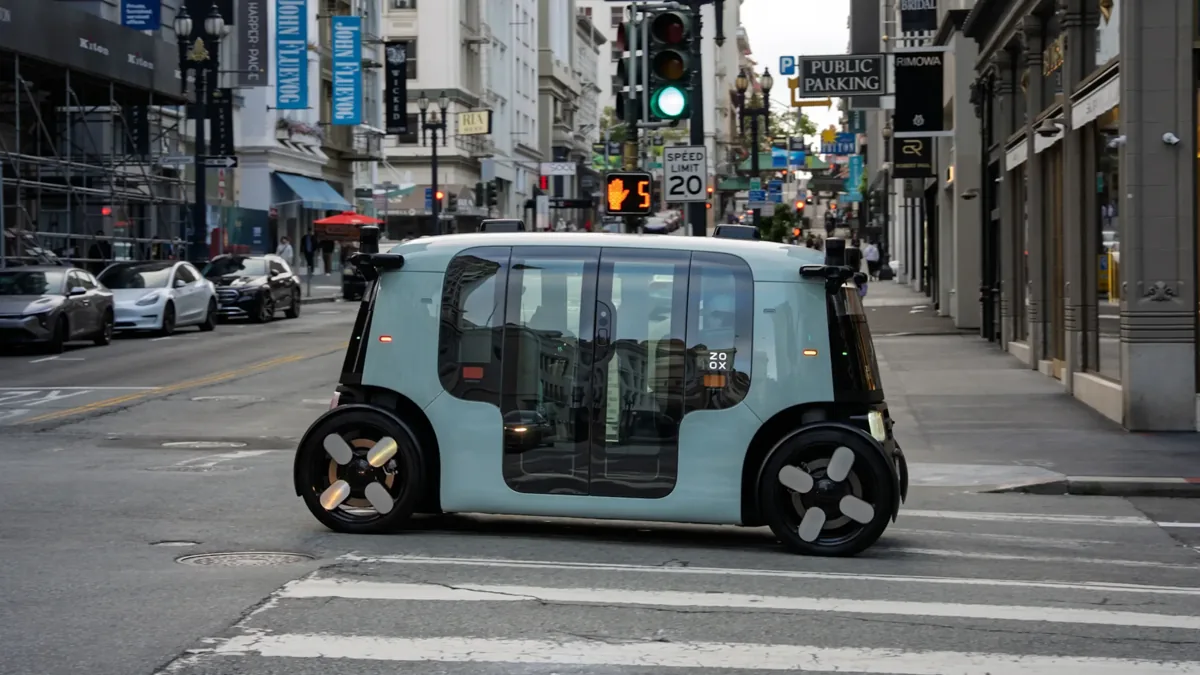
Zoox’s vehicles are designed as bidirectional, steering-wheel‑ and pedal‑free, four-passenger shuttles with inward-facing benches and floor-to-ceiling sliding doors.
3
Rides are bookable through both Uber and the Zoox app, highlighting the planned integration with existing ride-hailing platforms.
4
Zoox notes that it has already transported more than half a million passengers for free during testing and that around half a million people are on its digital waiting list.
5
Regulators announced a broader package to accelerate national autonomous-vehicle standards, including a three-year SAE partnership to develop performance standards for AVs.
Amazon-owned Zoox has won the first-ever federal approval to charge riders for trips in a robotaxi with no steering wheel and no pedals. The National Highway Traffic Safety Administration granted the exemption under the Part 555 regulatory pathway — the first time that route has been used for a paid robotaxi service, according to Smart Cities Dive.
The approval covers up to 2,500 vehicles per year for two years, with a cap of 5,000 total. Las Vegas is expected to be the first city where Zoox charges fares, with a launch planned for next month, PCMag reported.
A Shuttle Built From Scratch, No Driver Needed
Zoox's vehicle looks nothing like a retrofitted car. It is a bidirectional, four-passenger shuttle with inward-facing bench seats and floor-to-ceiling sliding doors. There is no steering wheel. There are no pedals. It was designed from the ground up to operate without a human driver, according to ZAG Daily.
The vehicle is also smaller than a typical sedan, making it easier to navigate tight city streets. Riders can book trips through the Zoox app or through Uber, giving it a direct link to one of the world's largest ride-hailing platforms, PCMag noted.
Half a Million Free Rides Led to This Moment
Zoox did not arrive at paid service overnight. The company has been testing its vehicles in Las Vegas and San Francisco for years. It has already carried more than 500,000 passengers for free during that testing phase, according to Smart Cities Dive.
Demand appears strong. Around 500,000 people are on Zoox's digital waiting list. The company has also run demonstrations in other cities beyond its two main test markets. Pricing for paid rides has not yet been announced.
NHTSA Frames Approval as Part of Broader AV Push
Regulators described the Zoox exemption as part of a wider effort to modernize how the US oversees self-driving technology. NHTSA announced a three-year partnership with SAE International to develop new performance standards for autonomous vehicles, according to Smart Cities Dive.
Officials said the oversight framework is designed to adapt as the technology evolves. The agency also signaled plans to update Federal Motor Vehicle Safety Standards, which currently assume a human driver is always present. The Zoox approval tests what a new standard could look like in practice.
Zoox Pulls Ahead in the Driverless Race
The approval puts Zoox in rare company. Most competitors — including Waymo, which operates paid robotaxis in Phoenix and San Francisco — use modified versions of existing vehicles. Zoox is now the first US operator to run a paid service in a vehicle built with no manual controls at all, according to Simply Wall St.
For Amazon, which acquired Zoox in 2020 for around $1.2 billion, the approval is a major step toward turning the investment into a real business. The robotaxi sector is growing fast, with multiple companies racing to scale up. Zoox now has a regulatory head start that rivals will need to match.
Sentiment
Mostly NegativeNEGATIVENEUTRALPOSITIVE
Publishers
19
Articles
56
Reach
75
Topics
A
AnonymousAuthor


