Rising Yields And Inflation
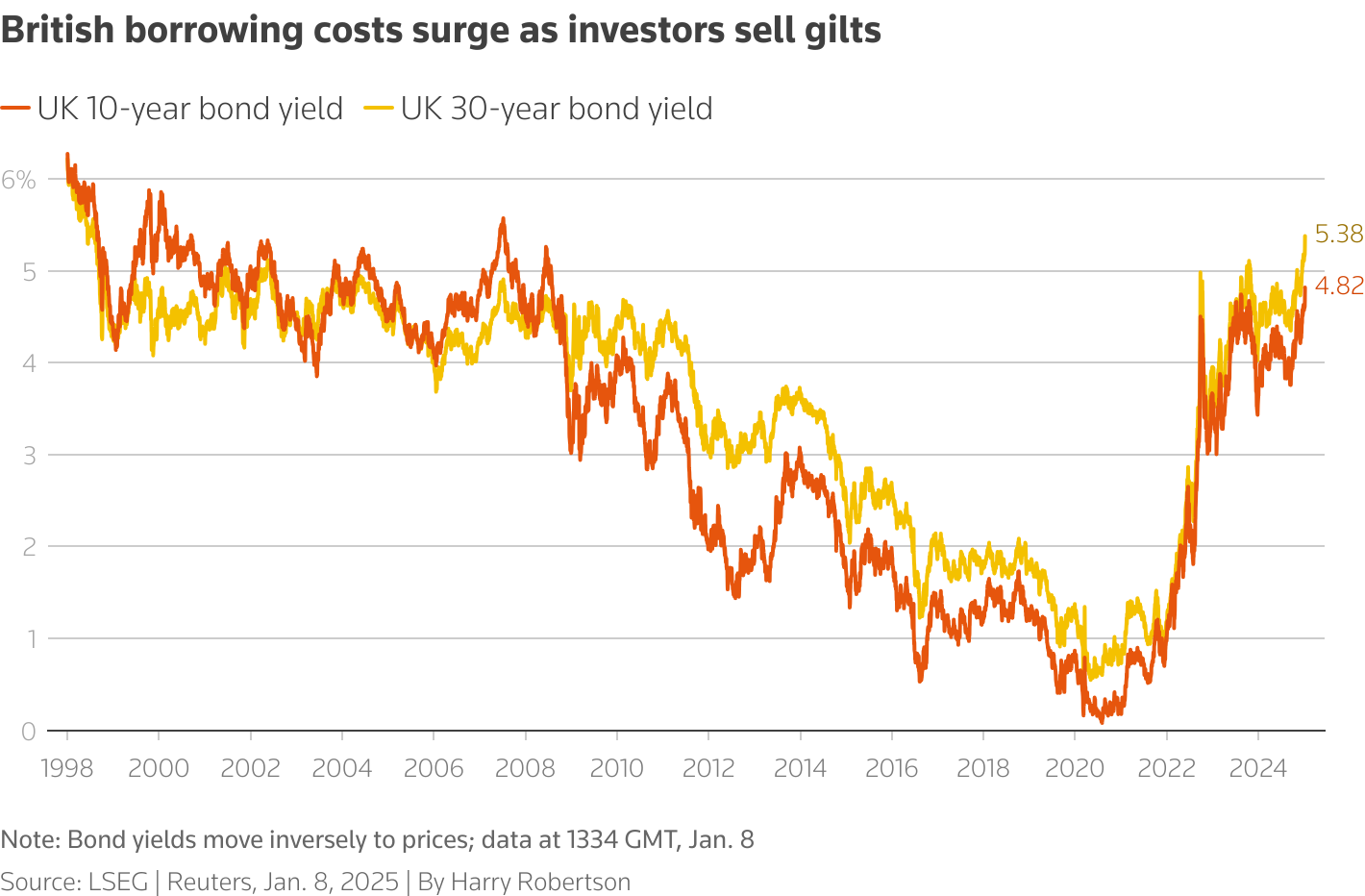
UK Gilt Yields Rise Toward 2008 Highs Amid Inflation and Budget Pressures
Anonymous
Key Points
1
The UK’s August budget deficit reached £18.3 billion, exceeding economists’ £15.5 billion forecast; inflation-related increases in state pensions and social-benefit spending contributed to the larger shortfall.
2
Preliminary September data showed a divergence across UK sectors: services companies cited weak domestic demand and geopolitical uncertainty, while manufacturing activity benefited from increased AI investment and higher defence spending.
3
Brent crude remained below $100 a barrel in one market session amid reports that Saudi Arabia was preparing to restart a key pipeline and that the United States had made progress in talks with Iran.
4
US preliminary PMI data indicated the steepest expansion in American business activity in more than five years, while the Federal Reserve’s latest rate increase was its first since 2023.
5
Ten-year gilt yields reached above 5.3% before easing to around 5.23%, which was described as close to the lowest level since September 8 after a recent decline in oil prices.
UK 10-year gilt yields are climbing toward 2008 highs as oil prices surge, inflation pressures mount, and the government's budget deficit swells beyond expectations. The August deficit hit £18.3 billion, ABP Live reported, exceeding forecasts of £15.5 billion and reflecting higher state pension and social-benefit costs. Meanwhile, rising US bond yields and hawkish central-bank signals are adding pressure on UK government debt.
Ten-year gilt yields briefly topped 5.3% before settling around 5.23%, a level last seen in early September Trading Economics noted. The pressure stems from a perfect storm: stronger-than-expected business activity, geopolitical uncertainty over Middle East oil supplies, and renewed expectations that the Bank of England could hike rates by 25 basis points in November.
Why August's Budget Deficit Blew Past Forecasts
The UK's August budget shortfall of £18.3 billion far exceeded the £15.5 billion economists had predicted. Inflation-driven increases in state pensions and social-benefit payments pushed spending higher than expected. This widening gap signals fiscal pressure ahead and may force the government to reconsider its fiscal rules before the Autumn Budget, raising questions about future borrowing costs.
Oil Prices Fuel Rate-Hike Expectations
Brent crude prices remain volatile amid Middle East tensions and US-Iran diplomacy. Kalinga TV reported that oil surges have pushed US Treasury yields to multi-year highs, mirroring pressure on UK gilts. Although Brent briefly dipped below $100 a barrel after reports of Saudi pipeline restarts and US progress in Iran talks, the overall upward trend in energy costs is fueling inflation concerns and strengthening the case for tighter monetary policy.
Preliminary September data showed mixed UK sector performance: services firms cited weak domestic demand and geopolitical uncertainty, while manufacturing benefited from AI investment and higher defence spending. This divergence underscores how external shocks ripple unevenly through the economy, adding complexity to the Bank of England's rate-setting decision.
US Economic Strength Spills Into Global Bond Markets
America's preliminary September PMI data revealed the strongest business expansion in more than five years, KuCoin reported, with the composite index reaching its highest level since July 2021. This robust activity has sent US 10-year Treasury yields surging to 19-year highs near 5.13%, ABP Live noted. The Federal Reserve's recent rate hike—its first since 2023—signals more tightening ahead, and these hawkish signals are rippling across Atlantic, pushing UK gilt yields higher.
Australia's 10-year yield has climbed to 5.4%, near 15-year highs, Trading Economics reported, proving that higher borrowing costs are a global phenomenon. Analysts warn that elevated bond yields and increased government debt issuance pose a greater near-term threat to equity markets than lingering concerns over an AI-sector bubble.
What Higher Borrowing Costs Mean for Markets and Policy
Surging gilt yields make it more expensive for the UK government to borrow, forcing tougher choices on spending and potentially limiting fiscal flexibility. At the same time, higher borrowing costs crimp corporate investment and consumer spending, weighing on equity valuations. The government faces pressure to modify its fiscal rules before the Autumn Budget—a move that could signal either flexibility or concern about the deficit trajectory ahead.
Sentiment
Mostly PositiveNEGATIVENEUTRALPOSITIVE
Publishers
22
Articles
112
Reach
134
A
AnonymousAuthor


