Zenith Chronomaster Solo Sport
Zenith Removes Chronograph Function To Introduce New Chronomaster Solo Sport Watch
Anonymous
Key Points
1
Pricing details reveal a notable gap: Chronomaster Sport (with chronograph) starts at $12,300, while Solo Sport date versions are $10,900 and the no-date variant is about $8,400, illustrating Zenith's push toward value within the El Primero lineage.
2
The Solo Sport keeps a high-frequency heart with the El Primero 3620, a three-hand movement derived from the 3600 that runs at 5 Hz (36,000 vph) and features a silicon escapement, a star-shaped rotor, and a 60-hour power reserve.
3
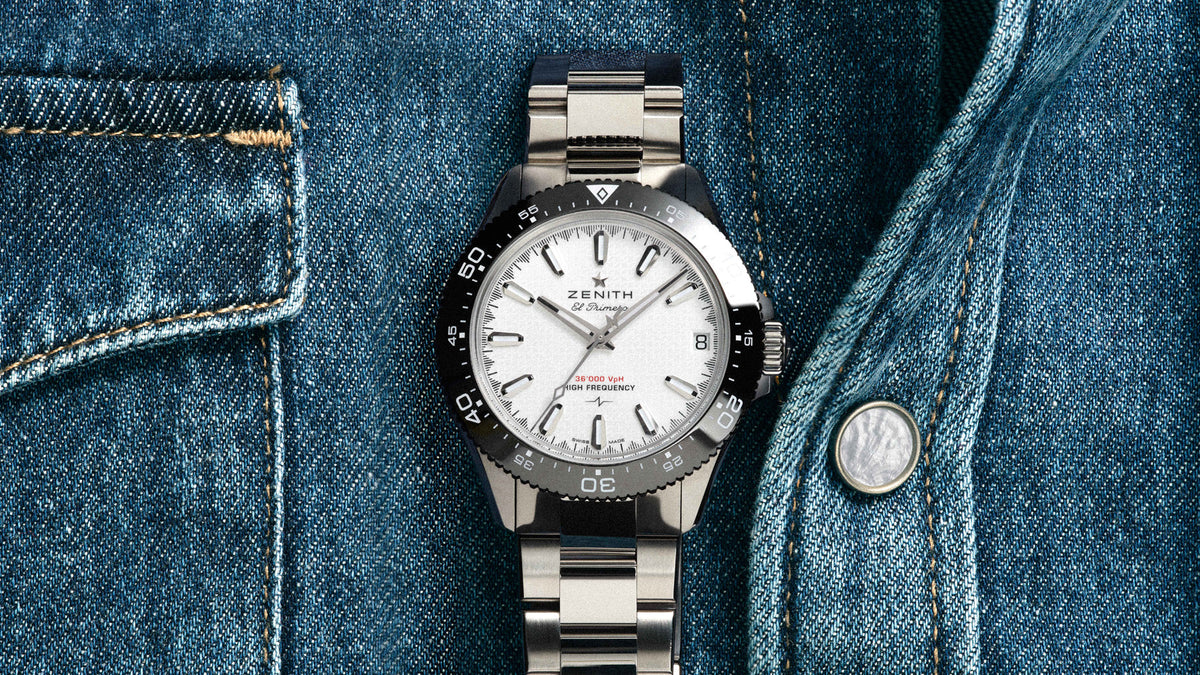
Dial and color options are expanded to solid ceramic surfaces with a new 45-degree Z motif; palettes include sunray-finished white, polished black, and polished brown ceramic dials, with a no-date version available as well.
4
Zenith introduces the ZENCLASP: a 41-component folding clasp that enables tool-free on-the-fly micro-adjustments in 2.5 mm increments, a feature highlighted in the Solo Sport's bracelet.
5
In addition to the three-hand silhouette, the Solo Sport retains robustness features: a 40 mm stainless steel case, unidirectional ceramic bezel, and 200 m water resistance, underscoring its everyday sports intent.
Zenith is reimagining its Chronomaster line with the new Solo Sport, a three-hand daily wear watch that strips away the chronograph but keeps the high-frequency El Primero heartbeat. Hodinkee reports the watch uses the El Primero 3620 movement, running at 5 Hz with a 60-hour power reserve, and arrives in a 40mm stainless-steel case with ceramic bezel and dial. Pricing starts at $8,400 for the no-date version and $10,900 for date models — well below the Chronomaster Sport's $12,300 entry point — signaling Zenith's push to attract younger buyers without sacrificing technical credibility.
The Solo Sport features a striking new ceramic dial with a repeating 45-degree Z motif that echoes the movement's rhythm. Stuff TV highlights that this marks the first time the Chronomaster line abandons the chronograph, a radical departure for a collection long defined by it. The watch also introduces the ZENCLASP, a 41-component folding clasp enabling tool-free micro-adjustments in 2.5mm increments, and offers sunray white, polished black, and polished brown dial options.
Preserving El Primero DNA
The Solo Sport retains the technical soul that defines El Primero watches. Hodinkee explains that the El Primero 3620 caliber — derived from the legendary 3600 — maintains the 5 Hz, 36,000 vph frequency that made the original El Primero revolutionary in 1969. The movement features a silicon escapement and star-shaped rotor, delivering the smooth precision that justifies the El Primero name while the 60-hour power reserve handles real-world wear patterns without daily winding.
Cleaner Design for Everyday Wearability
By dropping the chronograph complexity, Zenith achieved a cleaner, more wearable silhouette. Archynetys notes that the three-hand dial now features the new 45-degree Z motif across solid ceramic surfaces, replacing the busy subdials of traditional Chronometers. The 40mm stainless-steel case combines a unidirectional ceramic bezel with 200-meter water resistance, positioning the Solo Sport as a robust everyday sports watch rather than a specialized timing tool.
The ZENCLASP Brings Adjustment Freedom
Zenith engineered a breakthrough clasp to match the refined aesthetic. The ZENCLASP — a 41-component folding clasp — enables on-the-fly micro-adjustments in 2.5mm increments without tools, a feature rarely seen at this price point. Stuff TV emphasizes this practicality makes the Solo Sport more adaptable to bracelet-wearing conditions, from casual to formal dress codes.
Pricing Strategy Opens the El Primero Door
The Solo Sport's pricing undercuts the full Chronomaster Sport to broaden appeal. No-date versions start around $8,400, while date models sit at $10,900 — creating a $3,400 gap below the chronograph-equipped Sport at $12,300. This tiered approach lets Zenith capture buyers seeking El Primero prestige and high-frequency performance without committing to chronograph functionality or premium pricing, directly targeting a younger, value-conscious demographic.
Sentiment
Mostly PositiveNEGATIVENEUTRALPOSITIVE
Publishers
15
Articles
0
Reach
15
A
AnonymousAuthor


