Samsung M16 Display Debut
iQOO 16 Debuts Samsung 2K 165Hz Display With Record 10,000 Nit Peak Brightness
Anonymous
Key Points
1
The iQOO 16 will be the first Android smartphone to use Samsung Display’s M16 panels, while Apple’s upcoming foldable iPhone Duo is also reported to use elements of the technology.
2
The panel’s Q-Flex technology is designed to support up to 500Hz multi-finger touch sampling and a 5,000Hz instantaneous touch-sampling rate, features aimed particularly at mobile gaming.
3
Samsung Display and iQOO jointly defined, engineered and mass-produced the screen, with iQOO involved in developing and calibrating the light-emitting material, panel, display driver IC and manufacturing processes—not merely purchasing a finished panel.
4
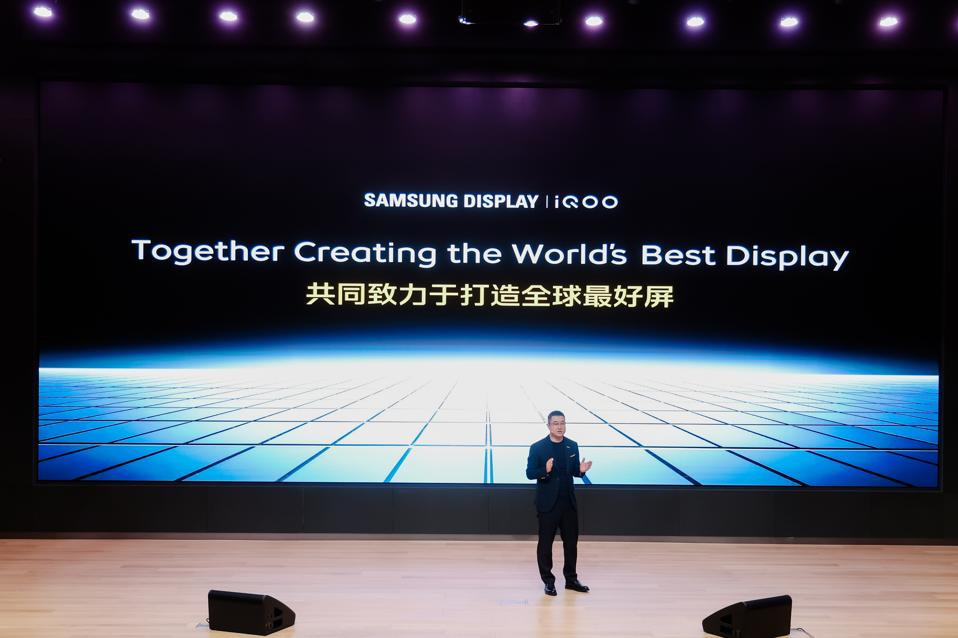
Samsung Display’s event at its Yongin headquarters marked the first time the company had jointly unveiled technology there with a smartphone brand; the company also described iQOO as the third major brand, after Apple and Samsung, to use its flagship light-emitting material.
5
Images of the iQOO 16’s redesigned rear show a raised square camera island with three cameras, an externally positioned LED flash, “100x Tele” branding and a hexagonal-patterned “Light Chaser” finish. The phone is also rumored to start above the iQOO 15’s India launch prices of Rs 72,999 for 12GB/256GB and Rs 79,999 for 16GB/512GB.
The iQOO 16 is the first Android phone to pair Samsung Display's new M16 OLED panel with 2K resolution and a 165Hz refresh rate, according to Forbes. The 6.85-inch screen hits 2,800 nits in standard mode and up to 10,000 nits in limited bright areas. Samsung Display and iQOO jointly engineered the panel—marking the first time Samsung hosted a technical unveiling with a Chinese smartphone brand at its Samsung Display headquarters in Yongin, Korea, according to Android Headlines.
The display cuts power use by up to 30% compared to earlier 1.5K gaming-phone panels, according to GSMArena. The iQOO 16 launches in China on September 29, 2026, with a Snapdragon 8 Elite Gen 6 Pro chip, 8,400mAh battery, and 100x zoom camera, per Gizchina. iQOO's deeper role in designing the panel—not just buying a finished product—signals a shift in how Android brands work with display makers.
How iQOO Co-Engineered Samsung's Latest Display Panel
iQOO didn't simply buy a finished screen. The brand helped develop the M16 panel from the ground up, calibrating light-emitting materials, integrating the driver chip, and tuning production lines, according to Forbes. This partnership marks a structural shift: historically, phone makers purchased off-the-shelf OLED panels. Samsung Display described iQOO as only the third major brand—after Apple and Samsung itself—to use its flagship light-emitting material, per Android Headlines.
The joint effort introduced faster pixel wiring, a 22-nanometer display driver, and polarizer-free OLED technology. These innovations enable 2K resolution at 165Hz without draining the battery as fast as earlier combinations, according to GSMArena. Broader use of M16 panels is expected across premium phones starting in 2027, including Samsung's Galaxy S27 lineup.
A Display Built for Extreme Gaming Performance
The M16 panel's Q-Flex technology supports 500Hz multi-finger touch sampling and a 5,000Hz instantaneous touch-sampling rate—features designed specifically for mobile gaming, according to Forbes. The screen also uses 3,300Hz PWM dimming to reduce flicker and offers 22% better brightness uniformity and 40% better color accuracy than prior panels, per Android Headlines.
Gamers gain console-grade visuals without severe battery drain. The 1,100-nit manual brightness, 2,800-nit peak, and up to 10,000-nit local brightness handle everything from bright sunlight to competitive esports play, according to Gizchina. These specs position the iQOO 16 as a serious gaming phone that doesn't sacrifice visual clarity for high refresh rates.
Price May Rise Above the Previous iQOO Model
The iQOO 15, the previous flagship, launched in India at ₹72,999 (about $875) for 12GB/256GB and ₹79,999 (about $960) for 16GB/512GB, according to Gizchina. The iQOO 16 is rumored to cost more due to the high-end M16 display, custom driver IC, and advanced processor. Final pricing and all specs remain unconfirmed.
The phone's rear shows a redesigned triple-camera module with a raised square island, three cameras, an externally mounted LED flash, "100x Tele" branding, and a hexagonal-patterned "Light Chaser" finish, per TechNetBooks. The device also sports a flat OLED screen and an 8,400mAh battery with 100W wired and 40W wireless charging capability.
Samsung's M16 Technology Beyond iQOO's First Launch
While iQOO claims the "world first" for 2K at 165Hz, Samsung's M16 emitter stack is also used in Apple's iPhone 18 Pro series and iPhone Duo foldable, as well as Google's Pixel 11 line, according to Talk Android. iQOO's distinction is the specific pairing of M16 with both 2K resolution and 165Hz refresh rate—a combo other flagships haven't yet announced publicly.
Tech analysts emphasize that iQOO has leaped from an upper-mid-tier gaming brand to an innovation leader, securing exclusive display hardware milestones ahead of major Android rivals, per Forbes. Independent reviews and real-world battery testing will be crucial for consumers evaluating whether the power-efficiency gains hold up in daily use.
Sentiment
Mostly PositiveNEGATIVENEUTRALPOSITIVE
Publishers
38
Articles
159
Reach
197
A
AnonymousAuthor


