Sulzer's Profitability Amidst Sales Dip
Sulzer H1 2026 Revenue Declines, But Strong Margins and Reaffirmed Guidance Point to Resilience
Anonymous
Key Points
1
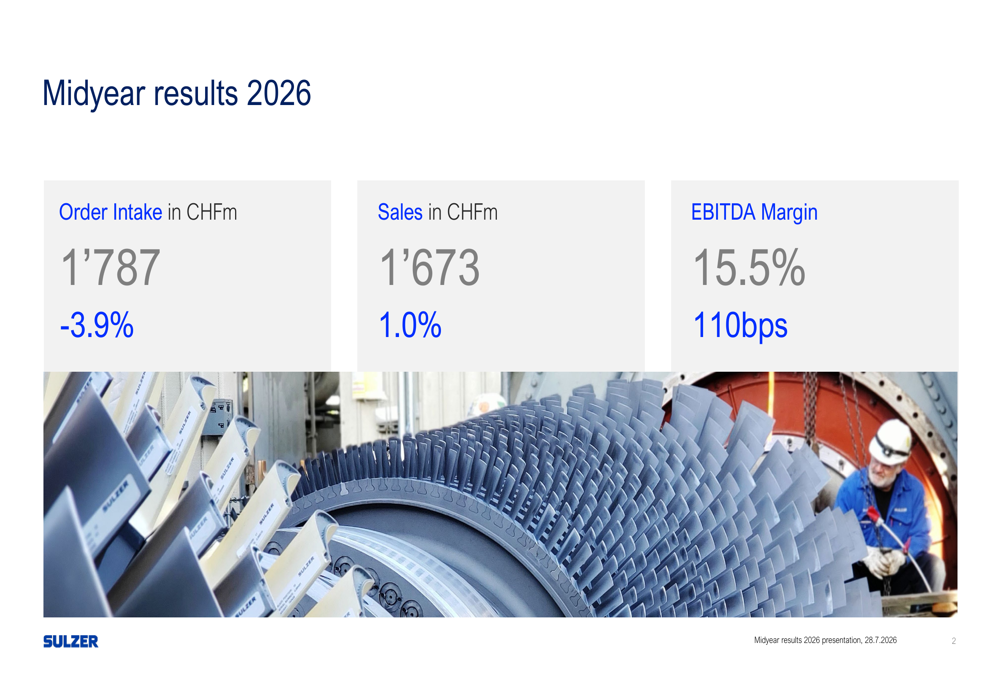
Sulzer attributes the margin uplift in H1 2026 to its 'Sulzer Excellence' program, lifting EBITDA margin to 15.5% (up 110 basis points vs H1 2025) and marking a third consecutive year of profitability improvement.
2
Despite geopolitical fragilities, Sulzer notes that planning activities and project preparation are increasing for large energy and water infrastructure, suggesting a potentially stronger pipeline ahead.
3
Flow division achieved an EBITDA margin of 13.3% with 0.5% sales growth and 1.4% higher order intake, driven by Energy and Infrastructure, while Water and Industry faced delays due to supply-chain disruptions.
4
Services delivered a 17.7% EBITDA margin with 4.4% higher sales and a 0.2% year-on-year increase in order intake, supported by ongoing energy-related demand but tempered by a high prior-base from large orders in H1 2025.
5
Chemtech faced headwinds from delayed final decisions on technologies such as biopolymers, Carbon Capture, and Sustainable Aviation Fuels; order intake fell 22.7% and sales declined 4.9%, yet EBITDA margin remained resilient at 11.7% as cost-reduction measures accelerate to make the division leaner.
Swiss industrial giant Sulzer posted first-half 2026 revenue of CHF 1.673 billion, down 4% from CHF 1.744 billion a year earlier, according to Market Screener. Net income came in at CHF 137.8 million, with basic earnings per share of CHF 4.07.
Despite the sales dip, the company held its ground on profitability. Sulzer's EBITDA margin rose 110 basis points to 15.5%, marking a third straight year of margin improvement. Management reaffirmed full-year guidance, signaling a stronger second half ahead, Investing.com reported.
'Sulzer Excellence' Program Pushes Margins Higher for Third Year
Sulzer credited its internal 'Sulzer Excellence' program for the margin gains. The program focuses on cost discipline and operational efficiency across all divisions. This lifted the overall EBITDA margin to 15.5% in the first half of 2026, up from 14.4% in H1 2025.
The company also flagged that planning and project preparation for large energy and water infrastructure are picking up. Investing.com noted this suggests a potentially stronger order pipeline in the second half, even as geopolitical tensions continue to weigh on final investment decisions.
Flow and Services Divisions Deliver Steady Profit Growth
The Flow division posted modest sales growth of 0.5% and lifted its EBITDA margin to 13.3%. Energy and Infrastructure demand drove that improvement. However, the Water and Industry segments faced delays tied to supply-chain disruptions, which held back fuller growth.
Services was the standout performer. The division grew sales by 4.4% and achieved an EBITDA margin of 17.7%. Ongoing energy-related demand fueled that result. Order intake grew just 0.2% year-on-year, held back by a high comparison base from large one-off orders placed in H1 2025.
Chemtech Stumbles as Green Tech Decisions Stay on Hold
Chemtech was the weakest link in H1 2026. Sales fell 4.9% and order intake dropped sharply by 22.7%. Customers delayed final decisions on projects tied to biopolymers, carbon capture, and sustainable aviation fuels. These are long-cycle technologies where large commitments take time.
Still, Chemtech held its EBITDA margin at 11.7%. Sulzer accelerated cost-reduction measures inside the division to make it leaner while it waits for deal flow to recover. Management said the goal is to keep the division profitable even in a slow order environment.
Guidance Held Firm Despite Geopolitical Headwinds and Trade Disruptions
Sulzer reaffirmed its full-year guidance for 2026, pointing to a back-loaded year. The company flagged ongoing geopolitical fragilities — including Middle East conflict and disrupted trade routes — as factors affecting supply chains and customer confidence, Market Screener reported.
Even so, Sulzer said demand for secure infrastructure — covering energy, water, and chemicals — remains a structural tailwind. The company's diversified global footprint gives it exposure across multiple end markets. That spread is helping it manage through a cautious investment climate without cutting its outlook.
Sentiment
Mostly PositiveNEGATIVENEUTRALPOSITIVE
Publishers
10
Articles
28
Reach
38
A
AnonymousAuthor


