Asian Chip Rout Deepens
Global Chip Selloff Plunges Japan's Nikkei and Korea's KOSPI Amid AI Slowdown
Anonymous
Key Points
1
Japan's Nikkei fell 3.59%, with chip names Advantest down 7.52% and Tokyo Electron down 8.84%, signaling a semiconductor-led rout rather than broad market weakness; the Philadelphia Semiconductor Index was down about 21% from its June 22 high (even as it remains up year-to-date).
2
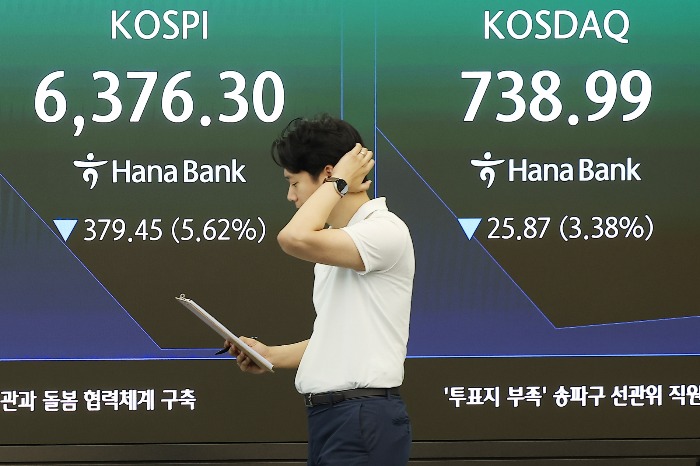
South Korea's KOSPI dropped about 7.2% to 6,266.78 as Samsung Electronics fell around 7% and SK Hynix slipped roughly 9%; Bloomberg later noted the Kospi fell as much as 8.1% intraday, underscoring a memory-led rout in addition to broader semiconductor weakness.
3
Intraday volatility in Korea prompted the KOSDAQ to activate its Sidecar mechanism to curb selling, highlighting the severity of the selloff beyond the main index.
4
Nvidia shares fell around 5% amid a wave of AI-related weakness, with reports that Nvidia offered about $250 billion in financing guarantees for OpenAI data centers fueling questions about the scale of AI infrastructure spending.
5
Investors fretting over AI demand noted China’s progress in domestic DUV lithography tools and the emergence of cheaper open-source AI models (such as Kimi K3), which could dampen demand for high-end memory and logic chips.
A sharp selloff in semiconductor stocks hammered Japan and South Korea on Tuesday, with Tokyo's Nikkei falling 3.59% to 62,599 and Seoul's KOSPI plunging as much as 8.1% intraday, according to BSS News and Bloomberg. Chipmakers led the rout, as fears over AI spending, China's chip advances, and cheaper AI models shook investor confidence worldwide.
The damage was deep and fast. In Japan, Tokyo Electron fell 8.84% and Advantest dropped 7.52%, according to KLSE Screener. In Korea, Samsung Electronics fell around 7% and SK Hynix slid roughly 9%, per KED Global. The Philadelphia Semiconductor Index has now lost about 21% from its June 22 peak.
Korea's KOSPI Hits a Three-Month Low
South Korea bore the brunt of the selloff. The KOSPI dropped about 7.2% to 6,266.78, its lowest level in three months, according to KED Global. The declines were so severe that the KOSDAQ — South Korea's tech-heavy secondary market — triggered its Sidecar mechanism. That is an automatic circuit breaker designed to slow panic selling when futures prices move too fast.
Samsung Electronics and SK Hynix are South Korea's two biggest memory chip makers. Their combined losses dragged the entire index lower. Head Topics reported that investor fears centered on two threats: the risk of overleveraged AI infrastructure spending, and rising competition from Chinese chipmakers undercutting global demand.
China's Chip Breakthrough Spooked Global Markets
A key trigger for the selloff was a report about a breakthrough in China's domestic chip-making tools. BSS News noted that news of advances in China's DUV lithography — the machines used to etch circuits onto chips — sent the Nikkei down as much as 4.1% and the KOSPI down 7.9% in early trade. DUV tools are a step behind the most advanced technology, but China building its own versions threatens to reduce its dependence on Western suppliers.
China's progress matters because it could allow Chinese firms to produce more chips domestically, cutting into demand for memory and logic chips made in Japan and South Korea. Analysts also flagged the rise of cheaper open-source AI models — such as Kimi K3 — as a sign that big AI infrastructure buildouts may slow. Less infrastructure spending means less demand for high-end chips.
Nvidia's $250 Billion Financing Deal Raises Red Flags
Nvidia shares fell around 5% on the day, adding to pressure across the sector. Reports surfaced that Nvidia offered roughly $250 billion in financing guarantees to support OpenAI data center construction. Rather than boosting confidence, the news raised questions. Investors worried it signals that AI companies need enormous financial backing just to keep building — a sign the easy part of the AI boom may be over.
TradingView noted that concerns are mounting over whether massive AI investments can actually deliver returns. The Shanghai Composite also fell 0.6% and the Shenzhen Component dropped 2.2%, reversing earlier gains, as the semiconductor rout spread to Chinese markets too. The selloff is broad: it now touches memory chips, logic chips, chip-making equipment, and the AI companies that buy them all.
Geopolitical Tensions Add to the Risk-Off Mood
Chip stocks were not the only source of anxiety. Comments from the US president about Iran added to a wider risk-off mood, pushing investors away from equities and toward safer assets. Risk-off is a term for when investors sell stocks and buy safer things like government bonds or gold. The combination of tech fears and geopolitical headlines made for a punishing session across Asian markets.
KED Global reported that Korean stocks fell to a three-month low as the China chip push rattled memory shares specifically. The selloff reflects a broader recalibration of how investors value chipmakers in a world where AI demand looks less certain, Chinese competition is growing, and the cost of building AI infrastructure keeps rising.
Sentiment
Mostly NegativeNEGATIVENEUTRALPOSITIVE
Publishers
25
Articles
107
Reach
132
A
AnonymousAuthor


