Missing Sailor Search Concludes
US Navy Suspends Search for Sailor Missing After Arabian Sea Helicopter Crash
Anonymous
Key Points
1
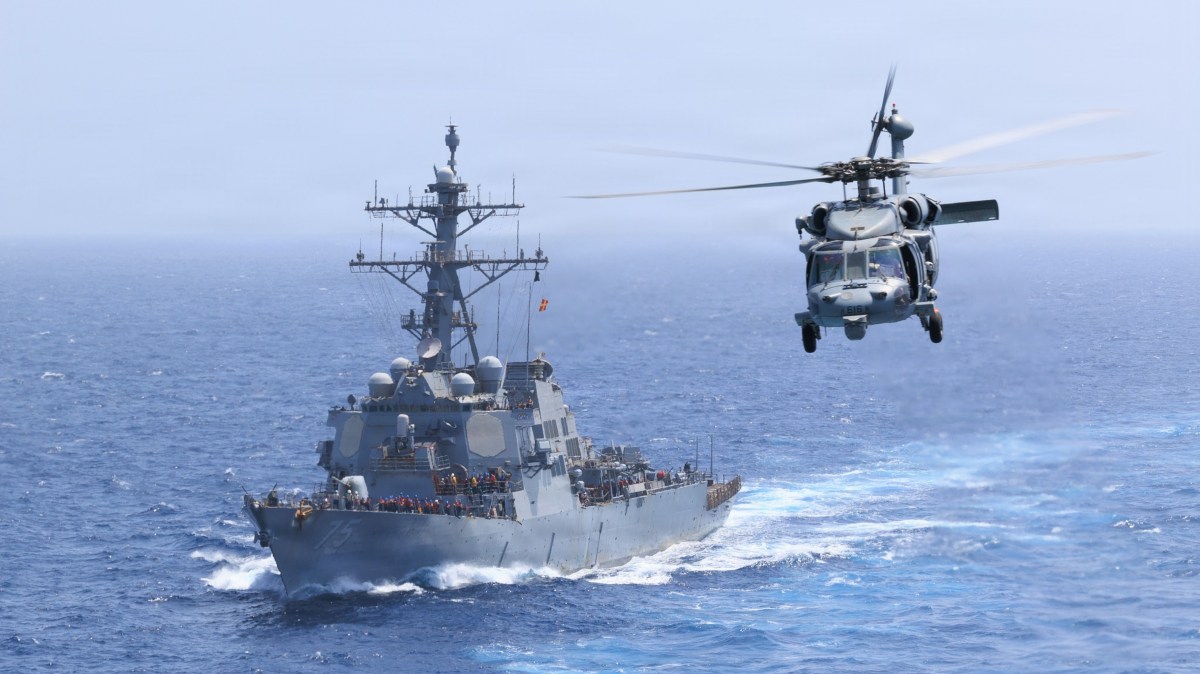
The missing sailor was assigned to Helicopter Sea Combat Squadron 5 (HSC 5) and the MH-60S Seahawk involved in the incident was attached to the USS George H.W. Bush, within Carrier Air Wing 7.
2
The helicopter conducted an emergency water landing around 3:30 a.m. Eastern Time on July 1, before the remaining crew were rescued.
3
The search operation spanned five destroyers and a pair of P-8 Poseidon squadrons, with fixed-wing aircraft and helicopters from both the USS George H.W. Bush and the USS Abraham Lincoln.
4
The USS George H.W. Bush is one of two aircraft carriers in the Middle East from late April, part of broader regional operations; contemporaneously, Operation Epic Fury had seen 42 fixed-wing or rotor aircraft losses as of mid‑May, underscoring ongoing regional activity.
The U.S. Navy has suspended its search for a sailor missing since July 1, after an MH-60S Sea Hawk helicopter made an emergency water landing in the Arabian Sea around 3:30 a.m. Eastern Time. Three of the four crew members were rescued in stable condition, but the fourth was never found, according to Task & Purpose.
The search lasted more than 102 hours and covered roughly 14,000 square miles — an area about the size of Maryland and Delaware combined. San Diego Union-Tribune reported that five destroyers, two P-8 Poseidon patrol squadrons, and aircraft from two carriers all took part before the Navy called off the effort.
Helicopter Crew From USS George H.W. Bush Goes Down
The MH-60S Sea Hawk was assigned to Helicopter Sea Combat Squadron 5, known as HSC 5. The squadron is part of Carrier Air Wing 7, which operates from the USS George H.W. Bush, according to Head Topics. The carrier has been in the Middle East since late April as part of broader U.S. regional operations.
The helicopter went down in the dark, before dawn. All four crew were aboard when it hit the water. The three survivors were quickly pulled to safety. The fourth sailor was not located despite days of intensive searching across a massive stretch of open ocean.
Two Carriers and Air Force Jets Join the Hunt
The search drew assets from across the region. Fixed-wing aircraft and helicopters flew from both the USS George H.W. Bush and the USS Abraham Lincoln. U.S. Air Force planes also joined the effort, according to SSB Crack. The operation stretched across the U.S. Central Command area of responsibility.
Five destroyers swept the sea surface while P-8 Poseidon aircraft — long-range patrol jets used to scan vast ocean areas — flew overhead. Despite all of that, the sailor was not found. Officials evaluated the search thoroughly before making the call to suspend it, Voice of Emirates reported.
No Sign of Hostile Fire Behind the Crash
Military officials said there is no indication that hostile action caused the helicopter to go down. The Navy classified the incident as an emergency water landing, not an attack. U.S. forces have been active across the Middle East in recent months, including during Operation Epic Fury, which saw 42 aircraft lost as of mid-May.
The crash is under review, but investigators have not pointed to enemy fire. The focus remains on understanding what went wrong mechanically or operationally during the overnight flight, according to Task & Purpose.
Missing Sailor's Name Withheld Pending Family Notice
The Navy has not released the missing sailor's name. Policy requires officials to wait at least 24 hours and to notify next of kin first. San Diego Union-Tribune noted the name will remain withheld until that process is complete.
The sailor's unit, HSC 5, is based out of Naval Station Norfolk in Virginia. The squadron flies the MH-60S, a helicopter used for search and rescue, cargo delivery, and combat support. The loss marks a painful moment for the crew of the George H.W. Bush and for the broader carrier strike group.
Sentiment
Mostly NegativeNEGATIVENEUTRALPOSITIVE
Publishers
16
Articles
35
Reach
51
Topics
A
AnonymousAuthor


