Gwangju Uprising Apologies
Korean High School Baseball Teams Apologize for Mocking May 18 Gwangju Uprising
Anonymous
Key Points
1
An official, multi-party delegation accompanied Paichai High School's 36 players to Gwangju, bringing the total visit group to 86 and including the headmaster, coaches, teachers, parents, and the superintendents of both the Seoul and Gwangju education offices, signaling high-level institutional involvement in the apology.
2
The six-month ban on Paichai High School from national tournaments was imposed by the Korea Baseball Softball Association in response to the taunting chants, illustrating formal disciplinary action beyond the apology itself.
3
Baejae High School’s faculty described the incident as stemming from a total collapse of ethical consciousness and historical awareness, indicating a systemic view of the problem within the school community.
4
The Baejae High School coach acknowledged personal responsibility, stating that focusing on winning prevented timely intervention and committing to leadership accountability to ensure such incidents do not recur.
5
The chants were tied to broader controversy surrounding a Starbucks Korea 'Tank Day' promotion, highlighting how a marketing controversy connected to the May 18 Gwangju Uprising amplified scrutiny of the players' remarks.
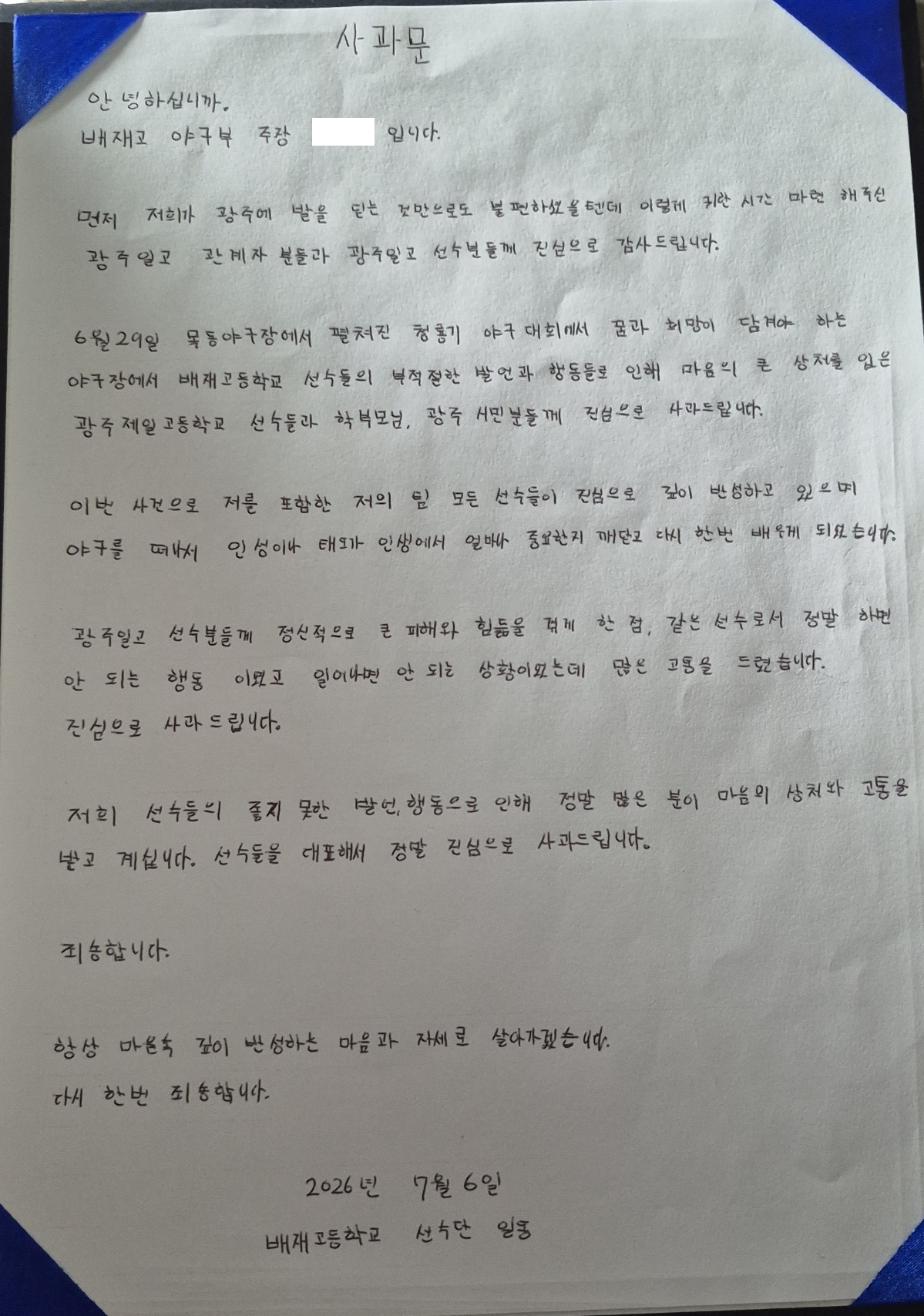
Two South Korean high school baseball teams have traveled to Gwangju to personally apologize for chants that mocked the May 18 Gwangju Democratization Movement — the 1980 pro-democracy uprising in which hundreds were killed. The apologies follow growing public outrage over remarks made during games, prompting formal bans, school investigations, and high-level institutional responses.
The incident gained wider attention partly because of its link to a Starbucks Korea 'Tank Day' promotion, which itself stirred controversy over its connection to May 18 imagery. That backdrop made the players' chants — "Let's go to Starbucks" — feel deeply offensive to many in Gwangju and beyond.
Paichai Sends 86 People to Gwangju to Apologize
Paichai High School's response was sweeping. All 36 players on the baseball team traveled to Gwangju, joined by the school headmaster, coaches, teachers, and parents. The superintendents of both the Seoul and Gwangju education offices also made the trip, according to Korea JoongAng Daily. The total delegation numbered 86 people — a sign of just how seriously school and government officials took the incident.
The team captain and coach both spoke during the apology. They stressed that character and respect matter more than winning. The visit was meant to show remorse directly to Gwangju Jeil High School and to the broader Gwangju community, which has long held May 18 as a sacred part of its identity.
Baseball Association Hits Paichai With Six-Month Ban
The apology was not the only consequence. The Korea Baseball Softball Association imposed a six-month ban on Paichai High School from national tournaments, according to Korea JoongAng Daily. The ban shows that punishment went beyond words. Formal disciplinary action was taken to hold the team accountable in a concrete way.
The ban came after a separate Paichai-related incident, adding pressure on the school. Multiple controversies in a short span fueled the public conversation about whether Korean high school sports culture has a deeper problem with historical awareness and ethical conduct.
Baejae High School Calls It a Total Ethical Collapse
Baejae High School also sent its baseball team, faculty, and parents to Gwangju to apologize to Gwangju Jeil High School. School leaders did not soften their words. Seoul Economic Daily reported that faculty described the incident as the result of "a total collapse of ethical consciousness and historical awareness" within the school community.
The Baejae coach took personal responsibility. He admitted that focusing on winning had prevented him from stepping in sooner. He pledged to lead differently going forward. The school also committed to investigations and reforms to make sure similar incidents do not happen again.
May 18 Remains a Deeply Sensitive Symbol in South Korea
The May 18 Gwangju Democratization Movement is one of the most painful events in modern South Korean history. In 1980, pro-democracy protesters in Gwangju were violently suppressed by military forces. Hundreds died. The city has since become a symbol of resistance and democratic values. Mockery tied to that history carries serious weight.
Across both cases, school officials described a failure to teach students about that history. The apologies signal a broader effort to rebuild trust — not just with Gwangju Jeil High School, but with the entire city. Leaders from multiple institutions pledged to make ethical education and historical respect a core part of their athletic programs going forward.
Sentiment
Mostly NegativeNEGATIVENEUTRALPOSITIVE
Publishers
11
Articles
2
Reach
13
Topics
A
AnonymousAuthor


