Ancient Marine Oasis
New Study Confirms Blood Falls Origin as Ancient Seawater, Reveals Trapped Marine Ecosystem
Anonymous
Key Points
1
Blood Falls sits more than 20 miles from the ocean, effectively creating a marine oasis in a polar desert, a characterization described as extraordinary by researcher Andrew Allen.
2
Genetic analysis shows a stronger marine signal in eukaryotes than in prokaryotes at Blood Falls, with about 9% of Blood Falls’ eukaryotes sharing similarity with ocean samples (prokaryotic marine signal is weaker, around 1%).
3
Researchers used DNA sequencing to identify thousands of microorganisms living in and around Blood Falls, providing molecular evidence of a relic marine ecosystem trapped under the glacier.
4
The study describes Blood Falls as a 'rare marine refuge in the polar desert' and notes that the subglacial brine–fed system retains marine-derived biosignatures long after separation from the ocean.
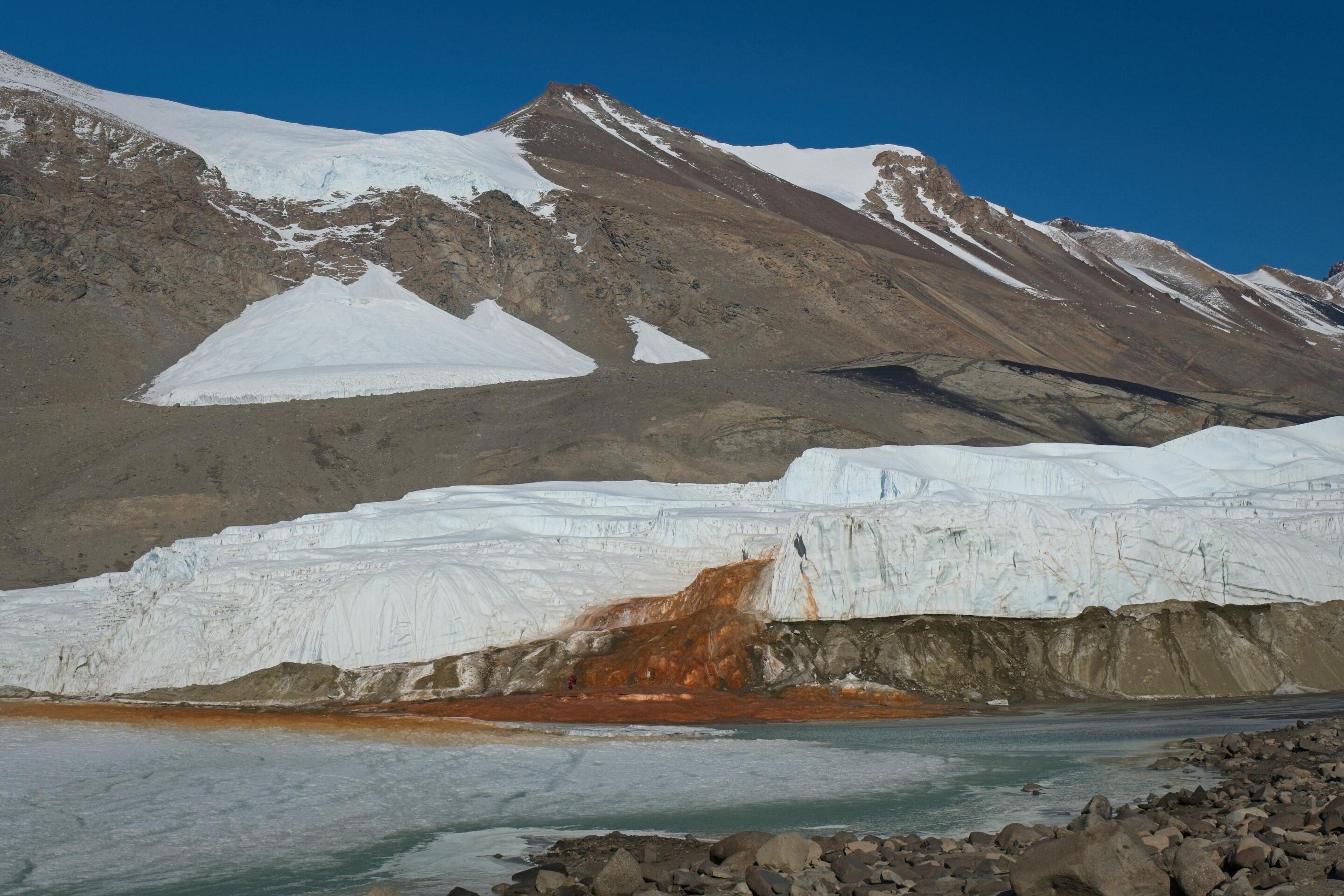
Antarctica's Blood Falls has long puzzled scientists with its eerie crimson color. Now, a study published in Nature Geoscience confirms the red brine pouring from Taylor Glacier into Lake Bonney originated as ancient seawater trapped beneath the ice — not local freshwater as some once thought. Phys.org reports the water hosts a distinct community of marine microorganisms, offering the strongest biological proof yet of the falls' oceanic origins.
Researchers analyzed 167 samples from Blood Falls and found marine life forms including diatoms, haptophytes, dinoflagellates, and ciliates — organisms that belong in the ocean, not a polar desert. The site sits more than 20 miles from the nearest coastline, making it, in the words of researcher Andrew Allen, an "extraordinary" marine oasis locked inside one of Earth's harshest environments, according to Newsy Today.
Ancient Seawater Trapped Under the Glacier for Millions of Years
The brine beneath Taylor Glacier is believed to be a relic of an ancient sea that once covered the region. Over millions of years, advancing ice sealed it off from the ocean. Daily Mail reports that iron-rich water slowly seeped through cracks in the glacier, oxidizing when it hit the air and turning the telltale red color that gives Blood Falls its name.
The new study reinforces what many researchers long suspected but could not fully prove. By doing DNA sequencing on thousands of microorganisms, scientists at the Scripps Institution of Oceanography built a molecular case. The genetic signatures found in the brine match ocean ecosystems — not the freshwater or terrestrial environments surrounding the glacier, according to Newsy Today.
Marine DNA Signal Points Strongly to an Ocean Past
The genetic data tells a clear story. About 9% of the eukaryotes — complex, celled organisms — at Blood Falls share close similarity with open-ocean samples. The prokaryotic signal, covering simpler single-celled life, is weaker at roughly 1%, but still present. Phys.org notes that eukaryotes tend to retain their marine identity longer, making them a reliable marker of ancient ocean origin.
Scientists describe Blood Falls as a "rare marine refuge in the polar desert." The subglacial brine system has held onto its marine-derived biosignatures even after being cut off from the ocean for an enormous stretch of time. That kind of long-term biological preservation in an extreme environment is what makes the site so scientifically valuable, according to Geo.tv.
What Blood Falls Tells Us About Life on Icy Moons
The findings go beyond Antarctica. Scientists say Blood Falls is a model for how life might survive under the icy shells of moons like Europa and Enceladus. Both moons are thought to have liquid water oceans buried beneath thick ice — conditions that mirror what exists beneath Taylor Glacier, according to Archynetys.
If microbial life can persist for millions of years in cold, dark, iron-rich brine cut off from sunlight and the open ocean, the odds of similar survival elsewhere in the solar system improve. Blood Falls offers a rare real-world test case. Researchers say studying it helps sharpen the tools scientists would need to detect life on other worlds.
Sentiment
Mostly NegativeNEGATIVENEUTRALPOSITIVE
Publishers
13
Articles
11
Reach
24
Topics
A
AnonymousAuthor


