Morocco's Green Energy Leap
AfDB Approves €100M Loan for Morocco's First Integrated LFP Battery Gigafactory
Anonymous
Key Points
1
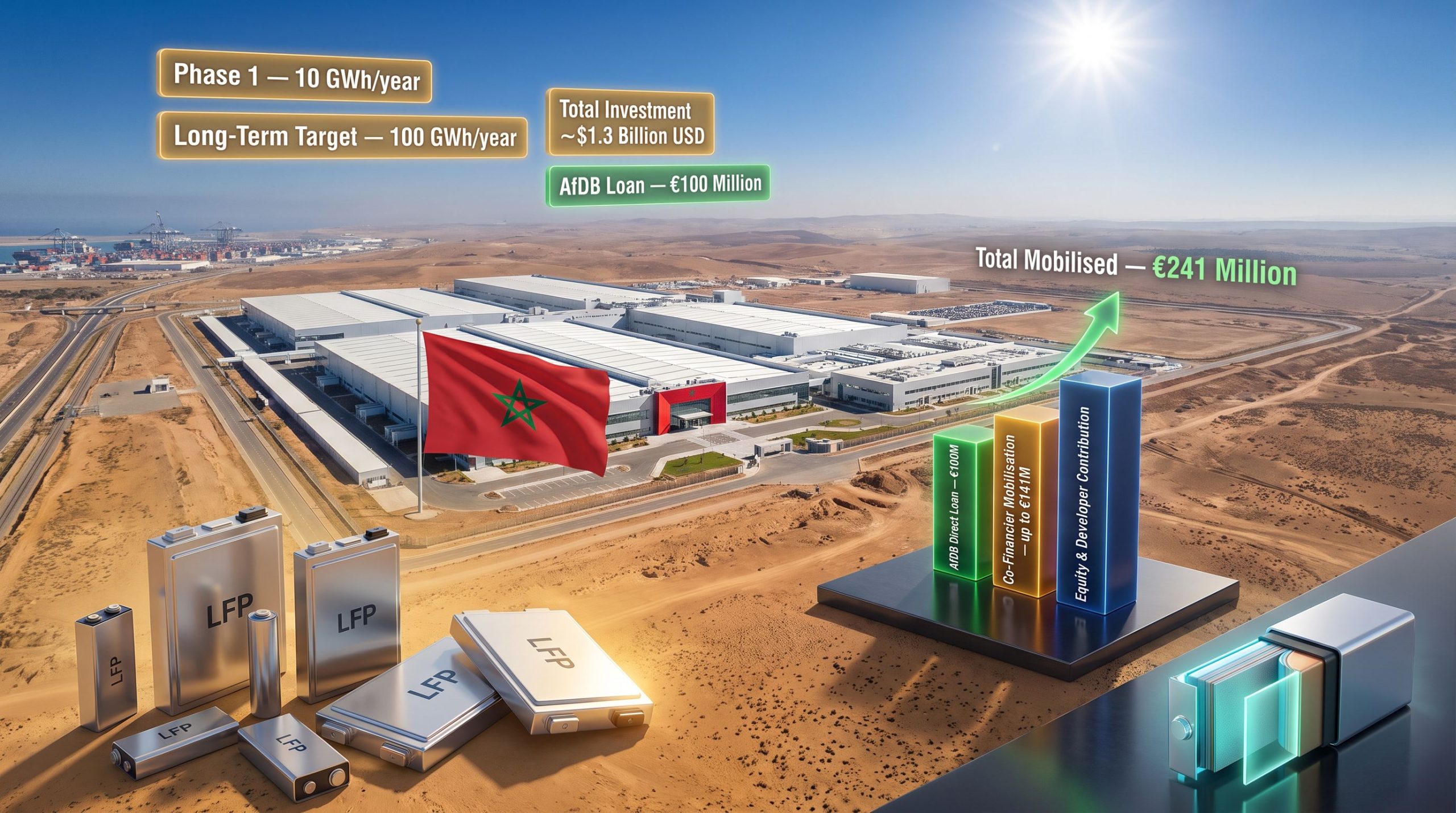
Financing backing figures differ across reports: up to €141 million from financial partners as the mandated lead arranger under NAFAD, while another source cites mobilization of up to $166 million from partners.
2
The project is expected to create more than 600 direct jobs in its first phase, with an estimated local integration rate of about 70 percent for the Moroccan component of the value chain.
3
The plant will also include production of cathode materials as part of its full cathode-to-cell battery value chain.
4
Location and scope details place the gigafactory in the Rabat-Salé-Kénitra Free Trade Zone, aligning with the Atlantic Free Zone Phase III in Kenitra, and it is touted as Africa’s and the MENA region’s first integrated battery plant covering from cathode materials to cells.
The African Development Bank has approved a €100 million loan — roughly $114 million — to build Africa's first integrated electric vehicle battery gigafactory in Morocco, according to Washington Post. The plant, led by Chinese firm Gotion High-Tech, will sit in the Rabat-Salé-Kénitra Free Trade Zone and start with 10 gigawatt-hours of annual production capacity, with plans to scale up to 100 GWh.
The AfDB also plans to pull in up to €141 million more from financial partners, acting as the mandated lead arranger under its New African Financial Architecture for Development framework, Discovery Alert reported. Officials called battery storage "the missing link" in Africa's clean energy transition.
Africa's First Cathode-to-Cell Battery Plant Explained
Most battery factories only handle one step of production. This plant will cover the full chain — from making cathode materials all the way to finished battery cells and packs. That makes it unique across Africa and the broader Middle East and North Africa region, according to WTOP News.
Gotion High-Tech, headquartered in Hefei, China, will lead the project. The company specializes in lithium iron phosphate, or LFP, batteries. LFP cells are known for being safer and cheaper than other battery types. They are widely used in electric vehicles and energy storage systems.
600 Jobs and a 70% Local Content Rate Targeted
The factory is expected to create more than 600 direct jobs in its first phase, Winnipeg Free Press reported. The project also targets a local integration rate of about 70 percent, meaning most of the Moroccan-made components will be sourced from within the country.
AfDB officials say the plant will help Morocco build out its green industrial base. The bank wants the project to anchor a regional hub for electric mobility. It could also help Africa process its own critical minerals locally, rather than exporting raw materials abroad at lower value.
Morocco's Kenitra Zone Becomes a Green Energy Bet
The gigafactory will be located inside the Atlantic Free Zone Phase III in Kenitra, part of the wider Rabat-Salé-Kénitra economic corridor. Morocco has spent years building this zone into an auto and aerospace manufacturing hub. Adding battery production deepens that industrial base significantly.
The plant will run on renewable energy, which AfDB says will help solar and wind power integrate more smoothly into Africa's grids. Bank officials argue that large-scale battery storage is essential for the continent to move away from fossil fuels and meet its clean energy targets.
AfDB Bets Big on Morocco as a Continental Industrial Anchor
The AfDB loan is not a one-off. It is part of a broader push by the bank to fund Africa's energy transition and industrial growth. The bank's role as mandated lead arranger means it is actively recruiting other lenders to co-finance the deal, Discovery Alert noted. One source cited a total partner mobilization target of up to $166 million.
If Morocco pulls this off at scale, it could shift how the continent approaches battery supply chains. Africa holds large reserves of the minerals needed for batteries — cobalt, lithium, manganese. Processing them at home, rather than shipping them raw, could capture far more economic value for African nations.
Sentiment
Mostly PositiveNEGATIVENEUTRALPOSITIVE
Publishers
10
Articles
42
Reach
52
A
AnonymousAuthor


