New AI Maps Moon
NASA and IBM Release Open-Source AI Model to Enhance Lunar Mapping and Exploration
Anonymous
Key Points
1
In benchmarking focused on possible ice deposits, the NASA-IBM model reduced errors by 23% compared with SwinV2-B, a Microsoft-trained vision system commonly used as a baseline for high-resolution image analysis.
2
For crater identification and classification, the model outperformed SwinV2-B by 19% while requiring only half as much training data, suggesting it may be more efficient for specialized lunar-mapping tasks.
3
The model was tested against a real lunar-impact case: after a SpaceX Falcon 9 rocket struck the Moon on Aug. 5, IBM’s system correctly identified the impact site as a new crater even though it overlapped an existing crater. IBM Research Europe director Juan Bernabé-Moreno said, “It worked fantastically,” describing the first-attempt result.
4
NASA’s Lunar Reconnaissance Orbiter supplied 17 years of observations that were particularly suitable for training the model, while the foundation-model approach allows researchers to fine-tune a broadly pretrained system for new scientific tasks rather than build a separate algorithm from scratch each time.
5
Potential ice deposits are important not only as geological targets but also because lunar ice could provide water and oxygen—resources that may support a sustained human presence on the Moon.
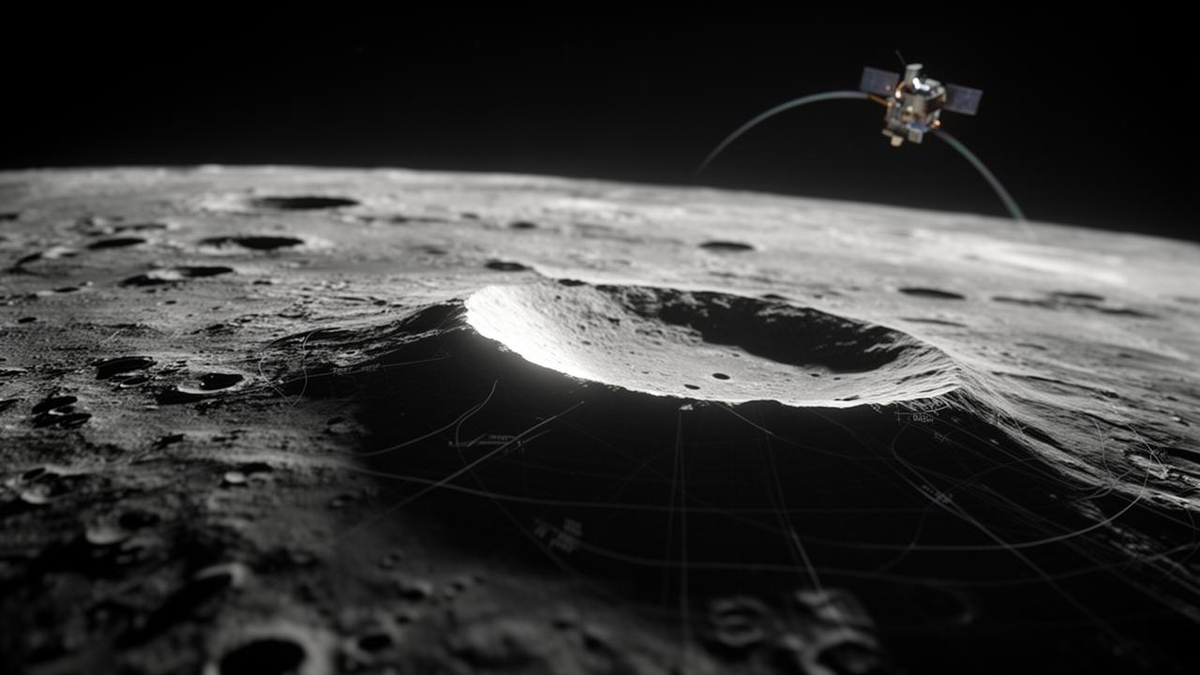
NASA and IBM have released an open-source AI model that analyzes lunar data with striking accuracy, reducing errors by up to 23% when hunting for ice deposits on the Moon. The Lunar Foundation Model, trained on 17 years of observations from NASA's Lunar Reconnaissance Orbiter, can spot craters, volcanic formations and potential water ice across massive datasets — giving scientists a powerful tool to prepare for the Artemis lunar missions NASA.
The two organizations also published tens of thousands of lunar maps and images on Hugging Face and GitHub, letting researchers worldwide build custom tools without starting from scratch. IBM Research Europe director Juan Bernabé-Moreno said the system performed "fantastically" when it correctly identified a new crater created by a SpaceX rocket impact in August, even though the crater overlapped an existing one.
AI Beats Standard Methods at Crater and Ice Detection
The NASA-IBM model outperforms Microsoft's widely used SwinV2-B image-analysis system by 19% on crater identification and needs only half the training data. For ice-deposit detection, the model cut errors by 23% compared to the baseline method Yahoo Tech. This efficiency matters because lunar ice could supply water and oxygen for sustained human missions on the Moon.
Training on Decades of Lunar Reconnaissance Data
NASA's Lunar Reconnaissance Orbiter has orbited the Moon for 17 years, capturing observations perfectly suited to train AI models. Rather than build a separate algorithm for each lunar task, researchers can now use this foundation model as a starting point and fine-tune it for their specific work Coinpaper. The approach saves time and resources compared to training new systems from scratch every time.
Open-Source Tools Unlock Global Lunar Research
Both the model and the dataset — containing tens of thousands of maps and images — are freely available on Hugging Face and GitHub. Scientists worldwide can now investigate lunar geology, map resources and plan potential exploration sites without proprietary barriers HeadTopics. This open approach accelerates discovery by pooling expertise across research teams and institutions.
A Milestone for AI-Powered Space Exploration
The Lunar Foundation Model represents one of the first public AI systems built specifically for scientific Moon exploration. Its success detecting a real impact crater proves the model works on actual problems, not just test data. As NASA prepares Artemis missions to land humans on the Moon, better AI tools for analyzing lunar terrain become increasingly valuable for mission planning and site selection BigGo Finance.
Sentiment
Mostly PositiveNEGATIVENEUTRALPOSITIVE
Publishers
22
Articles
154
Reach
176
A
AnonymousAuthor


