Quarterly Dividend Payouts Announced
Four Innovator Premium Income Barrier ETFs Announce New Quarterly Dividends
Anonymous
Key Points
1
JULH’s $0.4107 quarterly distribution equates to an annualized dividend of $1.64 per share and a reported yield of 6.6%.
2
JULH’s previous quarterly dividend was $0.2672 per share, before the announced increase to $0.4107.
3
JULJ’s $0.3364 quarterly dividend represents an annualized $1.35 per share and a reported yield of 5.4%.
4
OCTJ’s unchanged $0.3177 quarterly dividend works out to $1.27 annualized and a reported yield of 5.3%.
5
JULH is an actively managed fund built around S&P 500 FLEX options and U.S. Treasurys; it seeks income and a limited protective barrier against losses over a one-year period.
Four Innovator Premium Income Barrier ETFs announced quarterly dividend payouts this week, with distributions ranging from $0.3177 to $0.4107 per share payable October 2. The July 20 Barrier ETF (JULH) saw the biggest boost, jumping 53.7% to $0.4107 per share—equivalent to a 6.6% annualized yield. The other three funds offered yields between 5.0% and 6.3%, making them attractive for income-focused investors WatchlistNews.
JULH's Dividend Surge Leads the Pack
The July 20 Barrier ETF posted the strongest quarterly gain, raising its dividend from $0.2672 to $0.4107 per share—a 53.7% jump WatchlistNews. This translates to $1.64 annualized per share and a 6.6% yield. The fund uses S&P 500 FLEX options and U.S. Treasurys to generate income while offering limited downside protection over one-year periods WatchlistNews.
Smaller Gains Across Other Barrier Funds
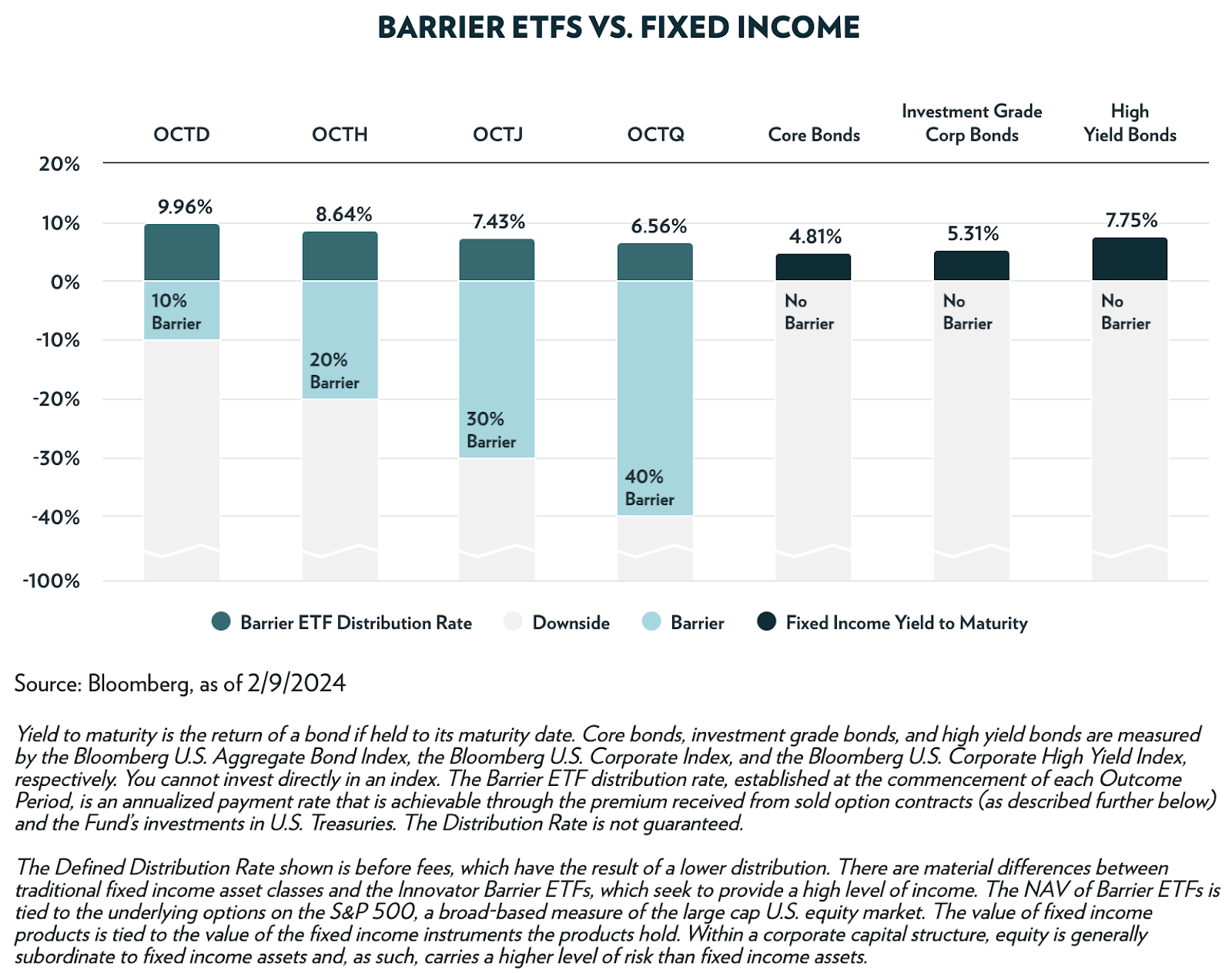
Three other Barrier ETFs posted more modest movements. The July 30 Barrier ETF (JULJ) raised its quarterly payout 2.6% to $0.3364 per share, yielding 5.4% annualized WatchlistNews. The October 30 Barrier ETF (OCTJ) held steady at $0.3177 per share, delivering a 5.3% yield WatchlistNews. The January 20 Barrier ETF (JANH) declared $0.3887, matching a 6.2% to 6.3% annualized yield.
Record Date Set for September 30 Shareholders
All four ETFs will pay dividends on October 2 to investors holding shares on the record date of September 30 WatchlistNews. These Barrier funds target investors seeking steady income with built-in downside protection—a feature that appeals to conservative portfolios in uncertain markets. The combination of option strategies and Treasury holdings creates a structured income approach.
Sentiment
Mostly PositiveNEGATIVENEUTRALPOSITIVE
Publishers
23
Articles
41
Reach
64
A
AnonymousAuthor


