DR Congo Virus Crisis
Deadly Bundibugyo Virus Outbreak Strains DR Congo Amid Severe Hunger and Conflict
Anonymous
Key Points
1
Contact tracing has reached 85.3%, while 819 patients remain in isolation or hospitalized; 15 patients were declared recovered in the 24 hours before the September 6 situation report.
2
The outbreak exposed a regulatory obstacle: the available certified Ebola diagnostic was not designed to detect Bundibugyo virus, and European Union rules require each new diagnostic test to undergo its own validation study, potentially slowing deployment during emergencies.
3
Researchers isolated Bundibugyo virus genetic material from a throat swab taken from a U.S. patient admitted to Charité on May 20 after contracting the virus in the Democratic Republic of Congo, using it to develop a reference standard for test validation.
4
WFP Country Director David Stevenson said food assistance must be integrated into the Ebola response because people who cannot feed their families are unlikely to comply with disease-prevention protocols: “If you can’t feed your family, it’s pretty difficult to adhere to health protocols.”
5
WFP described the outbreak as the fastest-moving Ebola-related epidemic on record, reporting more than 5,500 cases and 2,642 deaths during its first 100 days.
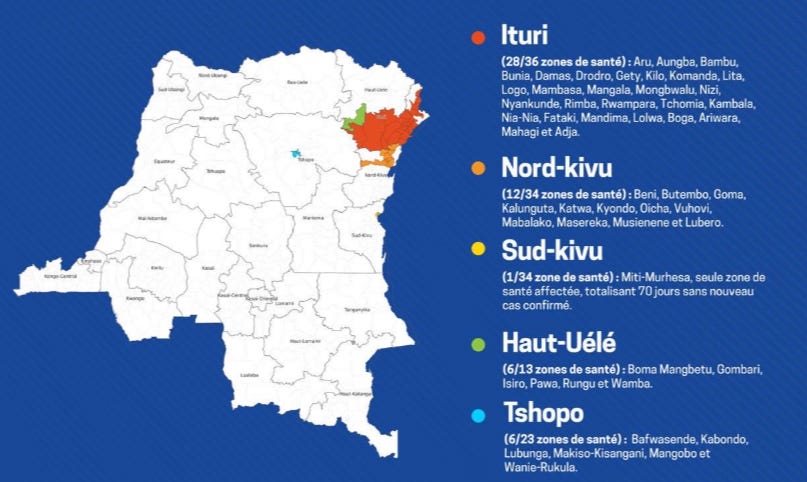
A rare Ebola outbreak in the Democratic Republic of Congo has spread across six provinces, killing more than 3,200 people. As of September 6, officials confirmed 6,686 cases of the Bundibugyo virus with a 48.3% death rate Medical Daily, making it the deadliest Ebola epidemic in the country's history. Ituri province remains the hardest-hit region, though the virus continues advancing into new health zones across the conflict-torn nation.
The outbreak has exposed a cruel intersection of crisis: researchers are rushing to develop diagnostics and test vaccines while humanitarian workers struggle against active conflict, mass displacement, and widespread hunger WFP. More than 500,000 people in Ituri face emergency-level food insecurity, undermining disease prevention efforts. The United States has committed over $860 million in aid, yet the response continues to lag behind the virus's rapid spread.
A Rare Virus Spreading Faster Than Any Ebola Before
The Bundibugyo virus is unusual—it's a rare strain of Ebola, not the more common Zaire subtype. Medafrica Times reports the outbreak has affected 61 health zones across six provinces, with Ituri at the epicenter. The virus moved explosively: WFP said it recorded more than 5,500 cases and 2,642 deaths during its first 100 days—the fastest-moving Ebola epidemic on record.
Contact tracing efforts have reached 85.3% coverage, a significant achievement in a conflict zone. Still, the system is overwhelmed: the DRC needs an additional 1,600 treatment beds Medafrica Times, and the WHO is calling for 5,000 more health workers. South Kivu province offers a glimmer of hope, having gone 97 consecutive days without a new confirmed case.
No Licensed Vaccine or Treatment—Yet Researchers Race to Help
Unlike other Ebola strains, Bundibugyo has no licensed vaccine or treatment available. Scientists are testing whether existing Ebola vaccines could protect people against this rare virus—a technique called cross-protection. Meanwhile, researchers isolated genetic material from a U.S. patient treated at Charité hospital in May to develop a reference standard for faster diagnostic tests Streamline Feed.
Diagnostic speed matters in an epidemic. The catch: the certified Ebola diagnostic test wasn't designed to detect Bundibugyo, and EU rules require each new diagnostic to undergo its own validation study—a process that can take weeks or months when outbreak speed is measured in days.
Hunger and War Are Sabotaging Prevention and Survival
The virus is not spreading in a vacuum. Active conflict and massive displacement are fracturing the response. Over 500,000 people in Ituri province face emergency-level food insecurity Modern Tokyo Times. When families cannot eat, disease prevention collapses: people take dangerous risks to find food, avoid clinics, and resist isolation protocols.
WFP Country Director David Stevenson put it bluntly: "If you can't feed your family, it's pretty difficult to adhere to health protocols." The agency is integrating food assistance directly into the Ebola response, recognizing that survival and disease control are inseparable in crisis zones like the DRC.
U.S. Aid Pours In, But Challenges Still Outpace Resources
The United States has committed $512 million specifically to the Ebola outbreak response and $350 million in regional humanitarian aid. Despite this significant commitment, the response has struggled to keep pace with epidemic growth. Medical Daily reports that the WHO gap assessment shows the system remains critically short of personnel, beds, and supplies.
As of September 6, 819 patients remained in isolation or hospitalized, and 15 patients were declared recovered in the previous 24 hours Democrata—small victories in a much larger crisis. Sustaining the response will require not just money, but security improvements, supply chain stability, and the completion of diagnostic and vaccine research.
Sentiment
Mostly NegativeNEGATIVENEUTRALPOSITIVE
Publishers
21
Articles
11
Reach
32
A
AnonymousAuthor


