MAGA Policy Arcade Games
White House Launches MAGA-Themed Online Arcade Games Highlighting Key Policy Messages
Anonymous
Key Points
1
The White House also adapted a Sega logo to read “MAGA” in promotional material, after posting it on its X account—tying the initiative explicitly to a major video-game brand.
2
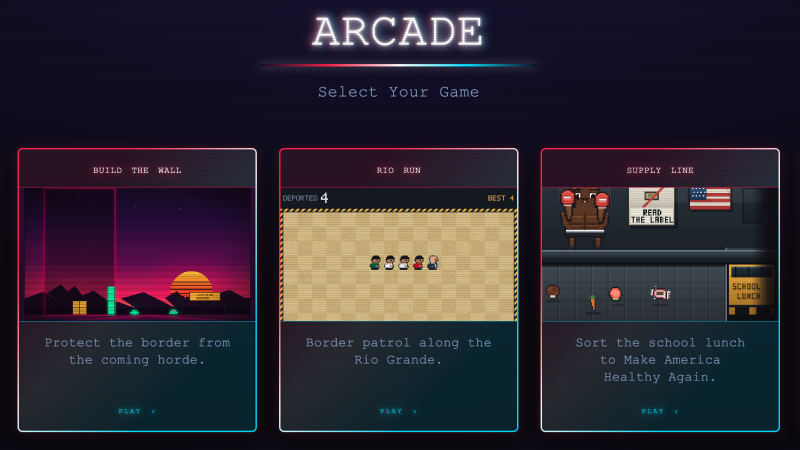
Several games include more specific on-screen targeting details: in the “Border wall”/Tetris-style remake, Fox and TMZ describe gameplay where “little green aliens” rush the wall and a message like “Border Breached” flashes if the wall isn’t high enough or if too many “aliens” get through.
3
The “Make America Healthy Again” boxing game includes pointed visual cues tied to Robert F. Kennedy Jr.’s agenda, including a graphic that reads “Seed Oils” with a red strike-through line.
4
A Trump-themed savings game is framed as “Fill your kids’ Trump Accounts,” with gameplay described as collecting money flying through the air and passing landmarks—such as the Washington Monument background (Duck Hunt-style net/catch mechanics).
The Trump administration has launched a series of arcade-style games on its official White House website, turning policy priorities into playable entertainment. The games—remakes of classic titles like Tetris, Snake, and Duck Hunt—embed messaging around border enforcement, deportation, child savings accounts, and health policy, according to CNN. Players can build a wall to stop "illegal aliens," collect money for "Trump Accounts" offering $1,000 per eligible child, and box unhealthy foods in a Robert F. Kennedy Jr.–themed health game.
White House officials framed the arcade as a way to "tell the story" of Trump's accomplishments through interactive entertainment. Critics and immigrant-rights groups condemned the games as trivializing human suffering and reducing deportation to a game mechanic, saying the approach sanitizes coercive policy through familiar, low-friction gameplay.
How Classic Games Became Political Tools
The White House adapted iconic arcade templates—Tetris, Snake, Flappy Bird, Duck Hunt—to encode policy messages. In the border-wall game, green "aliens" rush toward a wall; if too many breach it, a "Border Breached" message flashes. In a Snake-style chase game, players collect icons representing people to "deport." A net-catching mechanic mirrors Duck Hunt, but players collect flying money for children's Trump Accounts instead of shooting ducks, according to CNN.
Remixing familiar games lowers the "learning cost," allowing supporters to engage immediately without instructions. The arcade format sidesteps detailed policy tradeoffs and instead delivers rapid feedback loops: stack blocks, win points, avoid failure states. This turns contested issues like immigration enforcement into repeatable, emotionally engaging interactions rather than evidence-based debates.
From Policy to Savings Product Marketing
Multiple games revolve around "Trump Accounts," a federal savings product offering $1,000 to children born during Trump's term. Gameplay involves collecting flying money and filling virtual accounts, turning an abstract tax benefit into a concrete, shareable narrative. White House messaging bundles immigration enforcement and economic policy together—"Build the wall. Deport. Fill a Trump Account"—linking family security to the administration's broader platform.
Linking gameplay to a savings product converts generational economics into identity reinforcement. Players experience collecting money as problem-solving and reward, potentially broadening appeal from immigration-focused voters to families motivated by financial security and children's futures.
Rights Groups Question Gamifying Enforcement
Immigrant-rights advocates criticized the arcade as trivializing human suffering by translating deportation into game mechanics. A "deported" label becomes a failure-state message; enforcement shifts from a coercive government action into a win condition. This framing reduces moral friction by making harm feel like entertainment and problem-solving.
The administration explicitly positioned the games as "resonating with every American" and embodying a "culture of fun and winning" against opponents' "dark" vision. Critics said this emotional reframing—turning contested policy into lighthearted play—blunts public empathy while amplifying the government's narrative through familiar, engaging mechanics. The Sega-logo parody (rebranded as "MAGA") further tied the initiative to mainstream gaming culture.
Sentiment
Mostly NegativeNEGATIVENEUTRALPOSITIVE
Publishers
79
Articles
167
Reach
246
A
AnonymousAuthor


