Lloyds: Profit, Dividend, Buyback
Lloyds Banking Group Exceeds Expectations with Strong Profit, Boosts Dividend and Announces £1 Billion Buyback
Anonymous
Key Points
1
Lloyds' shares advanced 3.86% to £1.16 on Thursday, trading near their 52-week high after the results, signaling mixed but constructive sentiment rather than a uniform rally.
2
Lloyds' net interest margin improved to 3.19% in Q2, up 15 basis points year over year and 5 basis points from the prior quarter, driven by strong hedge income, franchise-led volume growth and asset growth.
3
The CET1 capital ratio stood at 13.6%, with a pro forma reading of 13.1% after accounting for the buyback and dividend accrual.
4
Half-year net income reached 3.065 billion pounds, with basic and diluted earnings per share from continuing operations of 0.048 pounds.
Lloyds Banking Group posted a strong first half, with pretax profit rising 14% to £2.27 billion in Q2 and half-year net income hitting £3.07 billion, according to Yahoo Finance. The bank rewarded shareholders with a 30% jump in its interim dividend to 1.58 pence per share and a fresh £1 billion share buyback.
Shares climbed 3.86% to £1.16 on Thursday, just a hair below their 52-week high of £1.16 set on July 6, according to MarketWatch. The stock outperformed the FTSE 100 by 0.10%, signaling broad investor confidence in the results.
Profit Beat Driven by Stronger Lending Margins
Net interest income — what Lloyds earns on loans minus what it pays on deposits — rose in the first half. The net interest margin reached 3.19% in Q2, up 15 basis points from a year ago and 5 basis points from Q1. Lloyds credited strong hedge income and steady loan growth for the improvement.
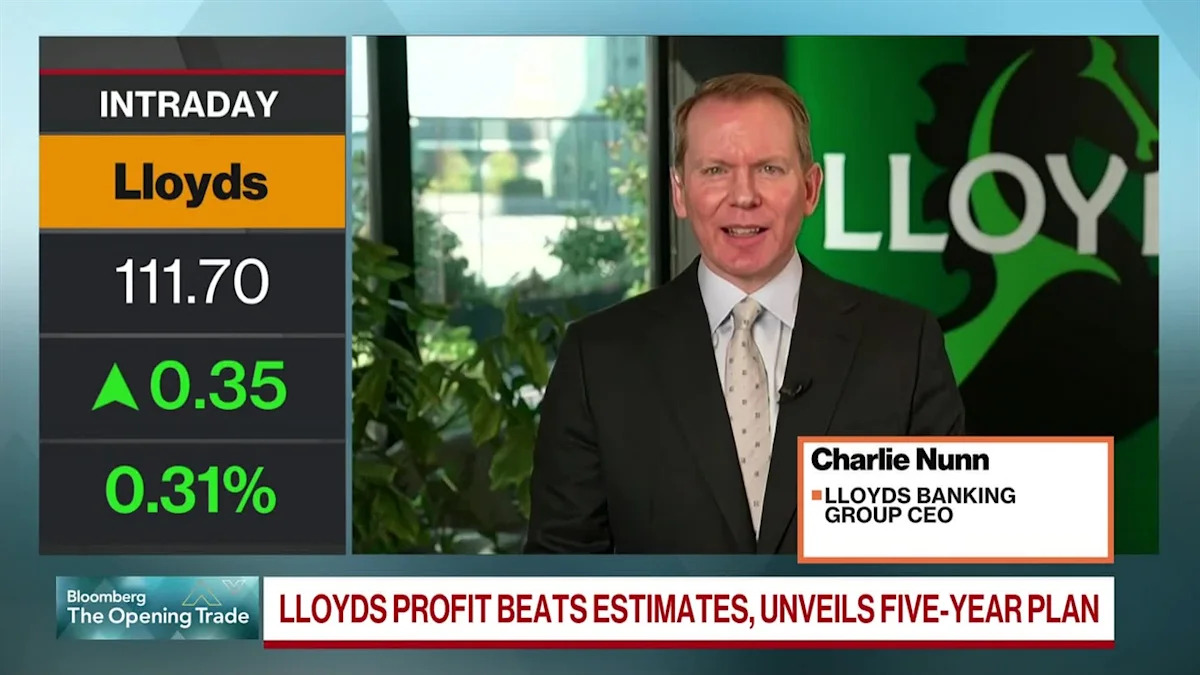
Total net income for Q2 came in at £4.96 billion, up 9.7% year over year, beating analyst expectations. Basic earnings per share from continuing operations stood at £0.048 for the half year. CEO Charlie Nunn said the group has "exciting growth to pursue" heading into the rest of the year, according to Yahoo Finance.
£1 Billion Buyback Added on Top of Existing Programs
Lloyds launched a new £1 billion share buyback on top of programs already running. The interim dividend rose 30% to 1.58 pence per share. Together, these moves signal that the bank feels comfortable returning cash to shareholders rather than holding extra reserves.
The CET1 ratio — a key measure of a bank's financial strength — stood at 13.6%. After accounting for the buyback and dividend, it drops to a pro forma 13.1%. That still sits well above the regulatory minimum, giving Lloyds room to keep investing and paying shareholders. The cost-to-income ratio held in the high 40s, pointing to tight spending discipline.
Accelerate 2030 Plan Targets New Revenue Streams
CEO Charlie Nunn used the results to push forward Lloyds' "Accelerate 2030" strategy, according to Yahoo Finance. The plan sets targets for 2026 and 2030 and includes a blueprint to grow revenue outside of traditional banking. That means expanding into areas like insurance, wealth management, and other financial services.
Nunn said the group sees a clear path to lifting non-banking revenues through the end of the decade. The strategy aims to reduce Lloyds' reliance on interest rate income, which can swing with Bank of England rate decisions. Diversifying revenue is key to hitting the bank's long-term profit targets.
Shares Near 52-Week High Despite Mixed Early Signals
Lloyds shares hit £1.16 on Thursday, just 0.30% short of the 52-week high set earlier in July, according to MarketWatch. The 3.86% single-day gain was one of the strongest moves in the FTSE 100 that session. Some earlier reports had flagged mixed market reaction, but the closing price told a more positive story.
Analysts are now watching whether Lloyds can hold gains as mortgage competition stays fierce across UK retail banking. The bank's strong capital position and generous shareholder returns give it a buffer. But rate cuts from the Bank of England could pressure its net interest margin in the quarters ahead.
Sentiment
Mostly PositiveNEGATIVENEUTRALPOSITIVE
Publishers
12
Articles
40
Reach
52
Topics
A
AnonymousAuthor


