EUCLYD Secures €200 Million
Dutch AI Startup EUCLYD Secures Over €200 Million to Challenge Nvidia Dominance
Anonymous
Key Points
1
The round also included participation from EIFO, Denmark’s Export and Investment Fund, as well as imec.xpand, Brabant Development Agency (BOM) and Quadri.
2
EUCLYD frames the infrastructure challenge as an “efficiency wall”: each increase in foundation-model capability requires more power, memory bandwidth and capital while making deployment more complex.
3
The company’s craftwerk station is designated CWS 32 and combines programmable ASIC compute, processor-memory co-design and system-level optimization, according to EUCLYD’s stated product roadmap.
4
Founded in 2024, EUCLYD is designing an AI inference system with an architecture distinct from GPUs, covering both the processor and memory architecture, CEO Bernardo Kastrup told CNBC.
5
The investment comes as major cloud companies and AI firms pursue alternatives to Nvidia’s chips: Google, AWS and Meta are developing their own AI processors, while OpenAI has said its first AI chip, called Jalapeño, offers “industry-leading speed and efficiency.”
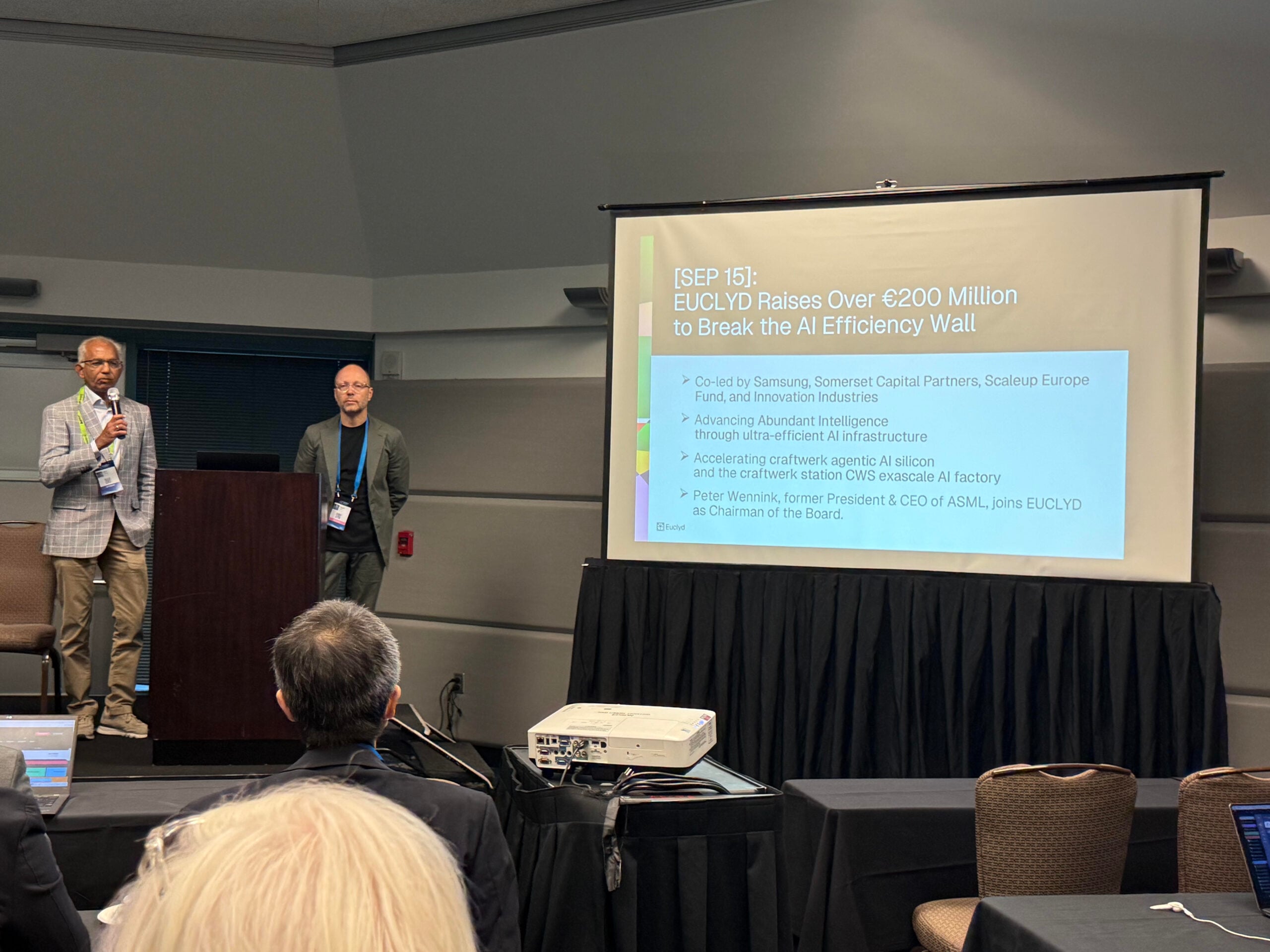
Dutch AI startup EUCLYD has raised over €200 million ($231 million) in Series A funding to build AI chips that compete with Nvidia's dominant system. Korea Herald reports Samsung Electronics co-led the round alongside Somerset Capital Partners, EQT's Scaleup Europe Fund, and Innovation Industries. The company is developing energy-efficient alternatives to traditional GPU-based AI systems that major cloud providers like Google, AWS, and Meta are also pursuing.
EUCLYD's new craftwerk station platform combines specialized processors and memory architecture to reduce the cost and power needed to run large AI models. Former ASML CEO Peter Wennink joined the company as chairman. SiliconAngle notes the startup frames AI's core challenge as an "efficiency wall," where each boost in AI capability demands more power and complexity.
Why AI Companies Are Ditching Nvidia
Nvidia's H100 and newer chips currently power most large AI systems, but the cost and energy demand keep rising. GamesBeat reports EUCLYD aims to deliver "abundant inference at low costs" — meaning AI models can run faster and cheaper. Google, AWS, Meta, and OpenAI are all developing custom chips to escape Nvidia's pricing power and reduce their infrastructure bills.
OpenAI has already unveiled its first custom chip, Jalapeño, claiming it offers "industry-leading speed and efficiency." EUCLYD's approach differs by redesigning both the processor and memory layout from scratch, not just tweaking GPU designs.
EUCLYD's Craftwerk Silicon and Station Design
The company's flagship product is the craftwerk station (CWS 32), a specialized AI inference system using programmable ASIC compute chips rather than general-purpose graphics processors. SiliconAngle explains the platform combines processor-memory co-design — meaning the chip and memory work as one integrated unit. CEO Bernardo Kastrup told CNBC the architecture is "distinct from GPUs," covering both processor and memory innovation.
This integrated approach targets a core problem: running AI models demands constant data movement between processors and memory, which eats power and slows performance. By redesigning the entire system, not just one component, EUCLYD claims it can deliver better efficiency than patching existing GPU architecture.
A Crowded Field of European and Samsung Backing
Samsung's investment signals confidence in EUCLYD and reflects Samsung's broader strategy to reduce dependence on Nvidia. DigiTimes reports the South Korean electronics giant joined Somerset Capital Partners and EQT's Scaleup Europe Fund in leading the round. Danish Export and Investment Fund EIFO also participated, underlining European interest in building homegrown AI chip alternatives.
Additional backers include imec.xpand, Brabant Development Agency, and Quadri. Founded in 2024, EUCLYD is still in early stages but has secured enough backing to compete seriously. The €200 million round ranks among Europe's largest AI infrastructure funding deals and shows investors believe the market has room for non-Nvidia solutions.
Sentiment
Mostly PositiveNEGATIVENEUTRALPOSITIVE
Publishers
23
Articles
15
Reach
38
A
AnonymousAuthor