Jalen Carter's Record Extension
Jalen Carter Becomes NFL's Highest-Paid Defensive Tackle in Eagles' $152 Million Extension Deal
Anonymous
Key Points
1
Jalen Carter’s four-year extension tops $160 million with $152 million guaranteed and an average of about $38 million per year, officially making him the NFL’s highest-paid defensive tackle and surpassing Jeffery Simmons’s prior market pace.
2
The deal helps solidify a two-man interior disruptor duo, with Carter joining Jordan Davis as the Eagles’ interior anchors and completing a major offseason emphasis on fortifying the front seven.
3
Carter was a major workload player in 2024, appearing in a large portion of snaps as Philadelphia leaned on him as a cornerstone of the run-stopping and pass-disruption front.
4
In the 2025 season, Carter battled shoulder injuries and appeared in 11 games with 3 sacks; Next Gen Stats also show a reduced pressure rate (7.7%) and significant double-team pressure (41.7%), highlighting the impact of injuries on his peak performance.
5
Carter’s prolonged impact is underscored by his Pro Bowl presence and career trajectory, including back-to-back Pro Bowl selections in 2024 and 2025 and a runner-up finish for Defensive Rookie of the Year in 2023.
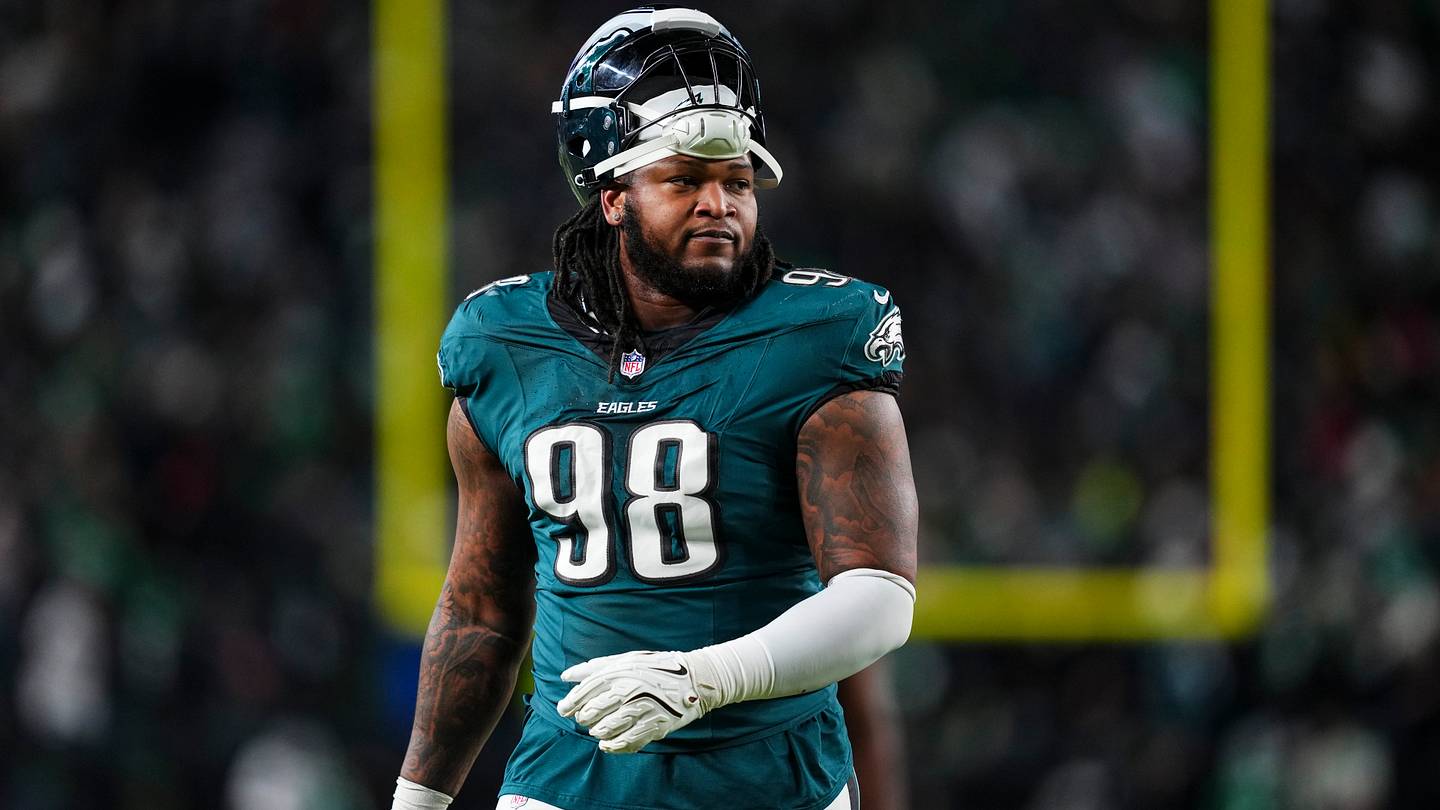
The Philadelphia Eagles have made Jalen Carter the highest-paid defensive tackle in NFL history. The team signed him to a four-year extension worth $152 million, with a maximum value of $160 million and $106 million guaranteed, keeping him in Philadelphia through the 2031 season, according to Crossing Broad.
The deal pays Carter an average of about $38 million per year, topping prior market-setters like Jeffery Simmons and Chris Jones. Carter, a two-time Pro Bowler, anchors one of the most dominant defensive fronts in the league alongside fellow interior tackle Jordan Davis.
Carter Sets New Defensive Tackle Pay Standard
No defensive tackle has ever earned more. Carter's $38 million average per year breaks the old market pace set by Simmons and Jones, per Yahoo Sports. The $106 million in guaranteed money makes the deal one of the richest commitments the Eagles have ever made to a single player. Agents Drew Rosenhaus and Jason Rosenhaus negotiated the contract.
The extension kicks in as a rookie deal add-on, locking Carter up well into his prime years. USA Today noted the deal could reach $160 million with incentives. For comparison, Simmons set the prior benchmark at around $35 million per year. Carter beats that by roughly $3 million annually.
Eagles Build a Two-Man Wrecking Crew Up Front
Carter does not work alone. The Eagles also signed interior tackle Jordan Davis to a four-year, $78 million deal this offseason. Together, the two form a powerful run-stopping and pass-rushing duo. Philadelphia is spending over $230 million combined to lock up both starters at the position, per Heavy.
The front-seven has been central to Philadelphia's identity. Carter's ability to draw double teams opens lanes for edge rushers. His 41.7% double-team pressure rate in 2025 shows how often teams gameplan around him, even when his stats dip, according to FanSided.
Shoulder Injuries Slowed Carter in 2025 Season
Carter battled shoulder problems throughout the 2025 season. He played in just 11 games and recorded 3 sacks. His pressure rate fell to 7.7%, down from prior highs. Despite that, the Eagles showed no hesitation in paying him like an elite player. The team views those numbers as injury-related, not a talent decline, per Yahoo Sports.
Before the injuries, Carter was a workhorse. In 2024, the Eagles leaned on him heavily as a run-stopper and pass-disruptor. He earned back-to-back Pro Bowl selections in 2024 and 2025. He also finished as a runner-up for Defensive Rookie of the Year in 2023, per Crossing Broad.
New Contract Squeeze Could Force Hard Cap Choices
The massive investment comes with a cost. Heavy reported that the Eagles now face fresh cap pressure after committing so heavily to the interior line. Fitting Carter and Davis together, along with other key contributors, could force the team to make tough decisions on other roster spots.
Still, the Eagles appear committed to building from the inside out. Keeping homegrown talent like Carter is a clear team priority. Philadelphia is betting that a dominant front seven is worth any cap gymnastics required to keep it together through 2031.
Sentiment
Mostly PositiveNEGATIVENEUTRALPOSITIVE
Publishers
54
Articles
287
Reach
341
A
AnonymousAuthor


