5G Crowd Sensing Trial
Samsung and Verizon complete a successful crowd-sensing trial using 5G infrastructure.
Anonymous
Key Points
1
Verizon CTO and SVP of Technology Development Yago Tenorio said the trial showed the company’s early vRAN investments were “paying off today,” allowing it to test 6G concepts such as ISAC over existing infrastructure. He added that future networks could “actively perceive and interact with [their] environment” to improve public safety and venue management.
2
Samsung’s Network in a Server platform consolidated network functions and accelerated AI computing into a single server, allowing the trial to use the existing 5G network without additional equipment.
3
The ISAC system could track both static and moving objects, including people, but could not identify individual attendees—an important limitation for assessing its privacy implications.
4
The companies did not identify the specific Dallas-area venue. Mobile World Live noted that AT&T Stadium in nearby Arlington hosted a separate ISAC demonstration by AT&T and Ericsson focused on drone sensing during the World Cup period.
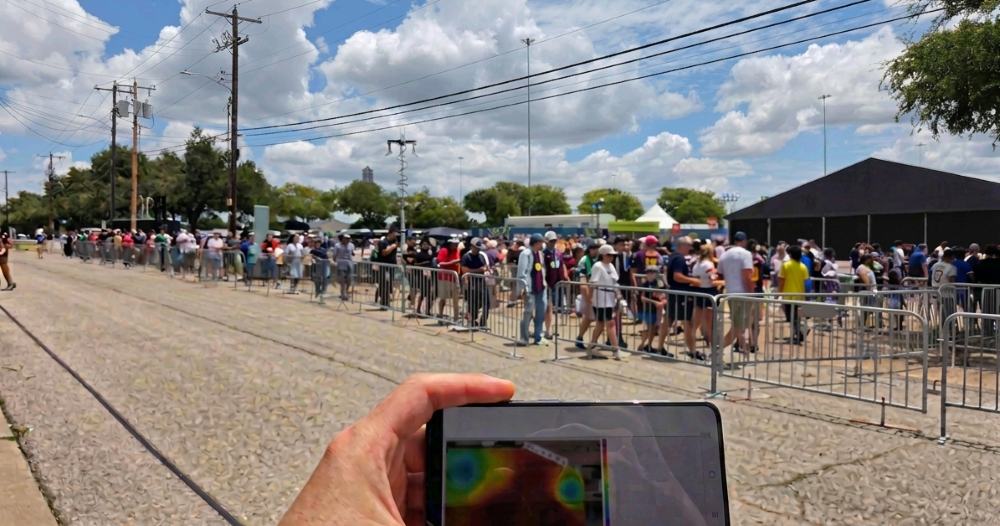
Samsung and Verizon completed an advanced sensing trial at a major soccer event in Dallas, demonstrating how 5G networks can track crowd movements in real time Telecom Tech News. The system used a 40 MHz radio and Samsung's AI-powered software to create a live heatmap showing crowd density and movement patterns — technology that could help event venues manage gates, reduce wait times, and spot overcrowding risks Data Center Dynamics.
The trial marks an early real-world test of 6G capabilities, though the system ran entirely on existing 5G infrastructure. Verizon CTO Yago Tenorio said the demonstration proved the company's earlier investments in virtual RAN technology were "paying off today," allowing engineers to test future 6G concepts like ISAC without waiting for a new network generation Telecom Tech News.
How the Sensing System Tracked Crowds Without Cameras
Samsung's Network in a Server platform compressed multiple network functions and AI computing into a single server Telecom Tech News. This allowed Verizon to add sensing capability to an existing Cell-On-Wheels unit equipped with a 40 MHz radio on the CBRS spectrum, avoiding the need for dedicated cameras or radar hardware at the venue.
The system analyzed how radio signals bounced off moving objects and people, then used AI to convert that data into a real-time crowd-density map Data Center Dynamics. It could track both stationary and moving people but crucially could not identify individuals — an important privacy safeguard as the technology matures.
Why 6G Sensing Could Transform Venue Operations
Event organizers struggle with bottlenecks at gates, concession areas, and restrooms where crowds bunch up unpredictably. Real-time density tracking lets staff open additional lines before dangerous overcrowding occurs Data Center Dynamics. Venue managers could also spot emerging crowd surges and alert security to intervene early.
The sensing capability could extend beyond concerts and sports. Airports, train stations, and shopping centers all face crowd-management challenges. Tenorio emphasized that future networks could "actively perceive and interact with [their] environment" to improve public safety across venues Telecom Tech News.
A 6G Demo Built on Today's 5G Foundation
Samsung and Verizon deliberately chose to run the trial on existing 5G infrastructure rather than waiting for 6G networks to arrive Telecom Tech News. This approach lets the companies test concepts and refine them now, accelerating practical deployment when 6G eventually launches in the coming years.
Critics noted that similar crowd-sensing applications could theoretically work on current 5G networks without a new generation Data Center Dynamics. Nonetheless, the trial underscores how software and AI innovation — rather than raw network speed — may define the next generation of telecommunications.
Sentiment
Mostly PositiveNEGATIVENEUTRALPOSITIVE
Publishers
17
Articles
21
Reach
38
A
AnonymousAuthor


