Robot Marathon Success
South Korean Robot Successfully Completes Full Marathon on Single Battery Charge
Anonymous
Key Points
1
RAIBO2 was developed as the successor to the team’s first-generation RAIBO, which was completed in 2021; the researchers began designing and building RAIBO2 in 2023 with long-distance, high-efficiency locomotion as its central objective.
2
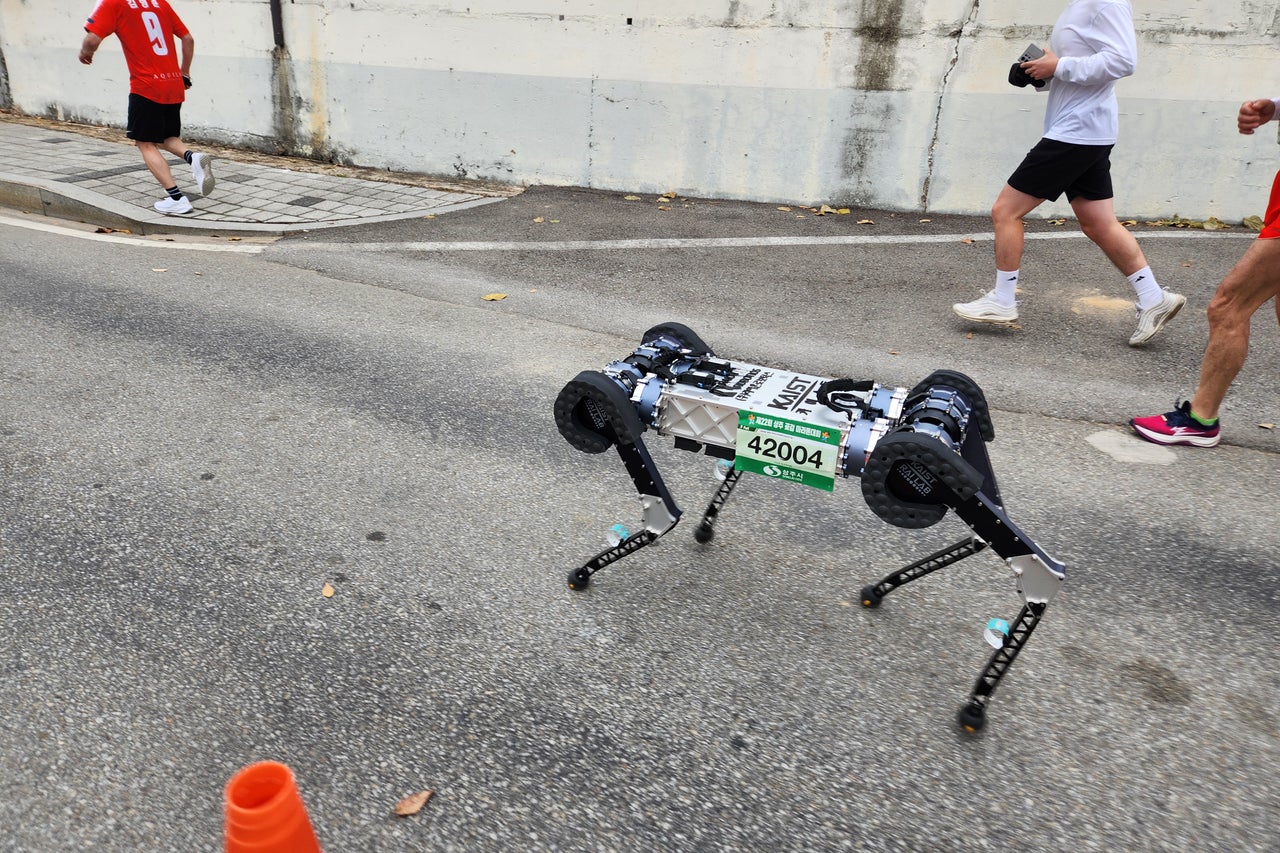
The researchers entered RAIBO2 as an officially registered participant alongside human runners in the Sangju Dried Persimmon Marathon, where it navigated asphalt roads, gentle inclines and changing temperatures while researchers ran alongside it to document the performance.
3
The team collected real-time power-consumption and locomotion data during the race, using the marathon to validate design principles for improving the energy efficiency of quadrupedal robots.
4
Researchers found that roughly two-thirds of the robot’s energy budget was lost as heat in the motors and drive electronics, while the remaining losses came from gear friction, slipping feet and the impact of each footfall.
5
The study’s lead author, Choongin Lee, framed the design goal in terms of distance efficiency rather than speed: “What matters is energy consumed per unit of distance.” The team consequently treated the robot’s limbs, power-distribution hardware and gait-control algorithms as a jointly optimized system.
South Korean researchers at KAIST have achieved a robotics milestone: RAIBO2, a four-legged robot, completed a full 42.195-kilometer marathon in 4 hours, 19 minutes and 52 seconds on a single battery charge. Interesting Engineering reports the robot ran the Sangju Dried Persimmon Marathon in 2024 alongside human runners, marking the first time a quadrupedal robot has finished a full marathon in an actual race. The breakthrough, now published in Nature, represents the first robotics research from South Korea to appear in the journal's flagship publication.
Rather than pack RAIBO2 with a massive battery, the KAIST team squeezed efficiency from every component. They reduced leg weight, cut motor losses, minimized friction in gears and feet, and trained an energy-efficient walking pattern using computer simulation and machine learning. The robot used only 1,280 watt-hours—about two-thirds of its battery capacity—giving RAIBO2 an estimated range of 65 kilometers, far exceeding comparable quadruped robots.
From RAIBO to Marathon Runner
RAIBO2 is the successor to the team's first-generation RAIBO, completed in 2021. The KAIST researchers began building RAIBO2 in 2023 with one clear goal: long-distance travel on minimal battery drain. AOL reports the team treated every piece—the robot's limbs, power distribution hardware, and gait algorithms—as a single system to optimize together. Nothing was designed in isolation; everything worked toward one mission: run farther on less energy.
Where the Battery's Energy Actually Goes
Understanding energy loss is understanding how to win the efficiency game. The KAIST team found that roughly two-thirds of RAIBO2's energy budget disappears as heat inside the motors and drive electronics. The remaining third leaks away through gear friction, foot slippage, and the shock of each footfall hitting the ground. Lead author Choongin Lee explained the design philosophy: "What matters is energy consumed per unit of distance," not how fast the robot moves.
Racing Real Asphalt Against Real Odds
The marathon course was not a controlled lab setting. RAIBO2 ran on actual asphalt roads at the Sangju Dried Persimmon Marathon, navigating gentle hills and temperature swings while researchers jogged alongside it. Tech Yahoo notes the robot's pace outpaced the average human marathoner. The real-world conditions meant the researchers could collect live power-consumption and movement data, turning the marathon itself into a final exam for their design principles. Every meter of the 42.195-kilometer race validated their engineering choices.
Sentiment
Mostly PositiveNEGATIVENEUTRALPOSITIVE
Publishers
18
Articles
16
Reach
34
A
AnonymousAuthor


