KOSPI Market Plunge
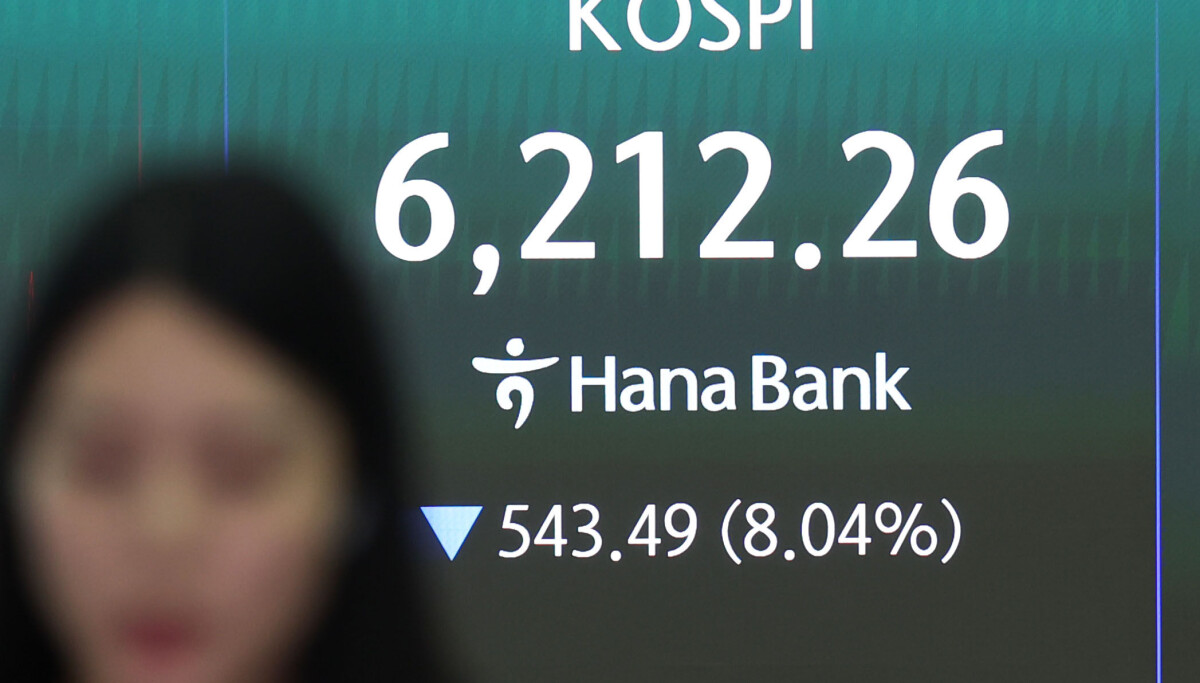
KOSPI Plunges 8% as Circuit Breaker Halts Trading Amid Semiconductor and CXMT IPO Fears
Anonymous
Key Points
1
CXMT's IPO pushed it to become the top-listed company by market capitalization in mainland China, valued at about 3.28 trillion yuan, intensifying concerns about the global DRAM oligopoly known to include Samsung Electronics and SK hynix.
2
Pre-market sell-side circuit breakers were triggered before the main market halt: the KOSPI's sell-sidecar activated around 9:06 a.m. after KOSPI 200 futures fell 5% or more for a minute; the KOSDAQ saw a sell-sidecar at 9:14:47 a.m. due to KOSDAQ 150 futures down 6% and the KOSDAQ 150 index down 3% for a minute.
3
There is a dueling tally of circuit-breaker counts this year: Korea Times reported seven circuit breakers, while Sed Daily later list eight by the time of reporting, underscoring ongoing volatility in the market.
4
Global semiconductor stocks weakened alongside the Korea market, with Nvidia (-4.99%), Micron (-2.25%), AMD (-5.17%), SanDisk (-11.02%), Western Digital (-4.21%), and SK hynix ADR (-7.47%) sliding; the Nasdaq Composite had closed the prior session down 0.18%, and the Philadelphia Semiconductor Index fell 2.23%.
South Korea's benchmark KOSPI index plunged more than 8% on Tuesday, July 28, triggering a 20-minute market-wide trading halt — the eighth such event in 2026. Korea JoongAng Daily reported the index fell 542 points to 6,213 before the circuit breaker fired at 10:13 a.m. Seoul time. Samsung Electronics dropped 9.45% and SK hynix plunged 11%, a day before both were set to report quarterly earnings. BeInCrypto noted the selloff spread to the KOSDAQ, which tumbled 6.54% to 714.83.
The trigger: China's top memory chipmaker, ChangXin Memory Technologies (CXMT), made its stock market debut the day before with a jaw-dropping 466% first-day surge. Its market value hit 3.28 trillion yuan — roughly $485 billion — making it mainland China's most valuable listed company. Investors feared it would break the tight three-player grip on global memory chips held by Samsung, SK hynix, and Micron. TradingKey said that fear, combined with worries about how much tech giants are spending on AI infrastructure, sent Korean stocks into freefall.
CXMT's Record IPO Shatters the DRAM Oligopoly Myth
CXMT listed on Shanghai's STAR Market on July 27 at an offer price of 8.66 yuan. It closed at 49 yuan — a gain of nearly 466% on its first day. Daily trading volume hit 141 billion yuan, the first time any mainland Chinese stock ever crossed 100 billion yuan in a single session. Armed with up to 66.6 billion yuan ($9.8 billion) in fresh capital, CXMT plans to nearly double its monthly wafer production to 550,000 by 2028. Yahoo Finance reported that investors fear a supply glut and a price war that would crush Samsung and SK hynix margins.
The same day CXMT listed, a report from The Information said China had begun domestic mass production of immersion deep ultraviolet (DUV) lithography machines — tools previously only made by Europe's ASML. ASML shares dropped 8.5% on the news. Samsung and SK hynix together make up more than 50% of the KOSPI's total market value, which is why a threat to their business hits the entire Korean market so hard.
Circuit Breakers Fire as Panic Spreads Before Market Open
Selling began before the regular session even got going. At 9:06 a.m., the Korea Exchange triggered a KOSPI "sell-sidecar" — a rule that pauses automated sell orders for 5 minutes when KOSPI 200 futures fall more than 5% for a full minute. At 9:14:47 a.m., the KOSDAQ triggered its own sell-sidecar after KOSDAQ 150 futures dropped over 6%. TradingKey said the KOSPI had already opened down 5.26% at 6,400.
At 10:13 a.m., the main market-wide circuit breaker fired. Trading stopped completely for 20 minutes. South Korea's Financial Services Commission Chairman Lee Eok-won held an emergency meeting with major securities firms the same morning. He warned: "In preparation for a scenario where demand does not sufficiently cool down, we will review and prepare additional measures in advance." A proposed 20% cap on single-stock leveraged ETFs in retail portfolios was floated as a likely next step.
Global Chip Stocks Bleed as AI Spending Fears Mount
The pain was not confined to Seoul. On Wall Street the night before, Nvidia fell 4.99%, AMD slid 5.17%, SanDisk dropped 11.02%, and Micron lost 2.25%. SK hynix's US-listed shares — known as ADRs — fell 7.47%. The Philadelphia Semiconductor Index, a key benchmark for global chip stocks, dropped 2.23%. The Nasdaq closed down 0.18%. Economic Times said the selling deepened as a Wall Street Journal report revealed Nvidia is negotiating up to $350 billion in credit lines to finance OpenAI's chip purchases, raising fears that AI spending is becoming dangerously circular.
Japan's Nikkei 225 fell over 2,600 points — about 4% — to slip below 63,000. Analysts at Mirae Asset Securities and Kiwoom Securities both urged calm. Han Ji-young of Kiwoom said: "Although there is no issue when it comes to the chip sector's fundamentals... there remains demand for profit-taking, while noises regarding AI and the chip sector are being raised again and again." Still, with three circuit breakers in July alone, Korea's market volatility has begun to rival that of major cryptocurrencies.
Korean Retail Investors Face Forced Deleveraging Ahead
Much of the damage was amplified by Korea's retail investors — locally known as "ants" — who poured more than 100 trillion won (about $67 billion) into the market in early 2026. A large chunk went into leveraged ETFs that double the daily moves of Samsung and SK hynix. When big foreign funds trimmed their Korea holdings, those ETFs had to automatically rebalance, triggering waves of forced selling. The won also weakened sharply to 1,469 per US dollar during the session.
Regulators are now moving fast. The FSC is expected to finalize tighter margin rules by July 31. The proposed 20% cap on leveraged single-stock ETFs would force many retail investors to sell holdings, potentially triggering another round of volatility. Institutional brokers at JPMorgan and Samsung Securities told clients the selloff was an overreaction, arguing that China's DUV lithography claims lack verified mass-production credentials and that CXMT chips will remain locked out of major Western tech buyers for now.
Sentiment
Mostly NegativeNEGATIVENEUTRALPOSITIVE
Publishers
116
Articles
132
Reach
248
A
AnonymousAuthor


