Massive Energy Storage Expansion
Adani and Juniper expand renewable energy storage capacity across major Indian projects
Anonymous
Key Points
1
Juniper said regulatory clarity from Central Transmission Utility of India Ltd. permits storage capacity to be added without increasing a project’s grid-connectivity allocation, allowing it to use existing transmission infrastructure more efficiently.
2
Juniper CEO Ankush Malik said the Bikaner addition gives the company extra merchant capacity without requiring more grid connectivity, and supports a more commercially flexible storage portfolio alongside its long-term contracted renewable assets.
3
Adani’s Khavda storage system uses lithium-ion batteries, an energy management system and automated telemetry to manage charging and discharging, optimize performance and provide grid services.
4
Adani said its 6.63 GWh system is equivalent in capacity to more than 150,000 mid-sized electric vehicles and can meet almost twice the estimated daily electricity requirement of the Delhi Metro.
5
The Khavda storage system is integrated with Adani’s planned 30 GW renewable-energy development across 538 square kilometres of barren land; the latest capacity addition was commissioned within 10 months of construction starting.
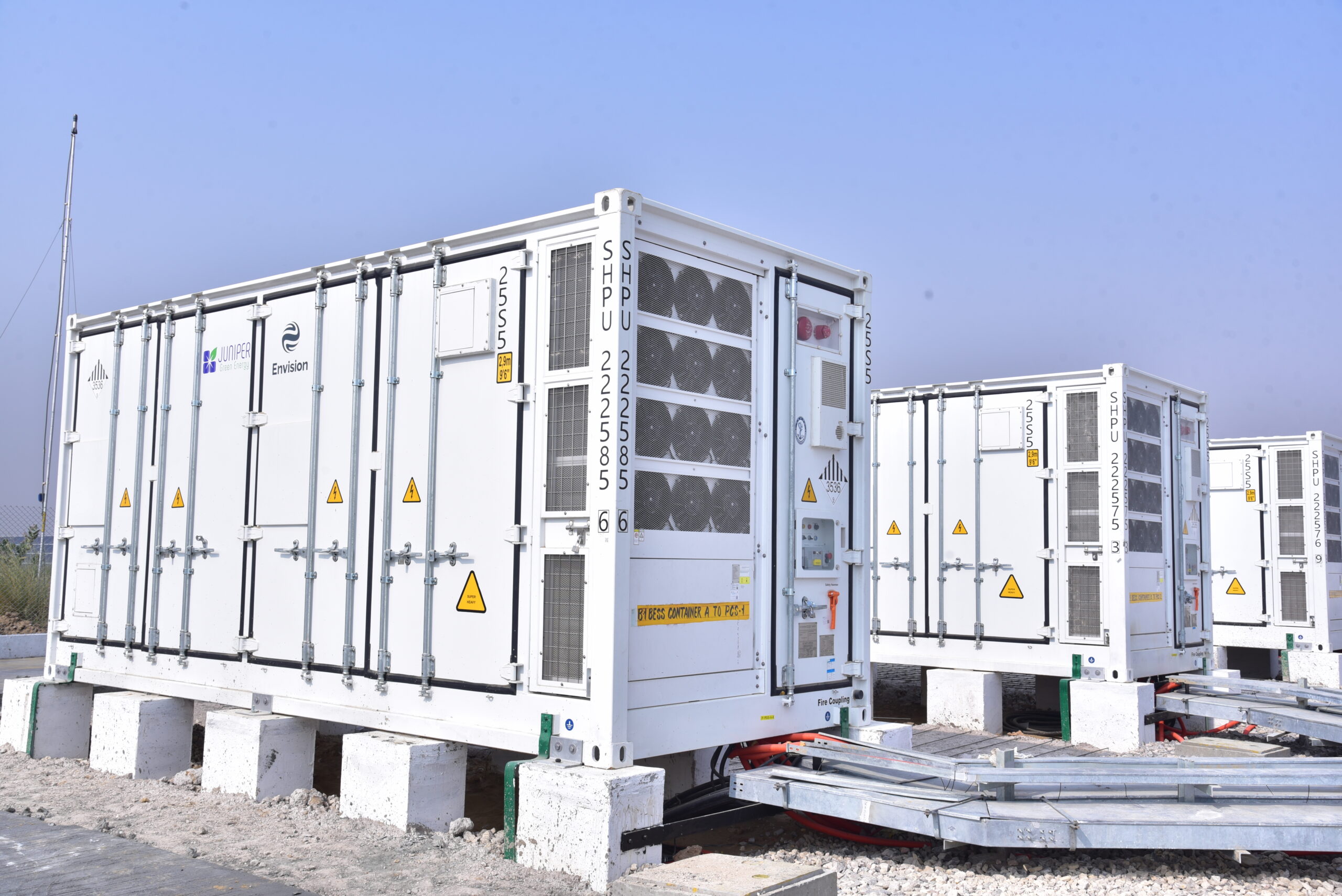
India's renewable energy storage is getting a major boost this week. Juniper Green Energy doubled its Bikaner Phase II battery storage site to 201.28 MWh by adding 100.64 MWh of capacity. Meanwhile, Adani Green Energy doubled its Khavda storage system to 6.63 GWh — now more than half of all operational battery storage in India and the world's largest single-site installation.
The dual expansions mark a turning point for India's grid. Adani says its Khavda system can power roughly two million homes for one full day. Juniper now operates about 2,725 MW of renewable capacity paired with 600 MWh of storage, giving the company more merchant flexibility without needing extra grid connections.
Juniper Unlocks Storage Growth Without New Grid Connections
Juniper's 100.64 MWh addition came with a major regulatory win. Central Transmission Utility of India confirmed that battery storage capacity can be added without increasing a project's grid-connectivity allocation. This means Juniper used existing transmission infrastructure more efficiently — a key cost advantage. CEO Ankush Malik said the Bikaner expansion gives the company extra merchant capacity while supporting long-term contracted renewable assets.
Adani's Khavda System Now the World's Largest Single-Site Storage
Adani Green Energy doubled its Khavda battery storage to 6.63 GWh — equivalent to 150,000 mid-sized electric vehicles or nearly twice the daily power needs of Delhi Metro. The system uses lithium-ion batteries, automated telemetry, and energy management software to optimize charging, discharging, and grid services. The company commissioned the expansion in just ten months of construction.
The 6.63 GWh represents more than 50% of India's total operational battery storage — a massive concentration at one site. Adani plans to add over 10 GWh more in the next fiscal year and reach 50 GWh within five years. The Khavda storage integrates with a planned 30 GW renewable energy development across 538 square kilometres of barren land in Gujarat.
India's Storage Race Accelerates Amid Grid Demands
Both expansions signal India's urgent pivot toward grid-scale battery storage. Renewable energy grows fast, but power must be stored and released when the sun doesn't shine or wind doesn't blow. Juniper's regulatory breakthrough on grid connectivity opens a new playbook for other developers. Adani's scale — 6.63 GWh at one site — demonstrates the economics now work for massive deployments.
India's operational battery storage was fragmented across dozens of smaller projects before these expansions. Now two companies control a dominant share. The trend suggests India is solving a critical problem: how to integrate 500+ GW of planned renewables without destabilizing the grid. Storage paired with solar and wind makes clean energy reliable 24/7.
Sentiment
Mostly PositiveNEGATIVENEUTRALPOSITIVE
Publishers
13
Articles
5
Reach
18
A
AnonymousAuthor


