Global Battery Storage Expansion
Battery Storage Projects Expand Globally to Improve Renewable Grid Stability and Integration
Anonymous
Key Points
1
GEON’s Phalodi project was implemented in alignment with Rajasthan’s Electricity Regulatory Commission Green Energy Open Access Regulations, 2025, notified on May 21, 2025.
2
SAJ’s EK70 carries a 10-year warranty and is rated for 10,000 battery cycles. Its modular design uses 314Ah cells and per-module DC-DC optimizers, allowing battery packs from different production batches to be combined without affecting performance.
3
Dubai’s planned battery-storage programme follows a 1 MW pilot launched in 2010; officials are expanding the programme as the UAE’s solar capacity, already above 2,500 MW, grows toward 2030 and beyond.
4
Masdar’s Abu Dhabi round-the-clock power project represents an estimated investment of about $6.1 billion, combining 5.2 GW of solar generation and 19 GWh of storage to supply 1 GW continuously.
5
Solaryaan’s C&I system includes remote monitoring through Solaryaan Cloud, with Wi-Fi, 4G and 5G connectivity for tracking system performance and managing energy use.
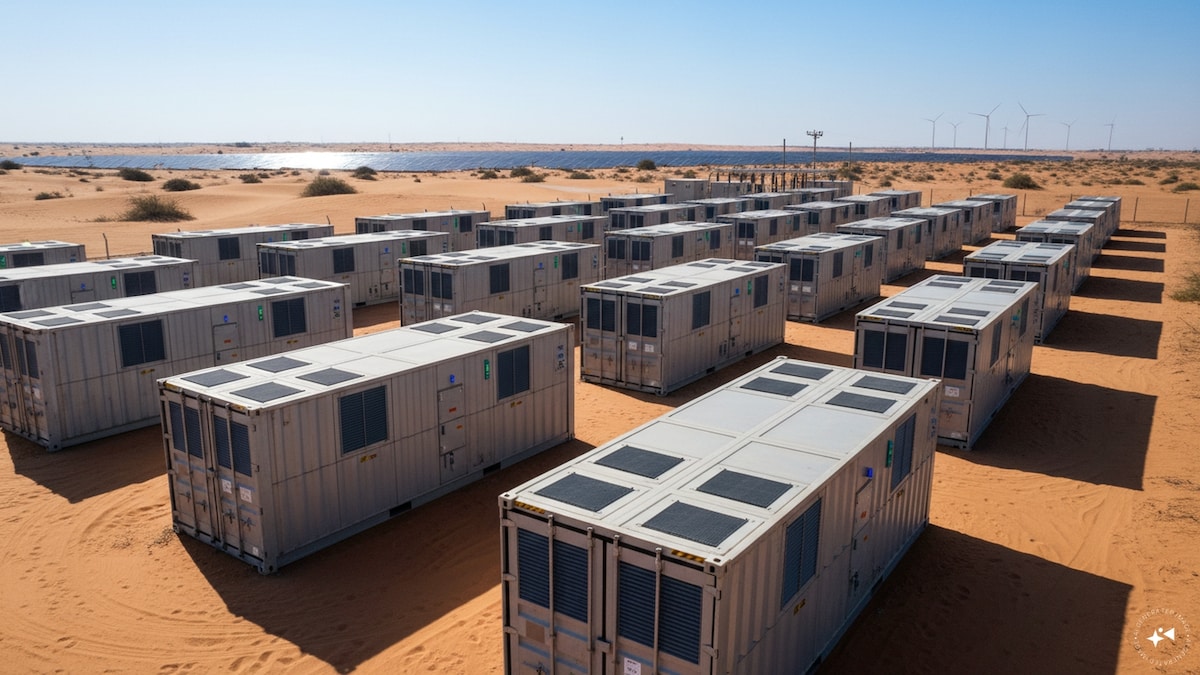
Battery storage systems are expanding rapidly across Asia and the Middle East as energy companies race to stabilize grids and integrate renewable power. CNBCTV18 reported that GEON, Kabra Extrusiontechnik's future technologies division, commissioned a 10 MW/20 MWh battery storage system in Phalodi, Rajasthan, designed to improve grid stability and renewable energy integration. Meanwhile, Dubai is targeting 1,000 to 2,000 MW of battery storage to support round-the-clock solar power, while Abu Dhabi's separate project combines 5.2 GW of solar generation with 19 GWh of storage.
The push reflects a global shift toward battery-backed renewable energy systems. Industry executives say success depends on effective system integration, battery safety safeguards, predictable long-term performance, and reducing supply-chain concentration. India's Solaryaan also introduced a 125 kW/241 kWh commercial system for peak shaving and backup power, while Australia's SAJ launched the EK70 residential battery with 10-year warranty and electric-vehicle charging.
GEON's Rajasthan Project Targets Grid Stability
GEON's new battery storage system in Phalodi will support grid stability, energy management, and renewable power integration under Rajasthan's utility requirements. CNBCTV18 confirmed the 10 MW/20 MWh system has completed testing and commissioning. The project could avoid approximately 100,000 metric tonnes of carbon dioxide emissions over 10 to 15 years if charged entirely with renewable energy. The system was implemented in alignment with Rajasthan's Electricity Regulatory Commission Green Energy Open Access Regulations, 2025, notified in May.
Australia and India Roll Out New Battery Systems
Australia's SAJ launched the EK70 residential battery system, which combines solar conversion, whole-home backup, energy management, and electric-vehicle charging capabilities. The EK70 carries a 10-year warranty and is rated for 10,000 battery cycles. Its modular design uses 314Ah cells and per-module DC-DC optimizers, allowing battery packs from different production batches to be combined without affecting performance.
India's Solaryaan introduced a 125 kW/241 kWh commercial and industrial system designed for peak shaving, outage support, and frequency regulation. The system reduces reliance on diesel generators. Solaryaan's offering includes remote monitoring through Solaryaan Cloud, with Wi-Fi, 4G, and 5G connectivity for tracking performance and managing energy use.
UAE and Abu Dhabi Pursue Massive Storage Scale
Dubai is expanding its battery storage programme significantly, targeting 1,000 to 2,000 MW of capacity to support round-the-clock solar power. This follows a 1 MW pilot launched in 2010. The expansion aligns with the UAE's growing solar capacity, which already exceeds 2,500 MW and continues growing toward 2030 targets.
Abu Dhabi's separate round-the-clock power project represents an estimated $6.1 billion investment. Masdar is combining 5.2 GW of solar generation with 19 GWh of storage to provide 1 GW of continuous electricity. This integration model demonstrates how large-scale solar and storage can deliver reliable baseload power without fossil fuels.
Industry Focuses on System Integration and Supply Chain Risk
Industry executives emphasize that large-scale battery deployment depends on three critical factors: effective system integration, safeguards against battery risks, and predictable long-term performance. They also highlight the need to reduce supply-chain concentration to avoid bottlenecks in battery materials and manufacturing. These concerns drive investment in modular designs, remote monitoring, and diverse sourcing strategies across multiple projects.
Sentiment
Mostly PositiveNEGATIVENEUTRALPOSITIVE
Publishers
15
Articles
7
Reach
22
Topics
A
AnonymousAuthor


