State September Temperature Records
Record September Temperatures Across Multiple States Highlight Ongoing Long-Term Warming Trends
Anonymous
Key Points
1
The North Dakota hottest Septembers article is hosted on Prime Publishers under the series 'hottest septembers in North Dakota since 1895,' with the article ID article_dd2dd03f-8a94-503a-ab24-50b3cf6ad08c.html, indicating a broader state-by-state projection rather than a single nationwide piece.
2
The New Mexico ranking page for Septembers is likewise hosted on Prime Publishers and uses the article_2478baba-ceac-5a2b-85a7-7aa0d085dddc.html URL, reflecting the same state-focused archival approach as ND.
3
The North Carolina Septembers ranking is published through Prime Publishers with the URL article_82bba249-dac9-5752-bdfe-bdcc84630286.html, continuing the pattern of state-specific historical temperature analyses.
4
The Minnesota Septembers ranking page is part of the same Prime Publishers series, accessible via article_b19a24b4-132d-5d45-86e9-06e6c207ed95.html, reinforcing the multi-state compilation approach for historical September heat records.
5
The Louisiana Septembers ranking is also hosted on Prime Publishers, with the URL article_3f1076b6-060a-5a56-8880-5925fafc5873.html, illustrating the spread of this state-by-state methodology across the five states highlighted in the series.
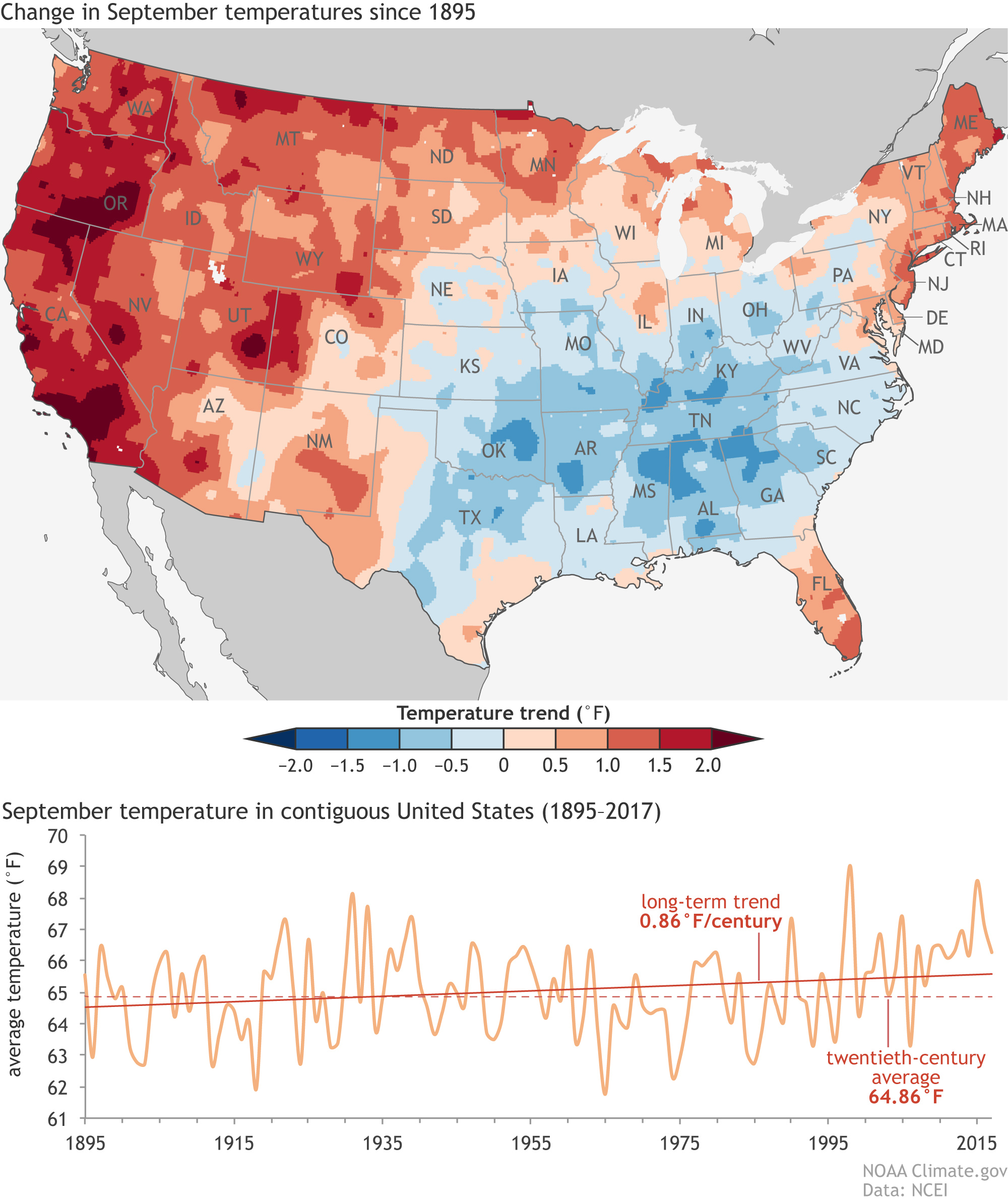
September heat records are shattering across the United States, reflecting a decades-long warming trend that shows no signs of stopping. NOAA data reveals that 2022 was the continental United States' third-hottest July on record, while 20 states hit their hottest September temperatures since records began in 1895.
The pattern is unmistakable: average temperatures have climbed roughly 2 degrees Fahrenheit since 1880, rising at a steady rate of about 0.14 degrees per decade. This warming trend has left its mark across diverse regions, from North Dakota to Louisiana, transforming September temperature records nationwide.
How North Dakota's September Heat Ranks Historically
North Dakota's hottest Septembers since 1895 tell a story of escalating temperatures in the Great Plains. NOAA and National Centers for Environmental Information compiled rankings based on the highest average monthly temperatures, including state highs, lows, and precipitation records.
The data shows that extreme September heat is not a rare event anymore. Multiple recent years now rank among the state's hottest on record, illustrating how rising temperatures are reshaping what September feels like across the region.
September Heat Records Spreading Across Multiple States
From New Mexico to Minnesota, from North Carolina to Louisiana, record September temperatures span nearly every corner of the country. NOAA data compiled by Stacker reveals how individual states are experiencing their hottest Septembers in more than a century.
This geographic spread underscores a critical point: extreme heat is not isolated to one region. Twenty states hit their hottest Septembers in recorded history, demonstrating how the warming trend affects diverse climates and ecosystems simultaneously.
A Warming Trend That Started in 1880
The rise in September temperatures is not new. Since 1880, average temperatures across the United States have climbed roughly 2 degrees Fahrenheit over 140 years. This averages to about 0.14 degrees per decade—a steady, persistent upward march.
What makes recent years stand out is the acceleration and consistency. The hottest Septembers are concentrated in recent decades, suggesting the rate of warming may be quickening. Record-breaking temperatures that once occurred once per century now happen multiple times per generation.
Why September Records Matter for Climate Understanding
Monthly temperature records like these serve as a clear thermometer for climate change. By tracking when individual states hit their highest September averages, scientists can map how warming is reshaping seasonal patterns across the country.
The data comes from rigorous temperature monitoring by National Centers for Environmental Information, ensuring that rankings reflect accurate measurements spanning more than 125 years. These records provide the foundation for understanding how fast the planet is warming.
Sentiment
Mostly NegativeNEGATIVENEUTRALPOSITIVE
Publishers
18
Articles
192
Reach
210
A
AnonymousAuthor


