Eos Energy Google MN8 Partnership Boosts Shares
Eos Energy Google MN8 Partnership Boosts Shares
Anonymous
Key Points
1
The Mammoth Solar project is located in Kanawha County, West Virginia, and is being developed on land that was formerly mined for coal, illustrating a notable land-reuse effort with potential local economic benefits.
2
The 3-asset blend at Mammoth Solar comprises 86 MW of solar, 10 MW of Z3 long-duration storage (100 MWh) delivering 10 hours, and 70 MW of lithium-ion storage (280 MWh).
3
Project timing is staggered: solar generation is slated to begin in 2028, followed by lithium-ion storage in 2029 and Eos' Z3 long-duration storage in 2030.
4
Eos’s backlog and revenue are notably concentrated and currently show profitability risk: backlog stands at about $807 million (3.4 GWh), with Frontier Power USA making up 49% of backlog; a related-party project accounted for 80% of second-quarter revenue, and Q2 gross margin was -71% with H1 revenue of $125.7 million against a 2023–24 annual guide of $300–$350 million.
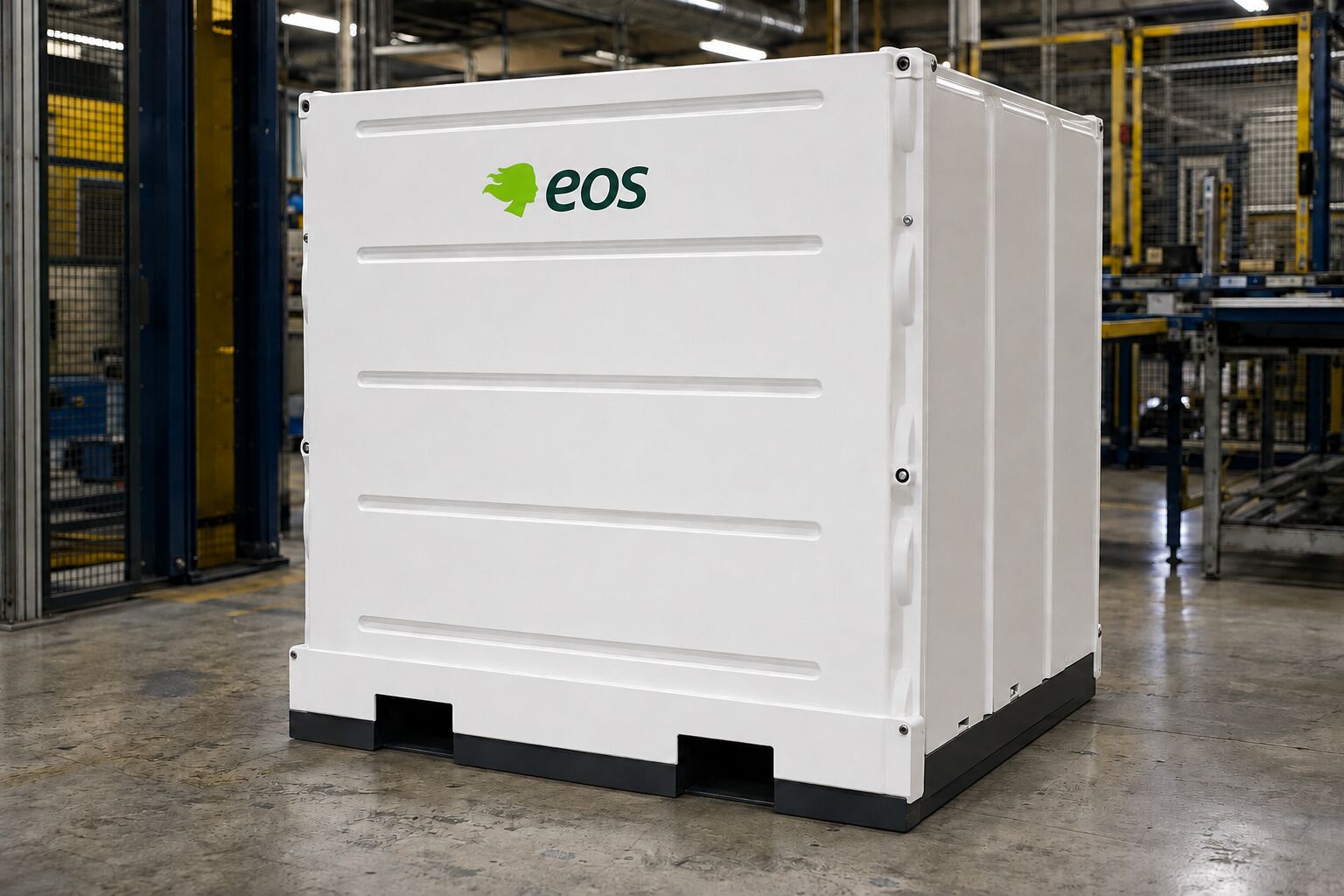
Eos Energy shares jumped after announcing a major partnership with Google and MN8 Energy to deploy its Z3 zinc-based battery system at the Mammoth Solar project in West Virginia. Yahoo Finance reported the stock rose 8.1% on the news, which marks Google's first project using Eos' long-duration storage technology. The facility will pair 86 MW of solar with 10 MW of Eos Z3 storage and 70 MW of lithium-ion batteries to power Google's regional data centers.
The project represents a major credibility boost for Eos, validating its Z3 technology with a hyperscale customer while expanding its customer base. However, Ticker Report noted that traders purchased 111,000 call options on Eos stock—a 67% jump from the daily average—signaling mixed investor sentiment. The deal also highlights concerns: Eos faces significant profitability challenges with a negative gross margin and heavy customer concentration in its backlog.
Three-Way Deal Combines Solar, Zinc, and Lithium Storage
The Mammoth Solar project sits on former coal mining land in Kanawha County, West Virginia—a reuse effort with potential local economic benefits. The site will contain three distinct energy assets: 86 MW of solar generation, 10 MW of Eos' Z3 long-duration storage (100 MWh total, lasting 10 hours), and 70 MW of lithium-ion batteries (280 MWh). Google will purchase energy, capacity, and clean energy credits from the facility under a long-term agreement.
The commercial timeline is staggered across three years. Solar generation launches in 2028, lithium-ion storage follows in 2029, and Eos' Z3 system comes online in 2030. Tech S2 reported the deal tests just 2.9% of Eos' current backlog, suggesting room for much larger deployments ahead. MN8 Energy will own and operate the entire site under a master supply agreement with Eos.
Google Validates Eos' Long-Duration Battery Technology
This is Eos' first project with Google, one of the world's largest cloud and data center operators. The partnership signals that hyperscale tech companies view zinc-based long-duration storage as a viable complement to lithium batteries for grid stability. Eos' Z3 technology can discharge for 10 hours—far longer than most lithium systems—making it ideal for overnight and multi-hour discharge scenarios that solar facilities require.
Landing Google as a customer enhances Eos' pitch to other major corporations seeking renewable energy solutions. The project also anchors Eos in the PJM Interconnection region, a major Eastern U.S. power grid where long-duration storage is increasingly valuable. However, the 2030 start date means this revenue is still years away, keeping near-term profitability pressures front and center for investors.
Profitability and Backlog Concentration Temper Investor Optimism
Eos reported a backlog of roughly $807 million (3.4 GWh) but faces severe margin challenges. In the second quarter, the company posted a negative 71% gross margin while one related-party customer accounted for 80% of Q2 revenue. Simply Wall St cautioned that Eos stock may be overvalued despite the Google deal, noting a 73% five-year share decline and ongoing valuation concerns. Revenue scaling must come with margin improvement.
The backlog itself shows concentration risk: Frontier Power USA represents 49% of the pipeline. While the Google deal brings diversification, Eos must prove it can manufacture and deliver units profitably at scale. Until the company demonstrates positive margins on large projects, share price gains may face headwinds from profit-focused investors watching execution closely.
Sentiment
Mostly PositiveNEGATIVENEUTRALPOSITIVE
Publishers
15
Articles
22
Reach
37
A
AnonymousAuthor


