FDA Panel Backs Test
FDA advisory panel supports Grail multi-cancer blood test following positive study results.
Anonymous
Key Points
1
The Galleri test uses a machine-learning algorithm to analyze chemical patterns in cell-free DNA, distinguishing DNA released by healthy cells from DNA associated with cancer.
2
Nima Nabavizadeh of Oregon Health & Science University said the test addresses a major screening gap because cancers without established screening methods account for up to 70% of cancer deaths in the United States, while emphasizing that Galleri should be used alongside—not instead of—standard screening.
3
The PATHFINDER 2 study was conducted at 32 clinical sites in the United States and Canada and required participants to be at least 50 years old; eligibility included people undergoing diagnostic evaluation for suspected cancer or those with a recent or previously untreated cancer history, underscoring that the study population was not a typical average-risk screening population.
4
The study found that 72.8% of cancers detected by the test were cancer types without Grade A or B screening recommendations from the U.S. Preventive Services Task Force; among people with newly diagnosed primary cancers detected by the test, 53% had stage 1 or 2 disease and 70.9% had stage 1, 2 or 3 disease.
5
Separately, Singapore-based Lucence is promoting a more personalized multi-cancer screening model that tailors panels to family history and lifestyle. Its chief executive, Min-Han Tan, said, “The future of cancer screening is not about testing for as many cancers as possible; it is about testing for the right cancers for the right person, at the right time.”
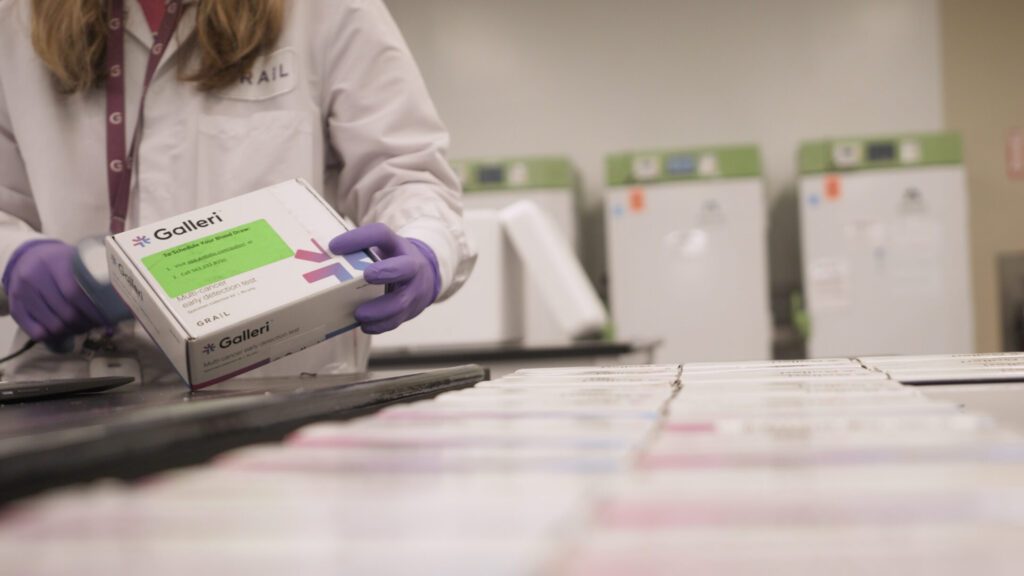
An FDA advisory panel unanimously backed Grail's Galleri blood test as reasonably safe and effective for detecting multiple cancer types in older adults. STAT News reported the 10-0 vote found the test's benefits outweigh its risks. The test analyzes cell-free DNA using machine learning to spot cancer signals across 17 broad cancer types, many without routine screening options.
In the PATHFINDER 2 study of 35,878 adults age 50 and older, Galleri detected 60.3% of cancers and identified one of the two most likely cancer origins in 91.3% of true-positive cases, Bloomberg Law reported. The test is meant to complement, not replace, standard screening. The FDA typically follows advisory panel recommendations but is not required to do so.
A Breakthrough for Cancers Without Standard Screening
The Galleri test addresses a critical gap in cancer detection. STAT News noted that cancers without established screening methods account for up to 70% of U.S. cancer deaths. Nima Nabavizadeh of Oregon Health & Science University emphasized the test should work alongside—not replace—conventional screening methods.
In the study, 72.8% of detected cancers lacked Grade A or B screening recommendations from the U.S. Preventive Services Task Force. Among newly diagnosed cancers the test found, 53% were stage 1 or 2, and 70.9% were stage 1, 2, or 3—earlier stages when treatment is often more effective.
What the Test Can and Cannot Do
Galleri uses a machine-learning algorithm to analyze chemical patterns in cell-free DNA—genetic material released into the bloodstream. The test distinguishes DNA from healthy cells from DNA linked to cancer. With 99.64% specificity, false alarms are rare, Chicago Tribune reported.
The 60.3% positive predictive value means the test correctly identifies cancer about 6 out of 10 times it flags a signal. Positive results require follow-up diagnostic testing. Crucially, the study enrolled people undergoing cancer evaluation or with recent cancer histories—not typical screening populations—so results may not fully apply to average-risk adults.
A Shift Toward Personalized Cancer Screening
While Galleri aims to test for many cancers at once, competitors are taking a different approach. Singapore-based Lucence is developing personalized screening panels tailored to family history and lifestyle. CEO Min-Han Tan said, "The future of cancer screening is not about testing for as many cancers as possible; it is about testing for the right cancers for the right person, at the right time."
This shift reflects a broader debate in oncology: universal multi-cancer screening versus targeted approaches based on individual risk. Both strategies aim to catch cancer earlier, when treatment outcomes improve. The FDA panel's endorsement suggests Galleri will likely become available, but its real-world impact will depend on cost, insurance coverage, and how doctors integrate it with existing screening.
Sentiment
Mostly PositiveNEGATIVENEUTRALPOSITIVE
Publishers
29
Articles
203
Reach
232
A
AnonymousAuthor


