Global Bond Market Selloff
Global bond markets suffer sharp selloff as strong economic data fuels rate-hike bets.
Anonymous
Key Points
1
The dollar held near its highest level since late July as the bond selloff unfolded, while gold extended losses after falling 1.7% in the previous session to about $4,290 an ounce.
2
Asian markets were mixed: Japan’s Nikkei 225 rose 1.7% after the country returned from a three-day holiday, while Chinese equities edged lower. China was also in focus after Washington and Beijing extended their trade truce by two months as President Xi Jinping arrived in the United States for his first state visit in 11 years.
3
SEI Investments’ Sean Simko described the market forces as a “trifecta” of stronger economic data, increased Treasury supply pushing five-year yields higher and expectations that inflation will remain sticky globally.
4
Swaps fully priced three quarter-point Federal Reserve rate increases over the following year, with substantial hedging for a fourth hike; that would put the policy rate in a 4.75% to 5% range, according to the Financial Post report.
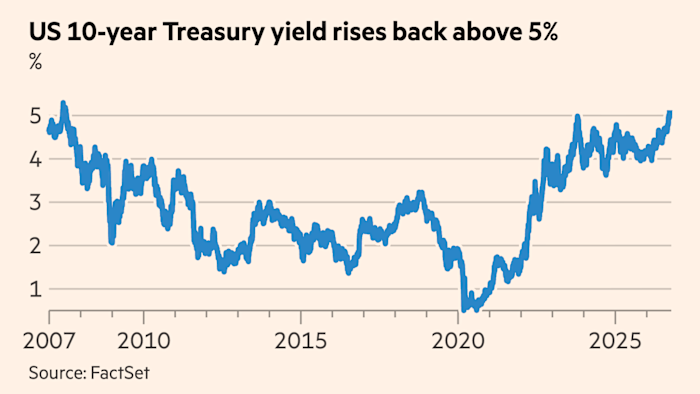
Global bond markets are selling off sharply as investors brace for higher interest rates. The U.S. 10-year Treasury yield jumped 15 basis points to 5.11%, while the five-year yield rose above 5% for the first time since 2007, according to Investing. Strong U.S. economic data, elevated oil prices above $102 a barrel, and weak Treasury auction demand are fueling fears that inflation will remain sticky and the Federal Reserve will keep rates high.
The selloff has rippled across global markets. Stock prices fell in Europe, Asia and the U.S. as higher discount rates squeezed risk assets. Morningstar reported that Treasury yields hit multiyear highs while government bonds declined in the eurozone and UK. Brent crude's continued strength raised concerns that energy costs could worsen inflation pressures worldwide.
A Trifecta of Forces Pushing Yields Higher
Three major factors are converging to drive the bond selloff. SEI Investments analyst Sean Simko called it a "trifecta": stronger-than-expected U.S. economic data, increased Treasury supply flooding the market, and expectations that inflation will remain persistent globally. The hot business activity shows the economy is stronger than many expected, reducing pressure on the Fed to cut rates soon.
The failed five-year Treasury auction particularly spooked markets. Investing noted that weak demand at this key auction signaled investors are losing appetite for bonds at current yields. This pushed five-year yields above 5% for the first time in 16 years. Longer-term yields are now approaching levels unseen in roughly two decades, a stark reminder of how much the bond market has shifted.
Fed Rate Hikes Expected to Continue Through Next Year
Traders have sharply increased bets that the Federal Reserve will keep tightening. According to Financial Post, swap markets are now fully pricing in three quarter-point rate increases over the next 12 months. There is substantial hedging positioned for a fourth hike, which would push the policy rate into a 4.75% to 5% range.
This shift reflects growing conviction that inflation won't fade quickly. The combination of strong demand and high energy prices is making it harder for the Fed to declare victory over price increases. Markets see little chance of rate cuts in the near term, and instead are preparing for continued tightening cycles ahead.
Oil Prices and Geopolitical Risk Keep Pressure On
Brent crude has remained above $102 a barrel after a sharp rally linked to Middle East tensions. MarketScreener reported that higher oil prices have fueled the global selloff alongside strong U.S. growth data. Energy costs directly feed into inflation, making it harder for central banks to ease monetary policy anytime soon.
Geopolitical risks remain a key watch point going forward. If tensions worsen or oil supply is disrupted further, prices could spike higher and accelerate inflation globally. Investors are closely monitoring developments in the Middle East, Treasury auction results, and upcoming inflation data to gauge whether the bond selloff will continue or stabilize.
Asian Markets Show Mixed Signals Amid Trade Diplomacy
Asian equities delivered a mixed picture as the bond selloff spread globally. Japan's Nikkei 225 rose 1.7% after the country returned from a three-day holiday, defying the broader selloff momentum. Chinese equities edged lower, though China's economy remained a focal point as Washington and Beijing extended their trade truce by two months.
President Xi Jinping's arrival in the United States for his first state visit in 11 years added a diplomatic dimension to markets. The extended trade truce offers some relief from tariff concerns but does little to address the underlying shift toward higher rates globally. The dollar held near its highest level since late July, while gold extended losses after falling 1.7% to about $4,290 an ounce.
Sentiment
Mostly PositiveNEGATIVENEUTRALPOSITIVE
Publishers
24
Articles
40
Reach
64
A
AnonymousAuthor


