Canada Investment Summit Plans Global Capital Push
Canada Investment Summit Plans Global Capital Push
Anonymous
Key Points
1
The summit is expected to draw managers overseeing more than US$100 trillion in assets, who will review more than 160 Canadian project proposals—an indication that Ottawa is framing the event as a national capital-formation effort rather than a conventional trade show.
2
The final group of five-year fixed-payment mortgages taken out during the pandemic represents about 12% of all outstanding Canadian mortgages; average payments for these borrowers are projected to rise roughly 15% upon renewal.
3
Canadian home prices have declined about 5% over the past year and roughly 20% from their 2022 peak, adding refinancing and collateral-related risks for some mortgage borrowers.
4
Diesel prices reached a record $5.85 per gallon before crossing the $6 threshold, a development that could squeeze margins for Canadian energy and transport companies as well as other logistics-heavy businesses.
5
Canadian guaranteed-investment-certificate rates remained relatively attractive, with leading rates reported at about 3.75% for one year and 4.30% for five years as of Sept. 9.
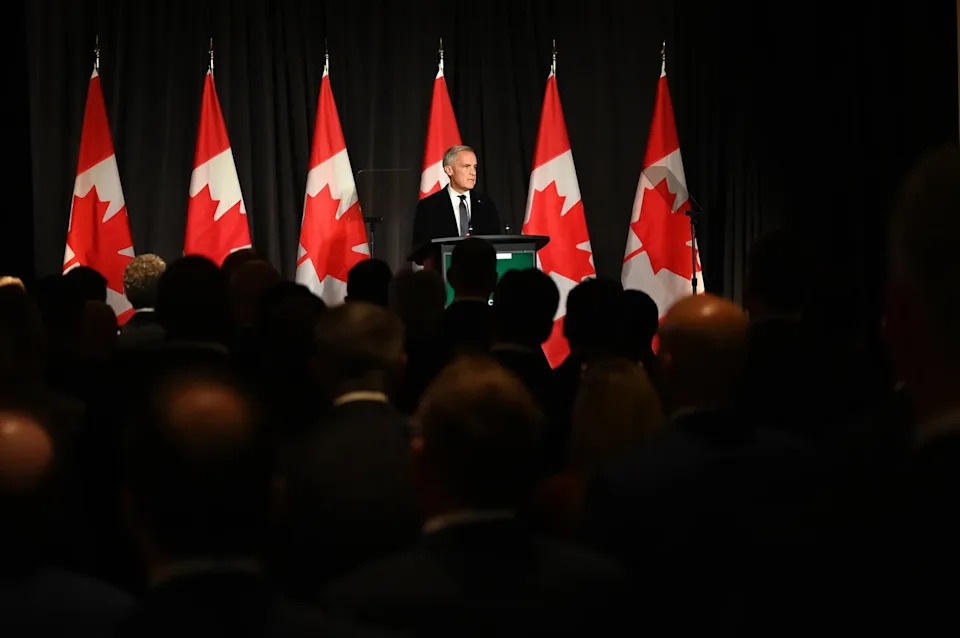
Canada's Prime Minister Mark Carney is launching an ambitious drive to attract C$1 trillion in domestic and foreign investment over five years, betting that global capital can unlock the country's critical minerals, energy, and infrastructure potential. Radio-Canada reports that the inaugural Canada Investment Summit opened September 14 in Toronto, drawing asset managers overseeing more than US$100 trillion and pitching 167 project proposals across mining, clean energy, ports, and utilities. Early results are promising: the summit closed September 15 with nearly C$500 billion in investment commitments, including a C$50 billion "Maple Fund" launched by the Canada Pension Plan Investment Board and Brookfield Asset Management.
Carney framed the effort as a sovereign pivot away from U.S. reliance, saying "Our ambition is catching up to our potential... Canada is taking control of our future." CanTechLetter highlighted that TD Bank alone pledged C$150 billion in 5-year financing, while CityNews noted that the summit drew global giants like BlackRock's Larry Fink and Macquarie Group's Shemara Wikramanayake. Yet success hinges on converting pledged capital into operating mines, processing plants, and supply chains—while navigating a tough macro backdrop of oil near US$110 per barrel, rising bond yields, and a weakening Canadian dollar.
Mortgage Renewals and Household Pressure Mount
Canada's households face an affordability squeeze as fixed-rate mortgages signed during the pandemic begin to reset. About 12% of all Canadian mortgages—the final cohort of five-year fixed loans from 2021–2022—are renewing at substantially higher rates, with average payments projected to jump roughly 15%. Adding pressure, Canadian home prices have fallen about 5% over the past year and remain roughly 20% below their 2022 peak, creating refinancing and collateral risks for some borrowers who may owe more than their homes are worth.
Diesel prices have spiked to record levels, recently crossing $6.00 per gallon in Canada. This surge threatens margins for energy companies and logistics-heavy businesses, which could also feed broader inflation. Meanwhile, Canadian guaranteed-investment-certificate rates remain relatively attractive at about 3.75% for one year and 4.30% for five years, offering savers a modest refuge in a volatile economy.
Global Capital Stampede Driven by Critical Minerals Race
Canada sits atop vast deposits of minerals essential for electric batteries and renewable energy—lithium, cobalt, nickel, and rare earths. The summit's 167 pitches include 63 mining and minerals projects, 31 clean energy initiatives, and 16 port and infrastructure proposals. CanTechLetter reported that only 15 projects are fully permitted and ready to break ground, including the US$28.5 billion Ksi Lisims liquefied natural gas terminal. Global asset managers view Canada as a geopolitically safer alternative to supply chains dependent on China or politically unstable regions.
Canadian pension funds are stepping up as anchors. CPP Investments and PSP Investments, along with Ontario Teachers' Pension Plan, collectively committed over C$85 billion through the summit. Radio-Canada notes that the government is offering tax incentives and accelerated regulatory rulings for investors committing C$1 billion or more, while Manitoba waived provincial sales tax for Port of Churchill projects. Such sweeteners aim to overcome decades of capital outflow—over C$1 trillion in net outflows between 2015 and 2024.
First Nations Rights and Sovereignty Questions Loom
All 167 proposed projects cross lands where over 500 First Nations hold constitutionally protected rights, requiring mandatory Supreme Court-enforced consultation. This legal obligation could delay or reshape projects, raising questions about how quickly pledged capital can be deployed. Critics also worry that opening Canada's resources to foreign investors risks weakening national control over critical assets.
Federal NDP Leader Avi Lewis condemned the summit, arguing Carney plans to "save this country by selling it off" and prioritize corporate interests over household affordability. CityNews reported counter-summit protests erupted downtown during the event. Tracy Hughes of the Critical Minerals Institute cautioned that "capital alone does not build an industry," questioning who holds developers accountable if funds flow in but mines never open. These tensions reflect a broader debate: how much foreign ownership is safe, and who benefits when natural wealth is developed?
Can C$500 Billion in Pledges Become Real Projects?
The summit's C$500 billion in commitments—landing halfway toward Carney's C$1 trillion five-year goal—represents a stunning show of confidence in Canada's resource potential. Yet pledges and actual deployment are worlds apart. Permitting delays, Indigenous consultations, supply-chain bottlenecks, and volatile commodity prices could all derail timelines. CanTechLetter noted that TD Bank's Raymond Chun said the lender is encouraged by "a more streamlined approval process for strategic projects." Federal rules now prioritize CRA tax rulings for mega-investors, and provinces like Manitoba are cutting red tape.
Analysts at the C.D. Howe Institute and Rotman School of Management argue that federal guardrails can protect sovereignty while attracting necessary foreign capital. Their case: Canada's mines and energy will be built regardless—the question is whether Canadian pension funds and workers benefit from the upside. If the next 18 months convert even half the pledged capital into active construction projects, it could mark the start of a transformative investment supercycle. The next milestone: seeing whether bankers, miners, and Indigenous leaders can navigate the handshake into signed contracts.
Sentiment
Mostly PositiveNEGATIVENEUTRALPOSITIVE
Publishers
51
Articles
161
Reach
212
A
AnonymousAuthor


