Novo Nordisk Downgraded
Morgan Stanley Downgrades Novo Nordisk Due to Patent Risks and Growing Competition
Anonymous
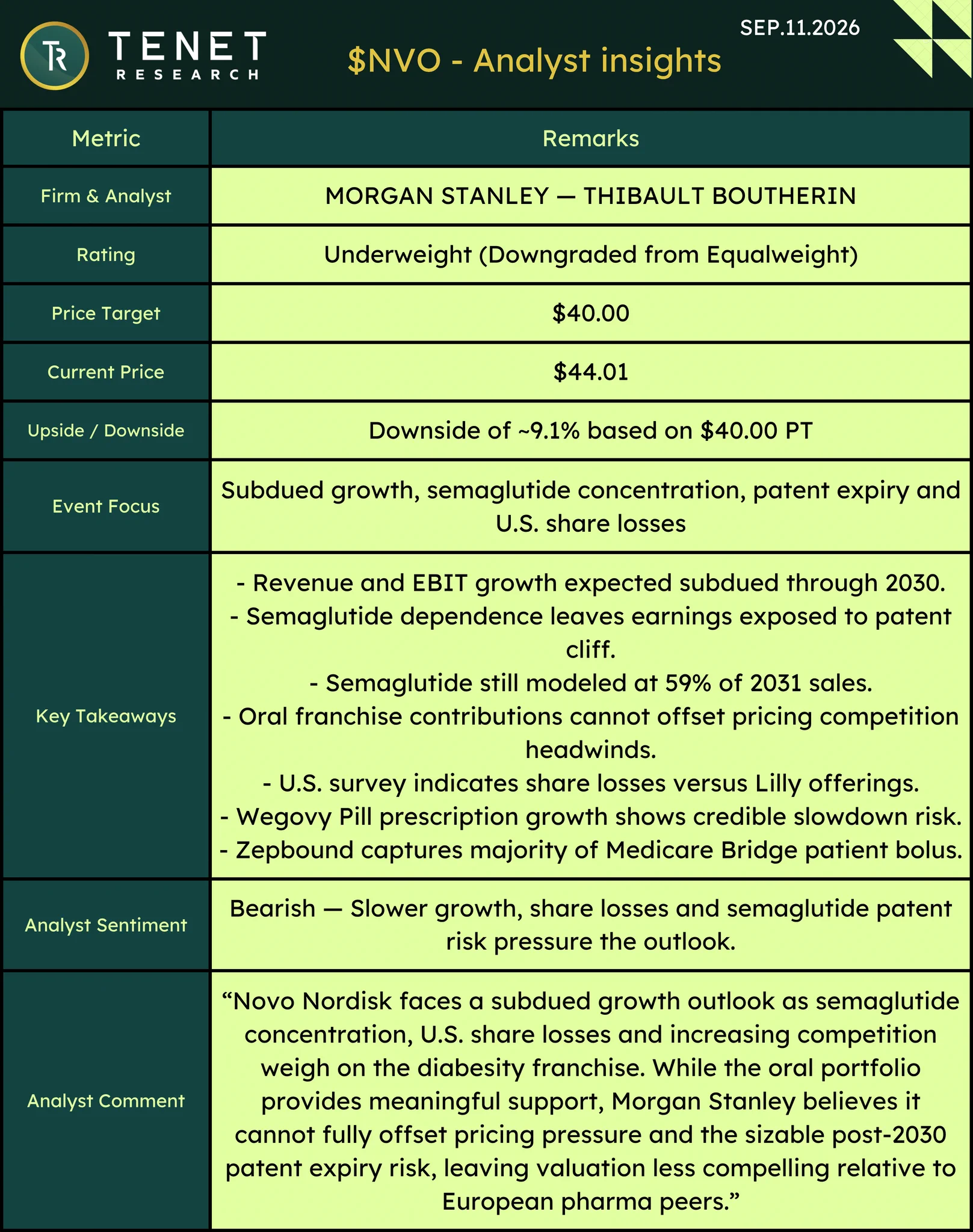
Key Points
1
Morgan Stanley projects semaglutide will still account for 59% of Novo Nordisk’s sales in 2031, when loss of exclusivity begins affecting the business.
2
The bank forecasts only 4% compound annual growth in both revenue and EBIT from 2027 through 2030, below its expectations for the broader European pharmaceutical industry of 4% revenue growth and 7% EBIT growth.
3
Morgan Stanley’s AlphaWise survey of 200 primary-care providers indicated that Novo could lose market share not only to Eli Lilly’s Zepbound, Mounjaro and Foundayo, but also to Lilly’s experimental next-generation obesity drug retatrutide beginning in 2027.
4
The bank said Novo’s oral-obesity pipeline could generate $10 billion in annual sales by 2031, but cautioned that this would not be enough to offset pricing pressure and competitive headwinds.
5
U.S. prescription data cited by Morgan Stanley suggested slower growth for Wegovy’s pill after a strong first half of 2026, while Eli Lilly’s Zepbound was capturing most of the demand from Medicare patients after the federal obesity-drug Bridge program began in June.
Morgan Stanley downgraded Novo Nordisk to Underweight, warning that the Danish drugmaker faces a looming crisis after 2030 when its blockbuster obesity drug semaglutide loses patent protection. Morgan Stanley cited subdued growth, high valuation, and fierce competition from Eli Lilly as reasons for the downgrade. Novo shares fell more than 2% on the news.
Semaglutide — the active ingredient in Ozempic and Wegovy — is projected to make up about 75% of Novo's revenue in 2026. Morgan Stanley warned that this heavy dependence on a single drug leaves the company vulnerable when generics arrive in the early 2030s, while Eli Lilly grabs market share with competing treatments like Mounjaro and Zepbound.
The Semaglutide Dependency Problem
Morgan Stanley projects that semaglutide will still account for 59% of Novo's sales in 2031, right when patent expirations kick in across Europe and the U.S. The bank forecasts only 4% annual growth in both revenue and operating profit through 2030. That lags the broader European pharma industry, which Morgan Stanley expects to grow 4% in revenue and 7% in profit over the same period.
Even Novo's oral-obesity pipeline — drugs taken as pills instead of injections — could generate $10 billion in annual sales by 2031, Morgan Stanley said. But that boost won't be enough to offset generic competition and price cuts when semaglutide loses exclusivity. The bank's price target remains $40 for U.S.-listed shares and 250 Danish crowns for Copenhagen-listed shares.
Eli Lilly Stealing Wegovy and Ozempic Patients
Morgan Stanley surveyed 200 primary-care doctors and found that Novo could lose market share not just to Eli Lilly's current drugs — Mounjaro, Zepbound, and Foundayo — but also to Lilly's experimental next-generation obesity drug retatrutide launching in 2027. U.S. prescription data cited by the bank showed Wegovy's pill slowing in growth after a strong first half of 2026, while Zepbound captured most demand from Medicare patients once the federal obesity-drug Bridge program began in June.
What Happens When Patents Expire
Patent cliffs can devastate pharma companies. When generic versions flood the market, prices plummet — sometimes by 80% or more. For Novo, semaglutide patents expire in early 2030s in the U.S. and Europe. Once that happens, cheap generics will compete directly with Novo's branded versions, slashing the company's profits and forcing it to pivot faster to new drugs. Morgan Stanley says Novo's pipeline isn't strong enough to fill that gap.
Sentiment
Mostly NegativeNEGATIVENEUTRALPOSITIVE
Publishers
13
Articles
39
Reach
52
A
AnonymousAuthor


