New European Arctic Strategy
European Leaders Urge Stronger Arctic Strategy Amid Rising Geopolitical Tensions
Anonymous
Key Points
1
The summit took place shortly after Norway seized a Russian vessel in the Svalbard archipelago at Ukraine’s request, an incident that drew condemnation from Russian President Vladimir Putin and underscored the region’s already heightened tensions.
2
German Chancellor Friedrich Merz said, “High north — and low attention — is over,” framing the summit as a response to Russia’s daily hybrid activities and expanding military capabilities in the Arctic.
3
The summit was also shaped by U.S. President Donald Trump’s repeated threats to bring Greenland, an autonomous Danish territory, under U.S. control, which has created diplomatic strain among Washington’s European allies.
4
The European Union’s Arctic strategy is being developed against a broader commercial backdrop that includes China’s growing trade through the region and the increased importance of the Northeast Passage after conflict around the Strait of Hormuz disrupted maritime routes.
5
Russia currently controls most of the Arctic’s icebreaking equipment, making Europe’s proposed expansion of icebreaker capacity not only an infrastructure issue but also a way to reduce dependence on a strategic rival.
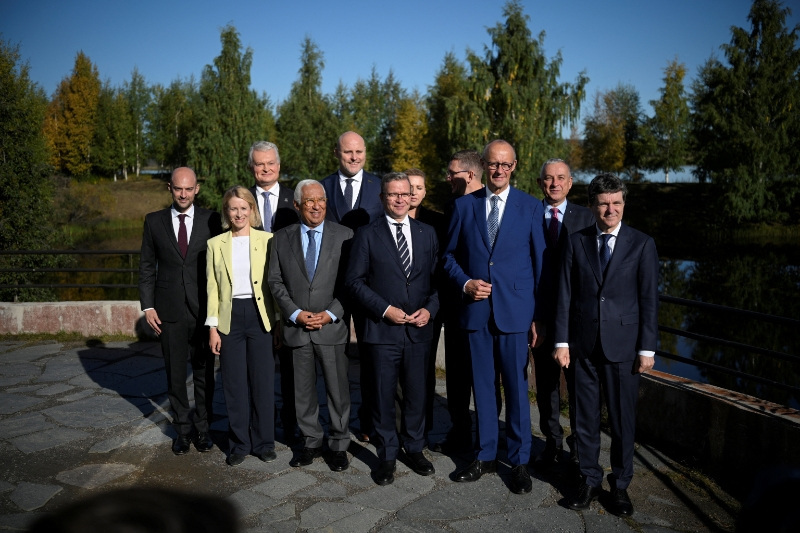
Twelve European countries gathered in Rovaniemi, Finland on September 13–14 to demand a stronger, more militarily focused European Union Arctic strategy. Hosted by Finnish Prime Minister Petteri Orpo and attended by German Chancellor Friedrich Merz, EU Council President António Costa, and foreign-policy chief Kaja Kallas, the summit marked a sharp pivot from the EU's 2021 Arctic policy, which emphasized climate and environment over security Associated Press.
The gathering came as Russia expands military bases, conducts hybrid attacks like GPS jamming, and controls most of the Arctic's icebreaker fleet. Leaders also flagged growing U.S. and Chinese commercial interest in the region, plus shipping disruptions in the Middle East that make Arctic routes increasingly valuable Deutsche Welle.
Russia's Military Buildup and Hybrid Threats Drive Summit
German Chancellor Friedrich Merz declared: "High north — and low attention — is over." He pointed to Russia's reopening of Soviet-era Arctic bases and daily hybrid operations targeting European infrastructure Associated Press. Kaja Kallas warned that Russia is conducting high-altitude missile tests and interfering with underwater cables and GPS systems across the region.
The summit convened days after Norway seized a Russian vessel in Svalbard at Ukraine's request—an incident that drew sharp condemnation from Putin and underscored Arctic tensions Associated Press. Finnish Prime Minister Orpo called Russia "the most significant and long-term threat to Arctic security and stability."
Europe Pushes for Arctic Icebreakers and Infrastructure Investment
Leaders called for expanded icebreaker capacity to protect trade routes and military access. Merz emphasized that icebreakers are "not just an issue for Finland" but "something for the entire European Union" EU Perspectives. Orpo proposed joint EU ownership of icebreakers to reduce Europe's dependence on Russia, which currently controls most Arctic icebreaking equipment.
The summit also demanded stronger surveillance, improved digital infrastructure, and better protection for critical assets. The EU has committed €200 million in support for Greenland TVP World, part of broader efforts to strengthen regional connectivity and resilience against Russian interference.
Trump's Greenland Threats and China's Growing Arctic Interest
U.S. President Donald Trump's repeated threats to bring Greenland—a Danish autonomous territory—under American control created diplomatic friction among NATO allies France 24. The threat prompted the EU to announce a €200 million support package for Greenland, signaling Europe's determination to maintain influence in the region.
Meanwhile, China is expanding commercial activity through the Northeast Passage as shipping bottlenecks in the Middle East's Strait of Hormuz drive interest in Arctic shortcuts TVP World. European leaders view this as part of a broader pattern of great-power competition reshaping the region.
New EU Arctic Strategy Expected This Fall With Security Focus
The Rovaniemi summit is expected to shape a revised EU Arctic strategy due in autumn 2026 Euractiv. Unlike the 2021 version, which prioritized climate and sustainability, the new strategy will emphasize military capability, surveillance, and defense infrastructure.
Romanian President Nicușor Dan proposed linking Arctic security with Black Sea challenges, arguing the two regions require coordinated defense and energy strategies Associated Press. Budgetary commitments for icebreakers, satellites, and dual-use infrastructure remain unallocated and will be negotiated as part of the EU's 2028–2034 budget cycle.
Sentiment
Mostly NegativeNEGATIVENEUTRALPOSITIVE
Publishers
57
Articles
221
Reach
278
A
AnonymousAuthor