UAE Flight Disruptions
UAE Airports Face Ongoing Flight Delays and Cancellations Amid Regional Security Advisories
Anonymous
Key Points
1
The European Union Aviation Safety Agency has kept a conflict-zone bulletin active for parts of the Gulf through late September, citing risks linked to tensions between the United States and Iran. The advisory does not close UAE airspace but is prompting more conservative routing and contingency planning.
2
The UAE aviation regulator has procedures for managing airport capacity during disruptions, including temporarily pausing departures from some regional airports bound for affected UAE hubs to reduce airborne holding and congestion.
3
Etihad said its Warsaw-to-Abu Dhabi flight EY160 on September 13 was cancelled after a delay caused by a technical issue, while its Abu Dhabi-to-Hanoi flight EY432 was delayed for operational reasons.
4
Emirates is offering eligible passengers complimentary date changes to Dubai and one free worldwide date change for tickets booked from April 2, 2026, subject to the airline’s terms and conditions.
5
Schedule filings and aviation analytics indicate that Etihad is still operating more than 90 percent of its originally filed frequencies for June through October 2026, despite capacity reductions and timing changes on selected routes.
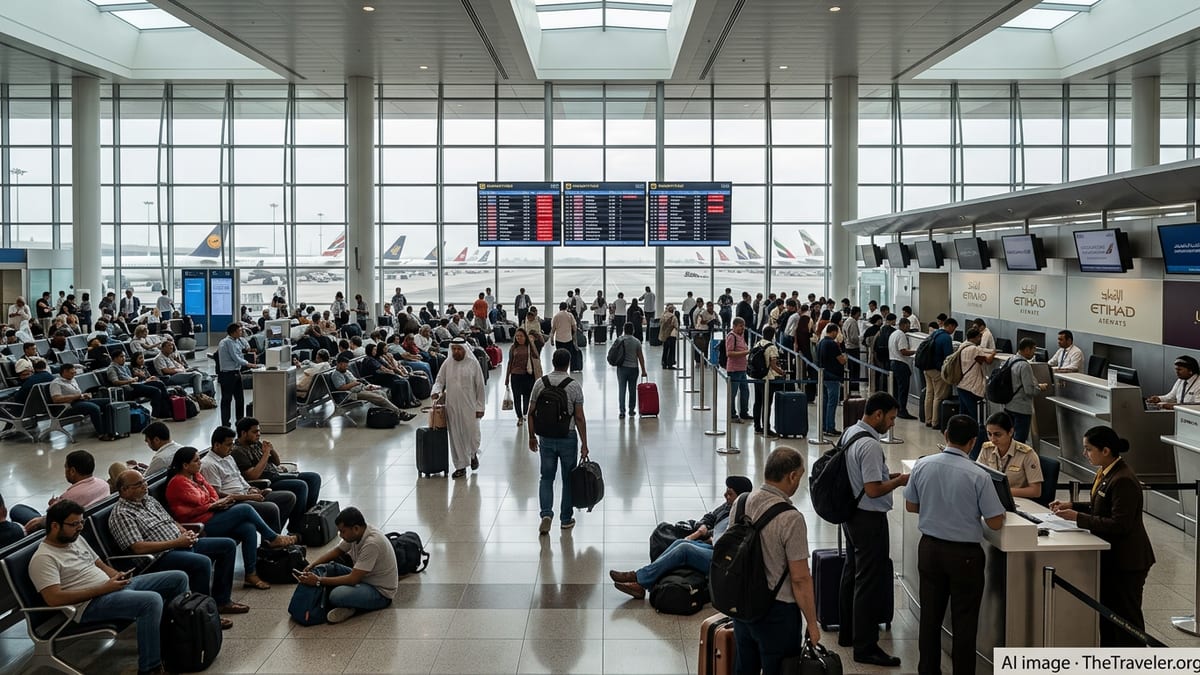
UAE airports remain open but are grappling with a wave of flight delays and cancellations that ripple across Dubai, Abu Dhabi, and Sharjah. Travel and Tour World reports over 60 cancellations and 1,130 delays affecting Middle East travel, with Emirates, Etihad Airways, and flydubai operating most services while Air Arabia cancelled select flights. The disruptions stem from regional security concerns, airspace advisories, and congestion rather than a full airport closure.
The Traveler confirms scattered delays and cancellations continue at Dubai International (DXB), Abu Dhabi's Zayed International (AUH), and Sharjah International (SHJ) airports on September 19, 2026. Airlines are rerouting around high-risk corridors and trimming schedules as regional tensions between the US and Iran persist. Passengers must check directly with their airline before heading to the airport, as schedules change at short notice.
EU Safety Alert Keeps Gulf Routes Under Scrutiny
The European Union Aviation Safety Agency maintains a conflict-zone bulletin for parts of the Gulf through late September. This advisory flags risks tied to US-Iran tensions but does not close UAE airspace. Instead, it pushes airlines toward more conservative routing and contingency planning to avoid high-risk areas.
Etihad and Emirates Scale Back Schedules
Etihad cancelled its Warsaw-to-Abu Dhabi flight EY160 on September 13 due to a technical issue, and delayed its Abu Dhabi-to-Hanoi flight EY432 for operational reasons. Despite disruptions, schedule filings show Etihad still operates over 90 percent of originally planned frequencies from June through October 2026, with timing changes on select routes. Emirates offers eligible passengers free date changes to Dubai and one complimentary worldwide rebooking for tickets booked from April 2, 2026.
Airspace Capacity Controls Reduce Ground Congestion
UAE aviation regulators are managing airport capacity by temporarily pausing some departures from regional airports bound for affected UAE hubs. This tactic cuts airborne holding time and eases congestion. The Traveler notes that several international carriers maintain suspensions on select UAE routes, while others like flydubai continue serving destinations including Bahrain, Kuwait, and long-haul markets despite schedule uncertainty.
Passengers Face Repeated Checks and Short-Notice Changes
With regional demand and airport traffic remaining high, travelers face constant schedule shifts. Travel and Tour World and The Traveler both warn passengers to contact their airline multiple times before departing for the airport. Flight status can change hours or minutes before departure, and only airlines have real-time, accurate information on whether a flight will depart as scheduled, delay, or cancel.
Sentiment
Mostly NegativeNEGATIVENEUTRALPOSITIVE
Publishers
21
Articles
14
Reach
35
A
AnonymousAuthor


