Football Prediction Market Rules
Prediction markets launch for upcoming football games with detailed rules for settlement and cancellations.
Anonymous
Key Points
1
For the Las Vegas–Kansas City two-touchdown player market, only rushing and receiving touchdowns credited to the named player count; a quarterback does not get credit for a touchdown pass, and defensive or special-teams touchdowns count only toward a listed D/ST outcome. Overtime statistics are included.
2
In that player-touchdown market, a player who is active but never enters the game settles as “No.” If the player is inactive or ruled out before kickoff, the contract is canceled and settled at its pre-cancellation volume-weighted average price; settlement uses the data provider’s final statistic, with later corrections disregarded.
3
The Denver–San Francisco full-game total includes overtime. If a shortened or suspended game is declared final and the source agency records a total, that total determines settlement; if the game remains unfinished, contracts stay open until completion only if it occurs before the contract’s expiration.
4
For the Denver–San Francisco total, if the game is canceled or the contract expires before the game is completed, settlement is based on fair market value as determined by Rothera. The article also identifies certain team personnel and league officials as restricted persons under the market rules.
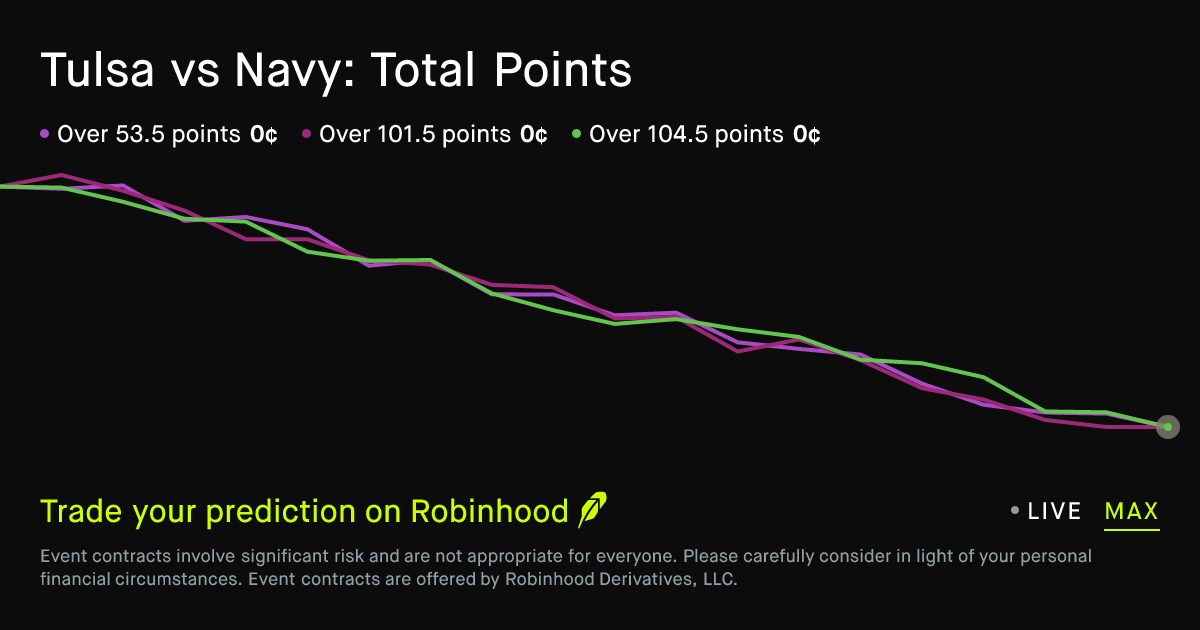
Prediction markets have opened on five scheduled October 2026 football games, offering contracts on player touchdowns, scoring totals, and game outcomes Robinhood. The markets cover NFL matchups between Houston–Dallas, Buffalo–New England, Kansas City–Las Vegas, and Denver–San Francisco, plus a college game between Tulsa and Navy. Each market has detailed settlement rules for overtime, postponements, and incomplete games.
These contracts let traders bet on specific outcomes like whether a player scores 2+ touchdowns or the total points in a game Robinhood. A tied third quarter pays both sides $0.50 per contract. If a game is canceled or incomplete when the contract expires, settlement uses fair market value determined by Rothera.
Player Touchdown Markets Count Rushing and Receiving Only
In the Kansas City–Las Vegas touchdown market, only rushing and receiving touchdowns count toward a player's total Robinhood. Quarterback touchdown passes do not qualify. Defensive and special-teams touchdowns count only if they involve a listed D/ST outcome.
A player who is active but never enters the game settles as "No" Robinhood. If the player is ruled out or inactive before kickoff, the contract is canceled and settled at its pre-cancellation volume-weighted average price. Overtime statistics are included in final tallies.
Three-Quarter Scoring Markets Handle Ties Equally
Several markets track third-quarter scoring, with special rules for ties Robinhood. If the third quarter ends in a tie, both "Yes" and "No" sides receive $0.50 per contract, splitting the payout evenly.
These markets settle using official statistics from the game's data provider Robinhood. Later corrections to the record are disregarded once settlement occurs. Postponed games that resume before contract expiration settle normally using final stats.
Full-Game Totals Include Overtime and Shortened Games
The Denver–San Francisco full-game total includes all points scored in overtime Robinhood. If the game is shortened or suspended but declared final, settlement uses the total recorded by the source agency at that time.
If a game remains unfinished when the contract expires, it stays open only if completion occurs before expiration Robinhood. If the game is canceled or the contract expires first, settlement relies on fair market value as determined by Rothera. Certain team personnel and league officials are barred from trading.
Sentiment
Mostly NegativeNEGATIVENEUTRALPOSITIVE
Publishers
16
Articles
7
Reach
23
A
AnonymousAuthor


