Tetris Copyright Dispute
The Tetris Company Condemns White House Arcade Game Over Divisive Border Theme
Anonymous
Key Points
1
The arcade included additional named clones beyond “Build the Wall,” including “Flappy Bill,” modeled on Flappy Bird, and “Rio Run,” based on Snake; the White House said more games were forthcoming.
2
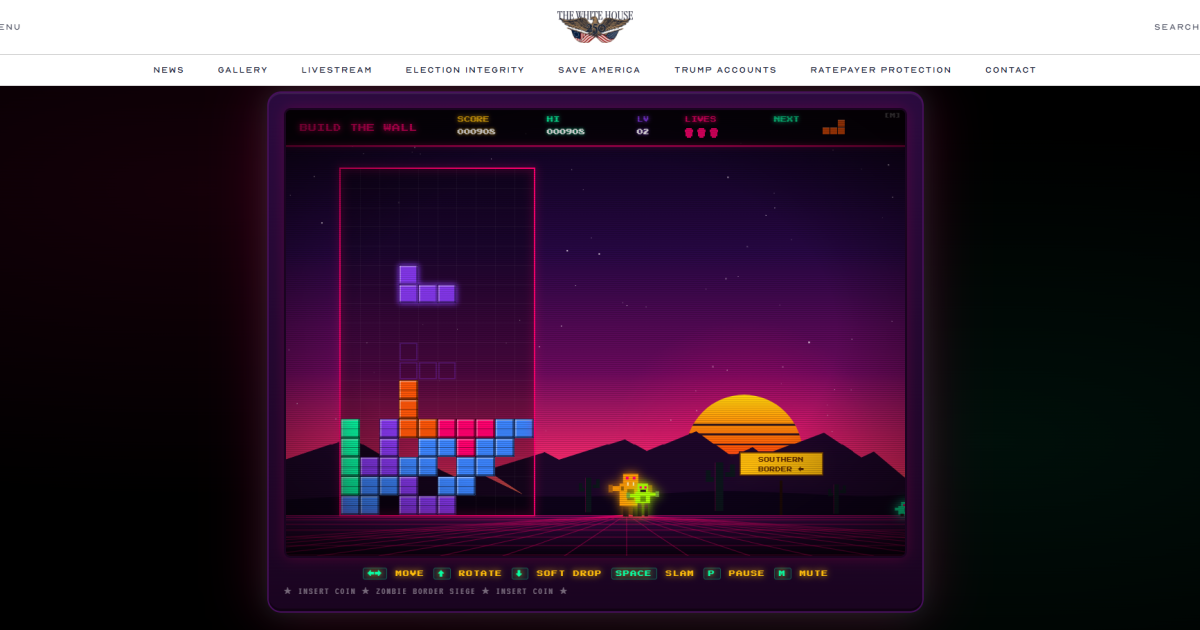
The “Build the Wall” game was labeled “ZOMBIE BORDER SIEGE,” and depicted the people approaching the border as zombie-like foreigners, adding a dehumanizing visual element beyond its Tetris-style mechanics.
3
The Tetris Company said the game’s objective traditionally is to “stack with purpose to clear as many lines as possible,” contrasting that gameplay tradition with the administration’s political use of the format.
4
Tetris is a major global brand: more than 520 million units have been sold, billions of games are played online annually, and Alexey Pajitnov, the Soviet programmer who created the original game, remains actively involved.
5
The Tetris brand’s rights are owned worldwide by Tetris Holding LLC, while The Tetris Company serves as its exclusive licensee; its licensing network includes major publishers such as Nintendo and Sega.
The Tetris Company has warned the White House that its new Arcade.gov site may infringe on its copyright, specifically targeting a game called "Build the Wall" that uses block-stacking mechanics nearly identical to Tetris. 8 News Now reported that the game asks players to stack blocks to stop migrants from reaching the southern border, a political message the company said it does not endorse.
The White House launched the arcade as a way to present President Trump's policies through retro-style games. The Tetris Company stressed it was not involved in creating the game and criticized its divisive messaging, warning that it takes copyright violations seriously. The company has not yet confirmed whether it will pursue legal action.
The Game That Looks Too Much Like Tetris
The White House arcade includes "Build the Wall," officially labeled "Zombie Border Siege." The Gateway Pundit noted that the game depicts approaching migrants as zombie-like creatures while using the distinctive block-stacking format Tetris pioneered. Players must stack blocks to create barriers—a mechanic that directly mirrors Tetris's core gameplay.
The Tetris Company emphasized that Tetris is meant to "stack with purpose to clear as many lines as possible"—pure puzzle-solving, with no political aim. The company highlighted that over 520 million Tetris units have sold worldwide and billions of games are played online annually. This scale makes the brand's meaning and reputation critical to protect.
A Broader Pattern of Game Knockoffs
The White House arcade did not stop at one imitation. News Nation Now reported that the site includes "Flappy Bill," modeled on the viral game Flappy Bird, and "Rio Run," based on the classic Snake. The White House announced that more games would be forthcoming, suggesting a systematic effort to adapt familiar gaming formats to policy messaging.
These games were designed to make policy accessible and entertaining. By using retro visual styles and recognizable mechanics, the arcade lowered the barrier to engagement. Players interact with political messaging repeatedly—constructing barriers, managing resources, and completing objectives tied to administration priorities.
Why Tetris Cares About More Than Just Lawyers
The Tetris Company's response focused on disconnection and principle rather than immediate legal threats. WGNO reported that Tetris Holdings denied involvement and emphasized the company's global brand standing. For a franchise linked to cross-generational play and cultural connection, association with anti-immigration content risks alienating players and confusing endorsement.
Tetris Holding LLC owns the brand worldwide while The Tetris Company acts as exclusive licensee. Its partnership network includes major publishers like Nintendo and Sega. Any appearance of endorsement for the White House arcade could damage those relationships and weaken the company's control over what Tetris means to its global audience.
Sentiment
Mostly NegativeNEGATIVENEUTRALPOSITIVE
Publishers
19
Articles
31
Reach
50
A
AnonymousAuthor


