Personal AI Supercomputer
AMD Unveils Threadripper Halo Station to Run Trillion-Parameter AI Locally
Anonymous
Key Points
1
AMD executive Jack Huynh said the workstation is designed to run AI models with more than 1 trillion parameters and described it as “about as close as you can get to a personal supercomputer.”
2
Each Instinct MI350P accelerator provides 144GB of HBM3E memory, up to 4TB/s of memory bandwidth and a rated board power of up to 600 watts, underscoring the system’s demanding performance and energy requirements.
3
The demonstrated workstation appears to have been assembled from existing commercial components, including Asus’ Pro WS WRX90E-Sage SE motherboard and a Phanteks Enthoo Pro 2 case capable of holding two ATX power supplies; a fully equipped system could require more than 3,000 watts.
4
The Threadripper Halo Station is positioned as a higher-performance counterpart to AMD’s smaller Ryzen AI Halo systems, while potentially competing with Nvidia’s DGX Station products, which support models of up to 1 trillion parameters and start at roughly $100,000.
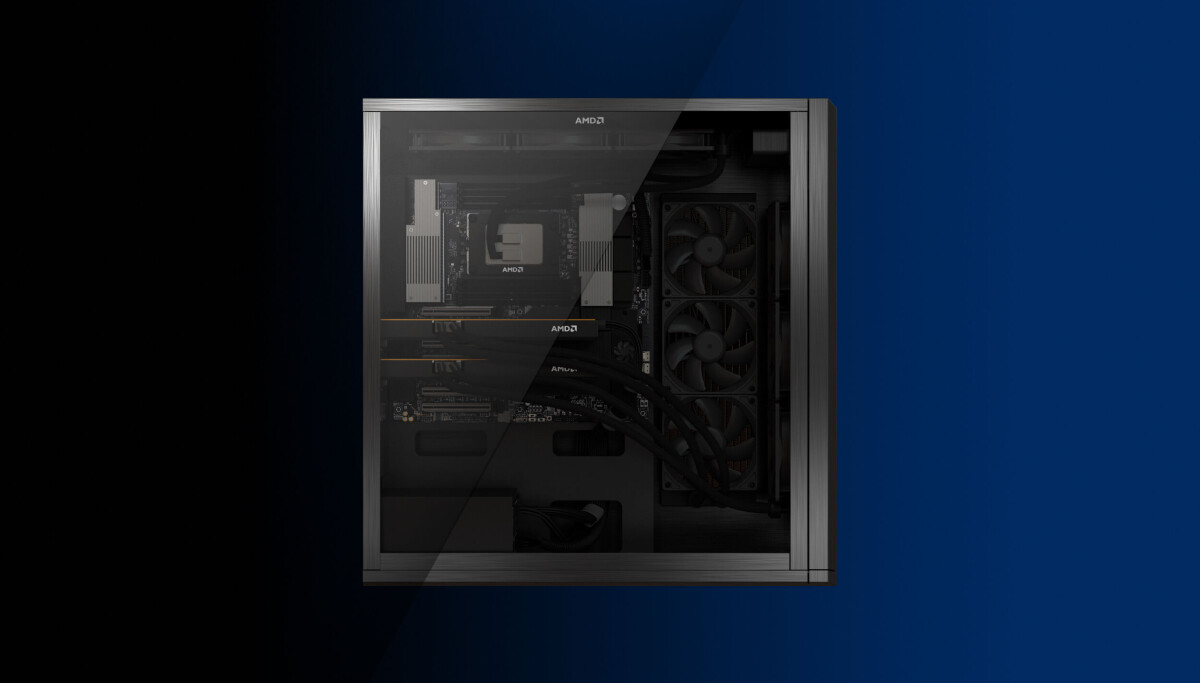
AMD unveiled the Threadripper Halo Station at IFA 2026, a liquid-cooled workstation built to run AI models with over 1 trillion parameters entirely on local hardware rather than through cloud services. PCMag reports the system combines a 96-core Ryzen Threadripper PRO 9995WX processor with up to four Instinct MI350P accelerators, delivering as much as 576GB of GPU memory and 2TB of DDR5 system memory for researchers and businesses who want to keep their data private.
AMD executive Jack Huynh called it Newsy Today reports "about as close as you can get to a personal supercomputer." The system demands serious power—up to 3,000 watts when fully configured. AMD has not announced pricing or a release date, though competitors like Nvidia's DGX Station start around $100,000.
A Liquid-Cooled Machine for Trillion-Parameter Models
The demonstrated Threadripper Halo Station sits on an Asus Pro WS WRX90E-Sage SE motherboard inside a Phanteks Enthoo Pro 2 case. TRIVIDI DIGITAL notes the system pairs the 96-core Threadripper processor with two Instinct MI350P accelerators in its shown configuration, though the design supports four. Each accelerator packs 144GB of HBM3E memory and delivers up to 4TB/s of memory bandwidth.
The setup targets developers, researchers, and enterprises running inference—the process of using trained AI models to make predictions. The Register describes it as a premium workstation for "researchers with deep pockets." Running such massive models locally gives organizations tighter control over proprietary data and avoids cloud service fees.
Power and Cooling Present Real-World Challenges
Each Instinct MI350P accelerator draws up to 600 watts of board power alone. A fully configured Threadripper Halo with four accelerators could demand more than 3,000 total watts, requiring specialized power supplies and cooling infrastructure. Newsy Today reports the liquid-cooling system is essential to handle the thermal load from so many high-performance components running simultaneously.
The substantial power and cooling requirements make this machine impractical for most home offices or small labs. PCMag notes the Threadripper Halo is explicitly a specialized tool for well-funded teams—not a mass-market product. AMD has not released pricing, but the engineering complexity and component cost suggest a six-figure price tag.
Positioning Against Nvidia and Smaller AI Systems
AMD's Threadripper Halo competes directly with Nvidia's DGX Station line, which also supports trillion-parameter models and starts around $100,000. Head Topics explains the Threadripper Halo is positioned as a higher-performance upgrade to AMD's smaller Ryzen AI Halo systems. It targets organizations that need more processing muscle than consumer-grade AI PCs but prefer avoiding cloud dependencies.
The system fills a gap for AI researchers, machine learning engineers, and enterprises developing proprietary models. TRIVIDI DIGITAL notes that local inference means faster response times and no cloud outages. However, without an announced release date or price, potential buyers must wait to see whether AMD's vision matches real-world performance and cost.
Sentiment
Mostly PositiveNEGATIVENEUTRALPOSITIVE
Publishers
13
Articles
7
Reach
20
Topics
A
AnonymousAuthor


