BRICS Open-Source AI Strategy
China unveils open-source artificial intelligence initiative for BRICS nations to expand Global South access.
Anonymous
Key Points
1
The AI plan was one of five proposals announced by Xi Jinping at the BRICS outreach session. The other initiatives focused on trade and investment facilitation, digital industries, intelligent manufacturing, and science and technology talent.
2
The expanded BRICS grouping includes Iran, Indonesia, Egypt, Ethiopia and the United Arab Emirates as full members, in addition to Brazil, Russia, India, China and South Africa, and has roughly 10 partner countries.
3
Indian Prime Minister Narendra Modi said BRICS-developed solutions should be adapted and made accessible beyond the bloc to address the needs of the wider Global South, while Russian President Vladimir Putin characterized BRICS as a force for a more multipolar world order.
4
Alibaba CEO Eddie Wu said the company would expand AI infrastructure investment beyond its previously pledged $53 billion, while Alibaba aims for its open-source Qwen model family to become a foundational technology layer with ubiquity comparable to Android.
5
At the Apsara Conference, Li Auto demonstrated a vehicle equipped with what it described as China’s first in-car AI agent able to order coffee by voice, and startup Galbot showed a robot serving refreshments to attendees.
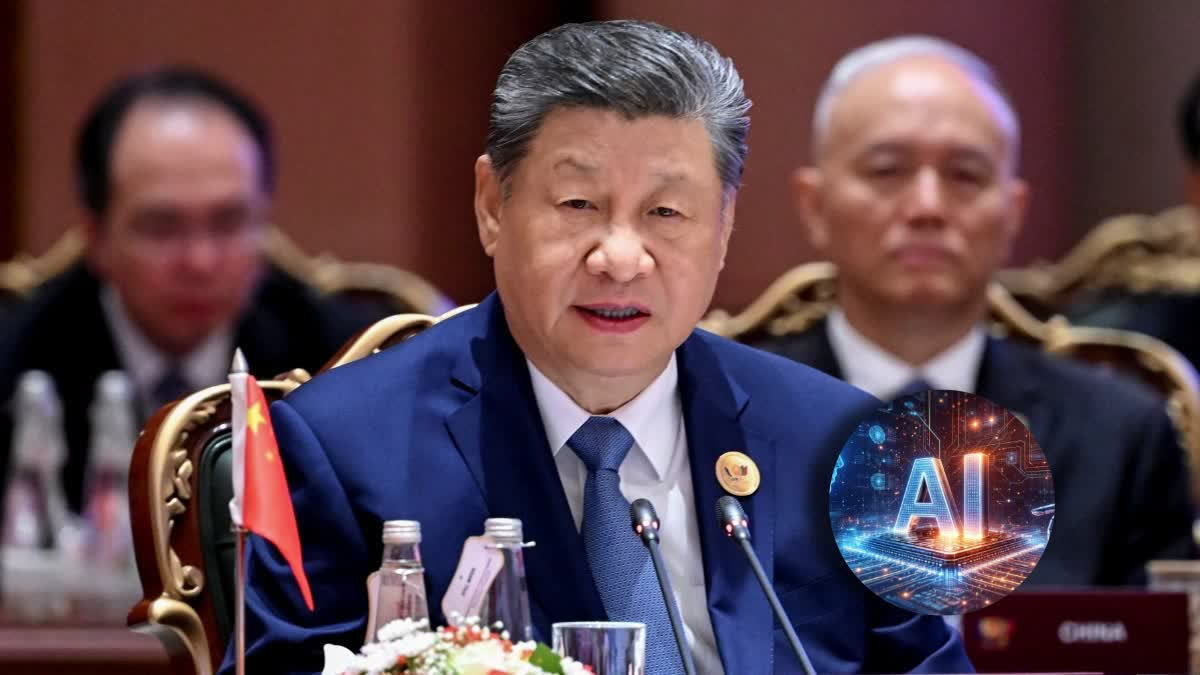
China is building an open-source AI platform for BRICS nations to compete with closed U.S. tech companies. ETV Bharat reported that President Xi Jinping announced the initiative at the BRICS summit in New Delhi, promising joint development of large language models and AI governance cooperation among the 10 BRICS members and 10 partner countries.
The move targets the Global South with cheaper, more accessible AI alternatives. China Daily highlighted China's push into embodied AI—robots that perceive, reason, and act in the physical world—including medical AI agents serving remote clinics and autonomous robots for hazardous work.
Five Proposals Beyond AI Cooperation
Xi's AI initiative was just one of five proposals unveiled at the BRICS outreach session. Eastern Herald reported that the other four focused on trade and investment facilitation, digital industries, intelligent manufacturing, and science and technology talent development across member nations.
The expanded BRICS bloc now includes Iran, Indonesia, Egypt, Ethiopia, and the UAE as full members, alongside the original five nations of Brazil, Russia, India, China, and South Africa. This broader coalition gives the initiative reach across multiple continents and economies.
Modi and Putin Back Multipolar AI Future
Indian Prime Minister Narendra Modi said BRICS-developed AI solutions must be adapted for the wider Global South beyond the bloc itself. Eastern Herald reported Modi's call for technologies that address needs across the developing world, signaling support for the open-source vision.
Russian President Vladimir Putin framed BRICS as a force for a more multipolar world order. The framing positions the AI initiative as part of a broader challenge to U.S. technological dominance and Western-led global systems.
Alibaba Pledges Massive Infrastructure Expansion
Alibaba CEO Eddie Wu announced the company would boost AI infrastructure investment beyond its previous $53 billion commitment. Bastille Post covered Alibaba's plans to scale embodied AI at the 2026 China International Fair for Trade in Services, where over 1,800 companies showcased AI innovations.
Alibaba's open-source Qwen model aims for ubiquity comparable to Android, serving as a foundation for AI agents, vehicles, robotics, and commercial technologies. Li Auto demonstrated a vehicle with China's first in-car AI agent that orders coffee by voice, while startup Galbot showed a robot serving refreshments.
Sentiment
Mostly PositiveNEGATIVENEUTRALPOSITIVE
Publishers
21
Articles
16
Reach
37
A
AnonymousAuthor


