US-India Trade Talks
Modi and Trump Review Trade and Energy Ties Amid Russian Oil Concerns
Anonymous
Key Points
1
The call was Modi and Trump’s first conversation since April, and their first since Trump signed the law expanding authority to impose tariffs on countries importing Russian energy.
2
India’s Foreign Minister S. Jaishankar had raised New Delhi’s concerns about the sanctions law directly with U.S. Secretary of State Marco Rubio during talks in New York; India warned that measures targeting its Russian energy trade could affect bilateral ties and international energy markets.
3
Russian crude shipments to India were about 2.1 million barrels per day in August and were expected to decline to around 1.75 million barrels per day in September, amid tighter export availability and greater competition from Chinese refiners.
4
Goyal’s U.S. visit included a roundtable with executives from American manufacturing and technology companies hosted by the National Association of Manufacturers, alongside his trade-ministerial meetings.
5
The leaders discussed regional conflicts including West Asia and the Russia-Ukraine war, according to government sources cited by Business Standard.
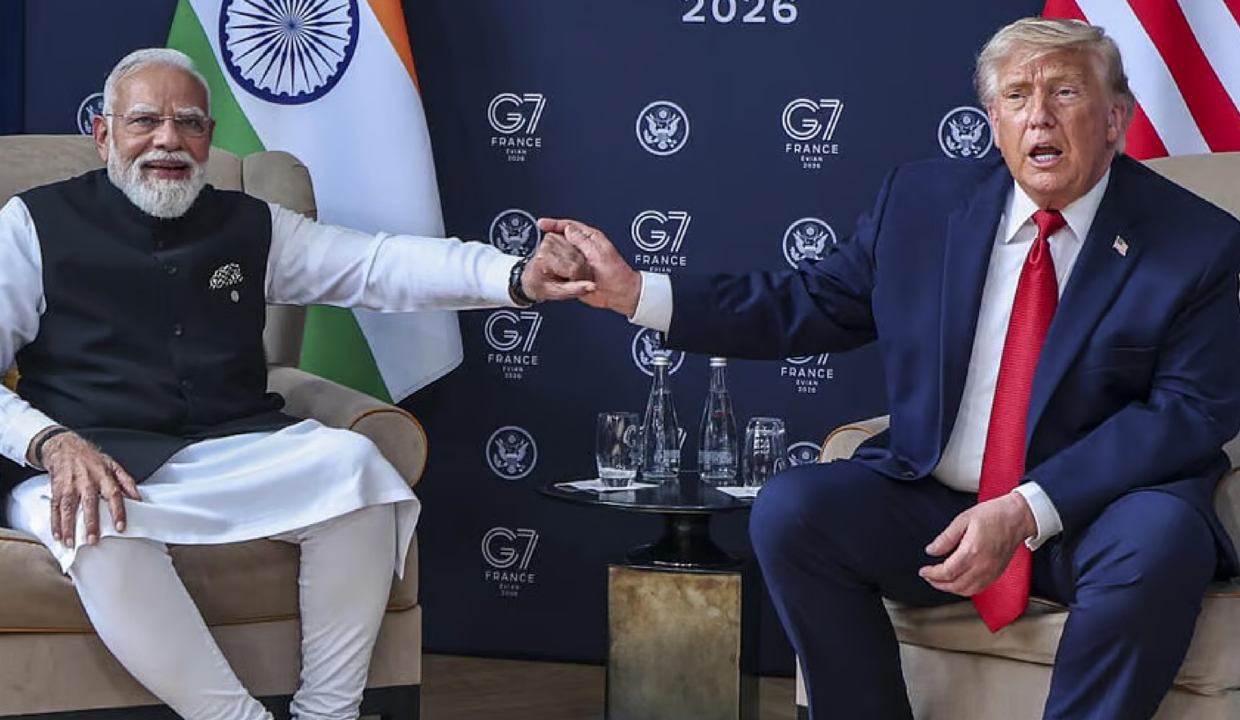
Indian Prime Minister Narendra Modi and U.S. President Donald Trump spoke by phone on September 30, reviewing trade, defense, energy, and technology cooperation as the countries pursue a bilateral trade deal. Business Standard reported the call marked their first direct conversation since April and came after the U.S. enacted tough new tariff authority targeting countries that buy Russian energy—a law that directly threatens India's energy security.
The timing is tense. India's Russian crude imports—a critical energy source—stood at 2.1 million barrels per day in August and are expected to drop to 1.75 million barrels per day in September. Business Standard noted India has warned Washington that tariffs on its Russian oil trade could damage bilateral relations and shake global energy markets.
A New Law Creates Immediate Friction
President Trump signed the Lindsey O. Graham Sanctioning Russia and Iran Act (SRIA) on September 18, granting authority to impose tariffs up to 100% on nations importing Russian energy Business Standard. India, which relies on Russian crude for economic and energy security, immediately flagged concerns. External Affairs Minister S. Jaishankar raised the issue directly with U.S. Secretary of State Marco Rubio at the UN General Assembly on September 23, Filter Coffee reported.
New Delhi warned that punitive measures could undermine the broader India-U.S. strategic partnership and destabilize global energy markets Business Standard. The Indian government affirmed it will take all necessary steps to protect domestic energy security, signaling New Delhi will not simply comply if tariffs are imposed.
Trade Talks Advance Amid Disagreements
Commerce Minister Piyush Goyal traveled to the U.S. on September 29 for the G20 Trade Ministers' meeting and bilateral trade negotiations Briefs Finance. He addressed a National Association of Manufacturers roundtable, touting "strong momentum in India-U.S. economic ties," Filter Coffee reported. Annual bilateral trade reached $132.2 billion in fiscal year 2025–26, with August merchandise exports to the U.S. rising 21.83% year-over-year to $8.4 billion.
U.S. Trade Representative Jamieson Greer is negotiating an interim bilateral trade agreement with Goyal Business Standard. Sources indicate the deal is "90%-plus" complete, but disagreements persist over tariff structures and market access. The two sides aim to finalize terms during G20 sessions in Milwaukee, though energy tensions loom as a potential dealbreaker.
Modi and Trump's Diplomatic Balancing Act
Both leaders used the September 30 call to reset the relationship after SRIA's passage. The Hindu reported Modi called the conversation "productive" and reiterated commitment to advancing the Comprehensive Global Strategic Partnership. Trump, meanwhile, signaled willingness to work around the energy issue—a senior U.S. official told The Wire there were "no hard feelings" over Indian purchases and pitched U.S. energy exports as an alternative.
The leaders discussed regional conflicts, including West Asia and the Russia-Ukraine war, affirming a shared interest in global peace and security Business Standard. U.S. Secretary of State Marco Rubio plans to visit India in October, and Modi is scheduled to visit the U.S. for the G20 Summit in Florida in December 2026. These high-level meetings will test whether the two powers can bridge their energy and trade differences.
India Prepares for Worst-Case Tariff Scenario
Indian refiners are already hedging against potential tariffs by diversifying crude sources Mint reported. Russia supplied 33% of India's crude in September, but refiners have requested that New Delhi negotiate a grace period or specific purchase quotas to transition contracts smoothly if tariffs are imposed The Wire. The diversification effort signals New Delhi expects U.S. pressure to persist regardless of diplomatic niceties.
Sentiment
Mostly NegativeNEGATIVENEUTRALPOSITIVE
Publishers
55
Articles
59
Reach
114
A
AnonymousAuthor


