Electric 550 Spyder Tribute
Porsche and Hedley Studios Revive Iconic 550 Spyder as Electric Tribute
Anonymous
Key Points
1
The original 550 helped establish Porsche’s motorsport identity after Hans Herrmann and Jaroslav Juhan finished third and fourth overall—and won their class—in the 1954 Carrera Panamericana, a result that inspired Porsche’s later use of the “Carrera” name.
2
The 550 J is based specifically on the later 550 A’s stiffer steel space-frame design, rather than simply replicating the original 550’s ladder chassis.
3
Hedley used Porsche’s corporate archives, 3D scans of cars in the Porsche museum and original technical drawings to reproduce the shape and details of the 550’s aluminum body in carbon fiber.
4
The optional RS package adds drilled brake discs and adjustable Bilstein dampers, while the car also uses modern coilover dampers, Eibach springs, Brembo brakes and Continental tires.
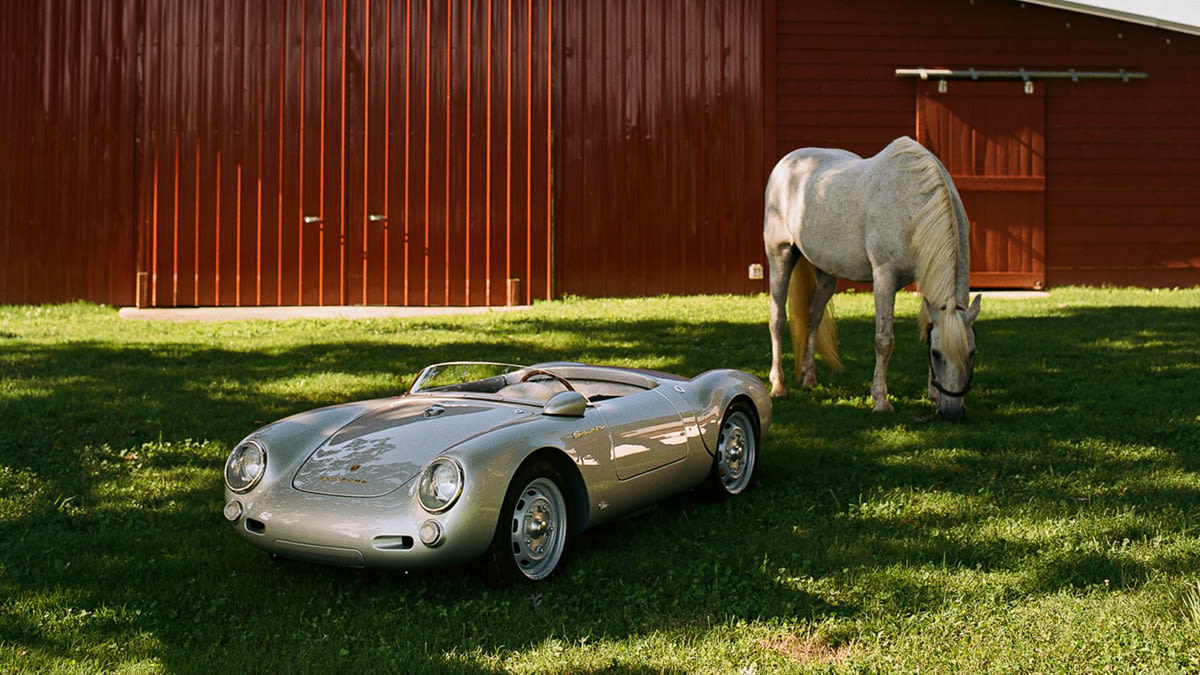
Porsche and British builder Hedley Studios have officially revived the legendary 550 Spyder as an electric tribute car called the 550 J. Yahoo Autos reports the hand-built, 80-percent-scale model uses carbon-fiber bodywork and a 48-volt electric motor producing 11 horsepower, with a top speed of 40 mph and roughly 30 miles of range. The original 550, produced in only 90 examples from 1953 to 1956, became famous for its racing success and its connection to actor James Dean.
Hedley will build exactly 250 of the 550 J vehicles in the UK, with deliveries starting in early 2027 and prices beginning at about £69,500—roughly $94,000 before taxes. Yanko Design notes the car was created to celebrate the 75th anniversary of Porsche Motorsport. The 550 J is not street-legal and is designed for private estates, closed circuits, and collector enthusiasts seeking a piece of racing history in miniature form.
How the Original 550 Shaped Porsche Racing
The 1950s Porsche 550 was a lightweight, mid-engined racing car that helped establish Porsche's motorsport reputation. In the 1954 Carrera Panamericana—a famous Mexican road race—the 550 finished third and fourth overall and won its class. This success inspired Porsche to later name an entire model line 'Carrera' after the race. The 550's victories proved that smaller, nimble cars could compete with far heavier competitors.
Electric Power in a Scaled-Down Package
The 550 J shrinks the original to 80 percent of its size while swapping the vintage engine for modern electric power. The base model delivers 11 horsepower and hits 40 mph, good enough for estate roads and closed circuits. An optional RS package bumps output to 22 horsepower, raises the top speed to 50 mph, and extends range to roughly 50 miles. Free York explains the car uses a steel tubular space-frame chassis with modern suspension and Brembo brakes for safety and handling.
Faithful Details Built From Porsche Archives
Hedley Studios used Porsche's corporate archives and 3D scans of original cars in the Porsche museum to design the 550 J. Engineers studied original technical drawings to recreate the iconic shape and details in carbon fiber instead of aluminum. The 550 J is based on the later 550 A model, which used a stiffer steel space-frame rather than the original's ladder chassis. Buyers can customize nearly every detail, from paint to interior trim, making each car unique.
Track Car, Not a Road Car
The 550 J is not homologated or registered for public roads. Yahoo Autos confirms it is intended strictly for private estates, closed circuits, and track days. This limits its use but positions it as a premium collector's vehicle for enthusiasts with access to private property or racing venues. The two-seater design and lightweight construction keep it nimble in tight spaces, perfect for spirited driving without highway regulations.
Sentiment
Mostly PositiveNEGATIVENEUTRALPOSITIVE
Publishers
19
Articles
17
Reach
36
Topics
A
AnonymousAuthor


