TSMC in Terafab Talks
Elon Musk confirms TSMC is in preliminary discussions to join the massive Terafab semiconductor project.
Anonymous
Key Points
1
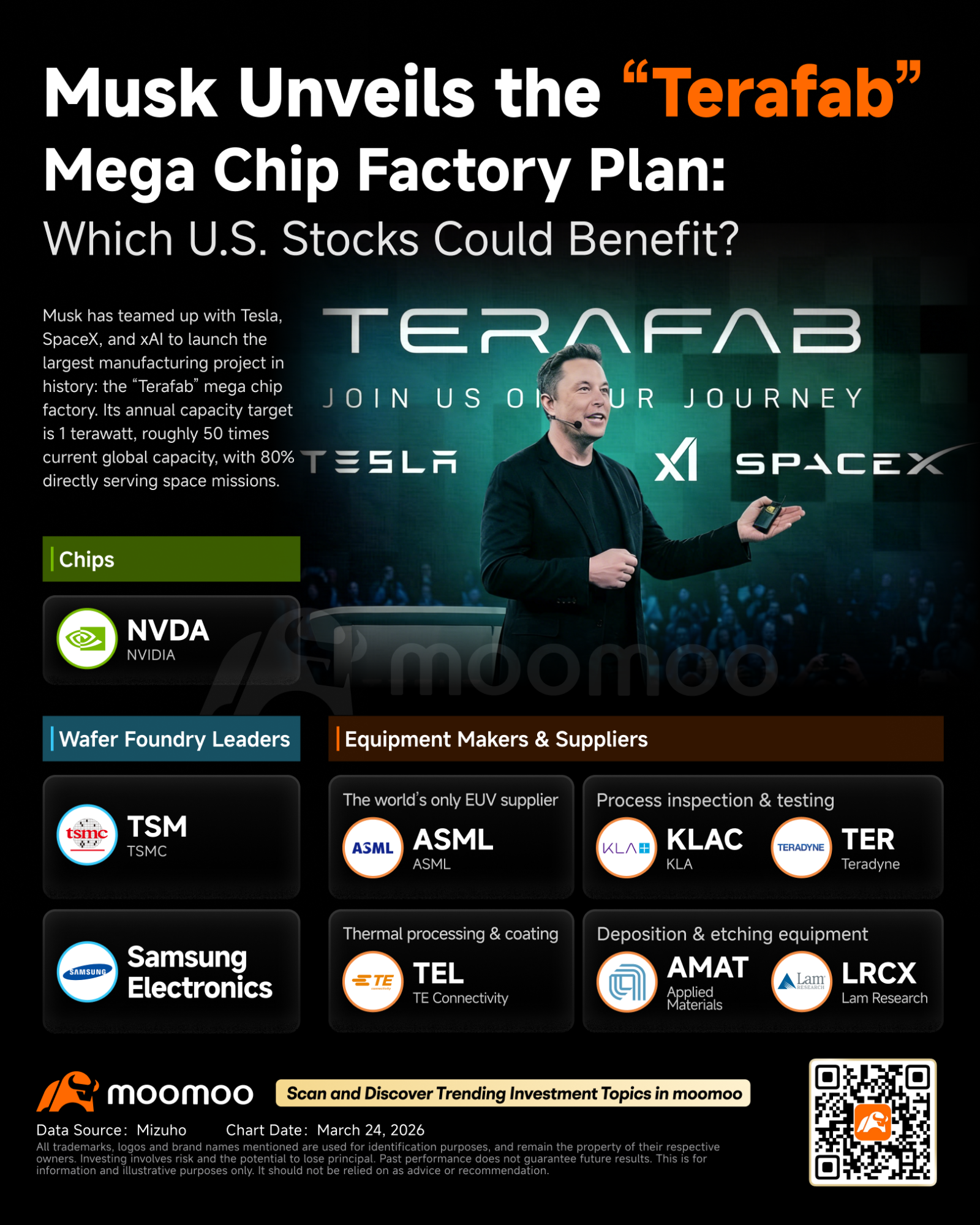
Terafab is targeting annual output of about one terawatt of computing capacity, with chips intended for applications including Tesla’s Optimus robots and Cybercab vehicles, SpaceX data centers, and xAI.
2
The planned main site is in Grimes County, Texas; the first phase is estimated to cost about $16.8 billion and the project aims to create at least 3,000 jobs. A prototype facility is already underway at Tesla’s Giga Texas in Austin.
3
Intel’s role as Terafab’s first manufacturing partner includes contributing its advanced 14A process technology.
4
Musk described the TSMC discussions as “Just discussions, but something may come of it.” Taiwan News also reported that TSMC’s Texas plans were expected to be a topic at the company’s October 15 earnings conference.
Elon Musk confirmed that Bloomberg Taiwan Semiconductor Manufacturing Co. is in early-stage talks to join Terafab, his Texas-based chip factory backed by Tesla, SpaceX, and xAI. No deal has been struck. Musk said on social media: X
The news rattled Intel shares, which fell about 4% on Finance Yahoo, while TSMC edged higher. Intel remains Terafab's first named manufacturing partner, supplying its advanced 14A chip-making process. Terafab aims to produce one terawatt of computing capacity annually for Musk's AI robots, vehicles, data centers, and satellites.
Musk's Semiconductor Ambitions Demand Multiple Suppliers
Terafab was born from a critical gap: Musk's companies need up to 200 billion AI chips yearly, but existing foundries can't meet that demand Bloomberg. The project's main facility will sit in Grimes County, Texas, with an estimated first-phase cost of $16.8 billion. Musk described the TSMC talks as preliminary: X"Just discussions, but something may come of it."
A prototype facility is already running at Tesla's Giga Texas in Austin Drive Tesla Canada. The full project could create 3,000 jobs and eventually require up to $119 billion in total investment. Musk has signaled that any TSMC role would be supplemental to Intel's core manufacturing partnership.
What TSMC Could Contribute to the Texas Project
TSMC discussions center on two possible structures, according to Benzinga: the chipmaker could operate a dedicated Texas factory, or remain an investor while others handle day-to-day operations. TSMC brings world-class expertise in advanced chip production—particularly in the cutting-edge 2nm and 3nm processes that power AI systems.
Building and scaling a new chip factory takes two to three years of construction plus another one to two years to ramp up production, Tikr noted, citing TSMC Chairman C.C. Wei. That timeline matters: Terafab needs capacity fast. Intel's 14A process is mature and proven, but TSMC's newer nodes could eventually supplement or compete with Intel's technology on the same campus.
Intel's Role Faces New Uncertainty in Foundry Fight
Intel secured Terafab's lead manufacturing role in April 2026, positioning its 14A process as the anchor technology Bloomberg. But the semiconductor industry has shifted: companies now hedge bets across multiple suppliers. TSMC's entry would test whether Intel's process can compete on the same production campus.
Analyst Rick Schafer at Oppenheimer flagged a key risk: TSMC's newer nodes could eventually displace Intel's older 14A process Finance Yahoo. Intel's stock reaction—a 4% drop—shows the market's concern. For Intel, which has struggled to rebuild its foundry business, every partnership matters. Losing Terafab exclusivity would be a setback.
Market Reaction and TSMC's October Earnings Signal
On October 5, 2026, Intel dropped 4% while TSMC's U.S.-listed shares rose 1% and Taiwan-listed stock climbed 3% Benzinga. The divergence is stark: markets see TSMC as a winner in the Musk ecosystem. TSMC is expected to address its Texas strategy during its October 15 earnings call Drive Tesla Canada.
The stakes are enormous. Terafab targets one terawatt of annual computing capacity—roughly 10 times the world's current dedicated AI chip output Bloomberg. Musk's plan to source chips from both Intel and TSMC hedges risk and signals confidence that Texas can become a global semiconductor hub, not just a single-foundry operation.
Sentiment
Mostly NegativeNEGATIVENEUTRALPOSITIVE
Publishers
28
Articles
55
Reach
83
A
AnonymousAuthor


