Securing critical minerals offshore
Japan to Conduct Full-Scale Deep-Sea Rare-Earth Mining Tests by 2027
Anonymous
Key Points
1
A breakdown of the extracted rare earths shows about 54% medium and heavy REEs (including yttrium, gadolinium, and dysprosium) and 46% light REEs (neodymium) in the seabed mud samples.
2
Approximately 50 tons of seabed mud have been recovered from depths around 5,600 meters, indicating substantial volumes at ultra-deep sites offshore Minamitorishima.
3
For February 2027, Japan plans a full-scale mining test lasting about a month with a target of roughly 350 tons of mud, after which the government will evaluate costs and benefits for industrialization by March 2028.
4
In addition to JAMSTEC and the Chikyu, the project involves JOGMEC (Japan Organization for Metals and Energy Security) as a partner in the deep-sea extraction effort.
5
Japan is pursuing international cooperation on seabed mining, with discussions planned with the United States about mining around Minamitorishima as part of broader efforts to diversify supply chains.
Japan has pulled roughly 50 tons of mineral-rich mud from nearly 6,000 meters below the Pacific Ocean, and officials say the find could reshape how the country gets rare earth elements. The mud, recovered near the remote island of Minamitorishima, contains high concentrations of heavy rare earths like dysprosium and gadolinium — materials critical for electric vehicles, wind turbines, and defense technology, according to Free Malaysia Today.
Japan now plans a full-scale underwater mining test in February 2027. The goal: extract around 350 tons of seabed mud over about one month. If the economics check out, the government aims to begin domestic production as early as 2028, according to Mining Weekly.
What's Inside the Deep-Sea Mud Near Minamitorishima
Lab analysis of the recovered mud shows a striking breakdown. About 54% of the rare earth content comes from medium and heavy rare earths — including yttrium, gadolinium, and dysprosium. The remaining 46% is light rare earths, mainly neodymium. Heavy rare earths are especially valuable. They are harder to find and critical for making powerful magnets used in EV motors and military hardware, according to Strat News Global.
The deposits sit in mud at depths between 5,600 and 6,000 meters. Some estimates suggest the reserves near Minamitorishima could meet Japan's demand for these minerals for decades. That would be a major shift for a country that currently imports nearly all of its rare earths, according to Modern Diplomacy.
JAMSTEC and Chikyu Lead One of the Most Ambitious Mining Projects Ever
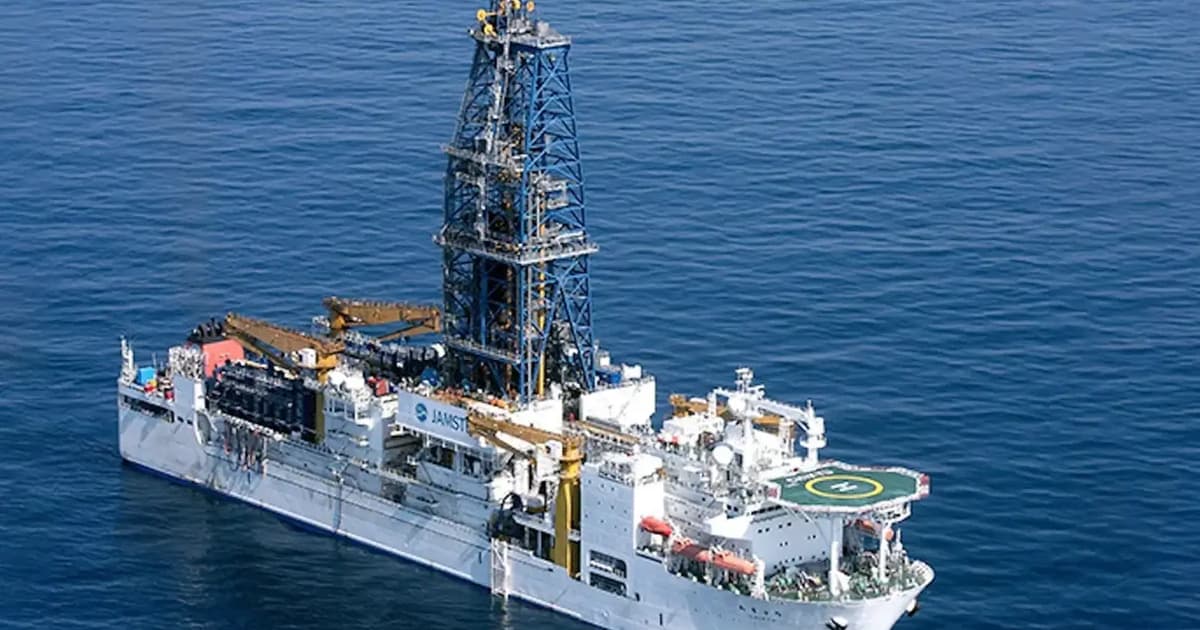
The research vessel Chikyu — a deep-sea drilling ship operated by JAMSTEC, Japan's marine science agency — is leading the extraction effort. JOGMEC, Japan's metals and energy security agency, is also a key partner. The project started in 2018 under a Cabinet Office initiative and has been steadily mapping the seafloor and testing recovery methods, according to Discovery Alert.
Getting mud from nearly 6 kilometers below the surface is extraordinarily difficult. The pressure at that depth is crushing, and the equipment must work in total darkness with no room for error. Officials call the 50-ton sample recovery a milestone — proof that ultra-deep extraction is technically possible, according to Free Malaysia Today.
China's Export Curbs Are Pushing Japan to Mine Its Own Seabed
China controls about 60% of global rare earth production and has tightened export controls in recent years. That has alarmed Japan, which relies on these minerals for semiconductors, EV batteries, and defense systems. Deep-sea mining near Minamitorishima offers Japan a chance to break that dependence and secure its own supply, according to Modern Diplomacy.
Japan is also seeking allies in this effort. Officials have opened discussions with the United States about joint mining activity around Minamitorishima. The talks are part of a broader push by both countries to build supply chains that don't run through China, according to Strat News Global.
Environmental Concerns Cloud the Path to Commercial Mining
Not everyone is celebrating the discovery. Environmental groups warn that digging up the deep seabed could destroy ecosystems that scientists barely understand. The ocean floor at 6,000 meters is home to unique creatures that take decades or centuries to recover from disturbance. Critics say the risks are being rushed past in the chase for minerals, according to Discovery Alert.
Japan's government says it will evaluate the full costs and benefits of large-scale extraction by March 2028 — after the 2027 mining test. That review will weigh economic gains against environmental harm. The outcome will determine whether Minamitorishima becomes Japan's next great resource frontier or a project shelved by its own risks, according to Mining Weekly.
Sentiment
Mostly NegativeNEGATIVENEUTRALPOSITIVE
Publishers
19
Articles
33
Reach
52
A
AnonymousAuthor


