Apple Unveils Reference Image Verification for iPhone 18
Apple Unveils Reference Image Verification for iPhone 18
Anonymous
Key Points
1
The chain of trust begins when the camera sensor is activated: it generates a signing-key pair, while the private key remains on the sensor. Apple says this hardware-level design helps protect against data-injection attacks, compromised operating systems and hardware attacks.
2
Apple says Private Cloud Compute assigns each reference image a confidence score. If a sensor receives a low score, new reference images from it will not be signed, and Apple can revoke either individual images or an entire sensor if fraud is detected; compatible iPhones retrieve updated revocation lists.
3
The reference negative is stored on the device with cryptographic timestamps that specify lower and upper bounds, in addition to pixel data and sensor metadata. Users can later send the unprocessed negative to Private Cloud Compute to render it for verification.
4
Apple says the system is designed to protect photographers’ privacy by avoiding an explicit public credential and preventing public links between multiple images taken by the same sensor or device, reducing the risk that a photo can be tied to a photographer’s identity or activity.
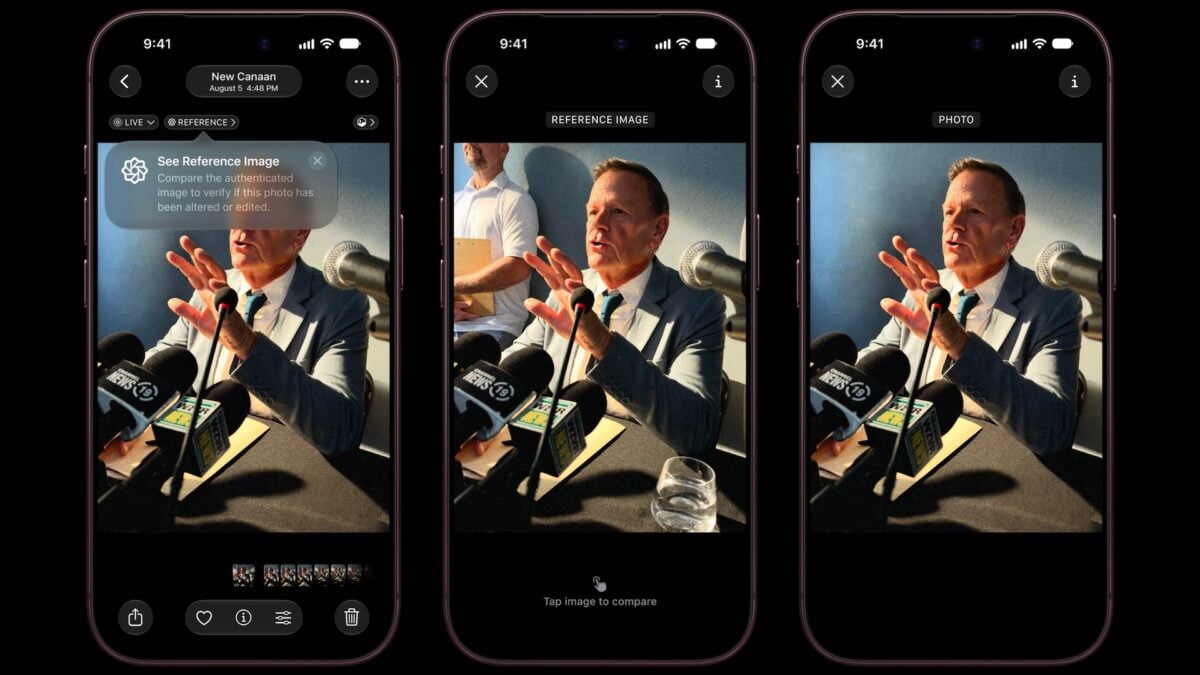
Apple has unveiled Apple Reference Image, a new camera feature coming to the iPhone 18 Pro and iPhone 18 Pro Max that uses hardware-level cryptography to prove a photo hasn't been tampered with Neoteo. The system signs pixel data directly inside the camera sensor during capture, before any software editing, creating a permanent digital record that shows exactly what the camera saw F-Stoppers. This approach aims to combat deepfakes and AI-generated images by establishing a verifiable chain of trust from the moment you press the shutter button.
The feature works by storing a signed, timestamped reference image on your device alongside the normal photo you can edit iDropNews. If you want to verify the image later, you can send it to Apple's Private Cloud Compute servers—which process it without actually viewing the underlying photo, protecting your privacy Android Headlines. Apple says this hardware-based system is more secure than existing software-only standards like C2PA, which attach authentication data after editing and can be stripped away.
How the Signing Process Protects Against Tampering
The security chain begins at the factory. Each iPhone 18 Pro's main camera sensor generates a unique cryptographic key pair—one private key stays locked inside the sensor hardware Android Headlines. When you take a photo, the sensor immediately signs the raw pixel data using ECDSA P-256 encryption before iOS touches it Neoteo. This hardware-level design protects against hacked operating systems, software exploits, and even physical attacks on the device. The private key never leaves the sensor, making it nearly impossible for attackers to forge false signatures.
Apple's Privacy-First Verification System
Unlike traditional photo verification, Apple Reference Image avoids publicly linking photos to a specific device or photographer F-Stoppers. Instead of issuing a public credential that could expose your identity, the system assigns a confidence score to each sensor through Private Cloud Compute Neoteo. If a sensor shows fraud—like a tampered chip—Apple can revoke its ability to create new signed images, and compatible iPhones automatically download updated revocation lists Android Headlines. This approach protects journalists and activists in high-risk regions by keeping their device identity secret.
What the System Can and Cannot Prove
Apple Reference Image proves that your iPhone's sensor actually captured the pixel data—it certifies the camera's hardware integrity iDropNews. But it cannot prove the scene itself was real. For example, if you photograph a high-resolution computer screen displaying an AI-generated image, the system will authenticate it as a genuine sensor capture Neoteo. The feature is also limited to the main rear camera sensor only, not the ultrawide or telephoto lenses. Users need an active internet connection to verify images through Private Cloud Compute, since the verification happens on Apple's servers.
Why Apple's Approach Differs From Industry Standards
Google and other manufacturers use C2PA, an industry-wide standard that attaches authentication metadata after the camera processes the image Android Headlines. Because this signing happens in software, researchers have shown it can be stripped away or forged by editing tools F-Stoppers. Apple's decision to sign data inside the sensor hardware before any processing creates a tamper-resistant foundation Neoteo. However, Apple arrived to verified photography later than Google's Pixel line and chose a proprietary solution rather than joining the open-standard C2PA coalition, creating a closed ecosystem exclusive to iPhone 18 Pro models.
Sentiment
Mostly PositiveNEGATIVENEUTRALPOSITIVE
Publishers
26
Articles
10
Reach
36
A
AnonymousAuthor


