Spot Bitcoin ETF Inflows
iShares Bitcoin Trust dominates spot Bitcoin ETF inflows amid a broad market rally.
Anonymous
Key Points
1
Bitcoin's price momentum picked up in early September, with a roughly 21% rally from Aug. 19 levels (as of Sept. 1), signaling renewed upside after a multi-week lull below $70,000.
2
Liquidity in the spot-Bitcoin ETF space remains highly skewed toward the largest vehicle, highlighted by Aug. 31 trading volume of more than 42 million shares (about $1.9 billion) for the iShares Bitcoin Trust, underscoring its market-leading liquidity.
3
In August, Amplify Bitcoin 2% Monthly Option Income ETF (BITY) saw short interest fall 35.9% to 890 shares (about 0.8% of float), with new stakes from institutions including OLD Mission Capital, Kestra Advisory Services, and Jane Street.
4
Hashdex Bitcoin ETF (DEFI) also experienced a notable decline in short interest in August, down 33.4% to 1,400 shares, equating to roughly 0.2 days to cover and about 1.2% of shares short.
5
Betashares QBTC on the ASX remains a focused, single-asset exposure vehicle, with AU$42.36 million in assets and 1,975,000 units, wrapping the Bitwise Bitcoin ETF as its sole holding and charging a 0.45% management fee.
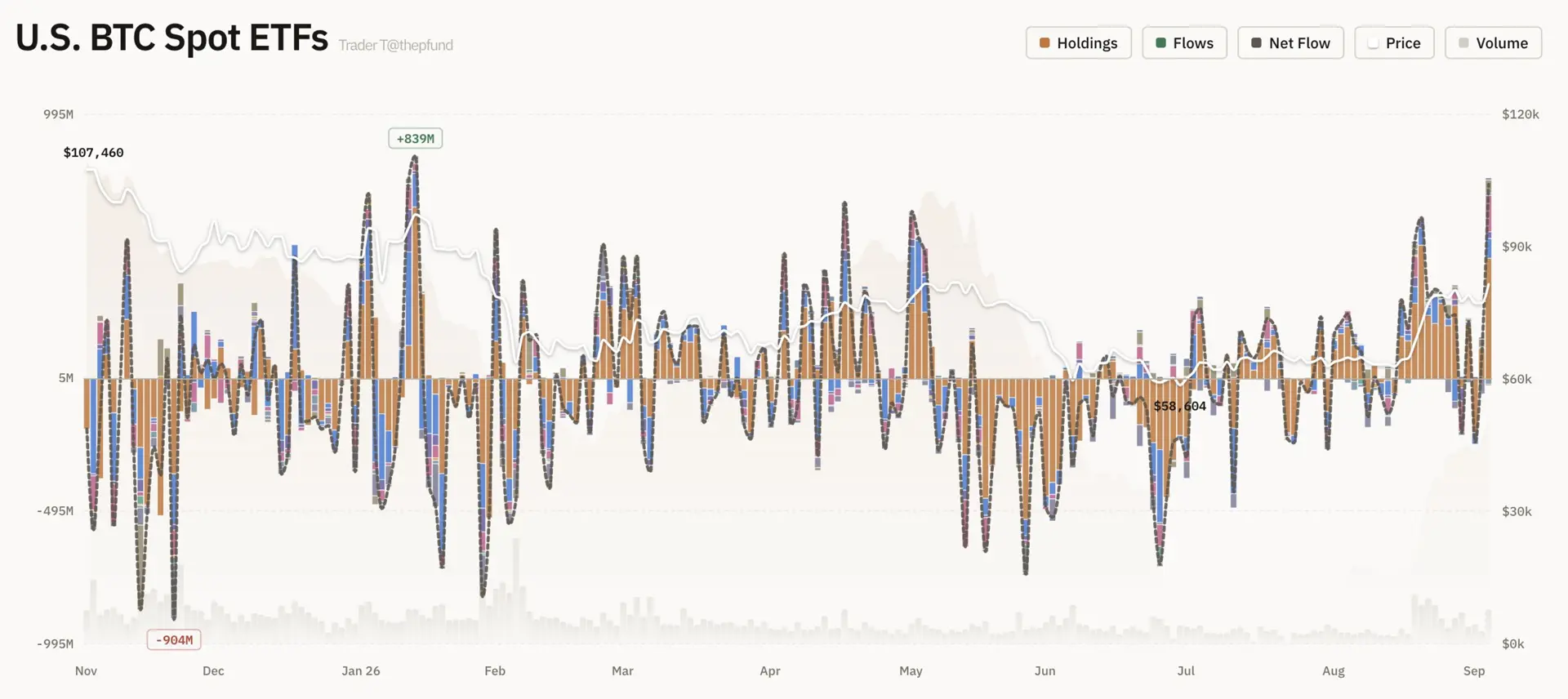
Bitcoin spot ETFs posted record inflows in early September as investors rushed into the space, with iShares Bitcoin Trust (IBIT) leading the charge. Crypto Briefing reported that BlackRock clients purchased $454 million worth of Bitcoin in a single transaction—the largest weekly total since October 2025. On September 3 alone, US spot-Bitcoin ETFs attracted $731 million in net inflows, marking the third-biggest daily inflow of the year, according to Bloomberg Bit.
The rally reflects renewed confidence after Bitcoin climbed roughly 21% from August 19 to early September following a multi-week slump below $70,000. iShares Bitcoin Trust now holds approximately $61.4 billion in net assets, cementing its dominance in the spot-BTC ETF landscape. Trading View noted that the trust's scale and liquidity—evidenced by over 42 million shares traded on August 31 alone (roughly $1.9 billion in volume)—keep it the clear market leader for institutional and retail buyers alike.
IBIT Dominance Reflects Investor Preference for Scale
The iShares Bitcoin Trust's commanding lead stems from its unmatched size and liquidity. With $61.4 billion in assets under management, it vastly outpaces peers and attracts the heaviest trading flows. Crypto Briefing highlighted that a single BlackRock client purchase of $454.96 million in one transaction underscores how institutional players favor IBIT for executing large positions without market slippage.
Retail and institutional traders prioritize three factors: liquidity, tracking accuracy, and fees. IBIT wins on liquidity—its August 31 volume of 42 million shares dwarfs competitors. This scale enables tight bid-ask spreads and reliable execution, making it the default choice for portfolio managers who need to move large amounts quickly.
Short Interest Declines Signal Shifting Hedging Dynamics
Short sellers have retreated from several Bitcoin ETFs in August, suggesting reduced bearish bets or changing risk management strategies. Amplify Bitcoin 2% Monthly Option Income ETF (BITY) saw short interest plummet 35.9% to 890 shares—just 0.8% of float. Hashdex Bitcoin ETF (DEFI) posted a steeper 33.4% decline, dropping to 1,400 shares short and representing only 1.2% of shares outstanding.
Institutional investors have simultaneously added stakes in these products. OLD Mission Capital, Kestra Advisory Services, and Jane Street all increased positions in BITY during August. This divergence—fewer shorts paired with fresh institutional buying—suggests renewed confidence in Bitcoin's longer-term trajectory and reduced hedging demand against prior weakness.
Global ETF Expansion Broadens Cryptocurrency Access
Bitcoin ETF adoption now extends beyond the US into Canada and Australia, reflecting worldwide demand for regulated crypto exposure. Betashares QBTC on the Australian Securities Exchange holds AU$42.36 million in assets, providing Australian investors a direct hedge into Bitcoin priced in local currency. The fund wraps Bitwise Bitcoin ETF as its sole holding and charges a 0.45% annual management fee.
Purpose Bitcoin CAD ETF's currency-hedged units cater to Canadian traders seeking USD-denominated Bitcoin exposure without foreign exchange risk. These regional vehicles illustrate how the ETF ecosystem is fracturing into specialized products—each tailored to specific liquidity pools, tax regimes, and investor bases. Cross-border demand validates Bitcoin's emergence as a mainstream institutional asset class.
Liquidity Gap Widens Between Market Leader and Rivals
The gap between IBIT and competitors continues to widen. On August 31, IBIT traded 42 million shares worth $1.9 billion—a volume level few peers can match on any given day. This liquidity premium lets large traders enter and exit positions at minimal cost, reinforcing IBIT's network effect and widening its moat.
Smaller ETFs must compete on niche factors: lower fees, specialized strategies (like BITY's options overlay), or regulatory advantages in offshore markets. Yet none have yet dislodged IBIT from the top spot. As long as institutional capital gravitates toward the largest, most liquid vehicle, the dominance is likely to persist.
Sentiment
Mostly PositiveNEGATIVENEUTRALPOSITIVE
Publishers
15
Articles
19
Reach
34
A
AnonymousAuthor


