Asian Games Teqball Debut
Football-Based Sport Teqball Makes Historic Medal Debut at 2026 Asian Games
Anonymous
Key Points
1
India’s 496-athlete contingent also includes Olympic medallists Mirabai Chanu, P.V. Sindhu, Aman Sehrawat and Manu Bhaker. The Asian Games will be broadcast on Sony Sports Network, with streaming on SonyLIV.
2
India’s teqball community grew from roughly 8 to 12 regular players at a Mumbai club before Teqball India was established in 2020 and national tournaments began the following year. The players said their first international competitions exposed how much more advanced other countries were.
3
The Indian representatives have not yet been able to pursue teqball full time: Declan Gonsalves works in content for a sports betting company, Mohamed Anas Beg is employed by a digital marketing agency, and Quimcy Dsouza works as a test engineer for sporting goods.
4
The addition of teqball and padel created extra logistical and funding requirements for the Aichi-Nagoya Games, requiring coordination and support from the relevant Asian and Japanese federations, according to organising committee head Hideaki Ohmura.
5
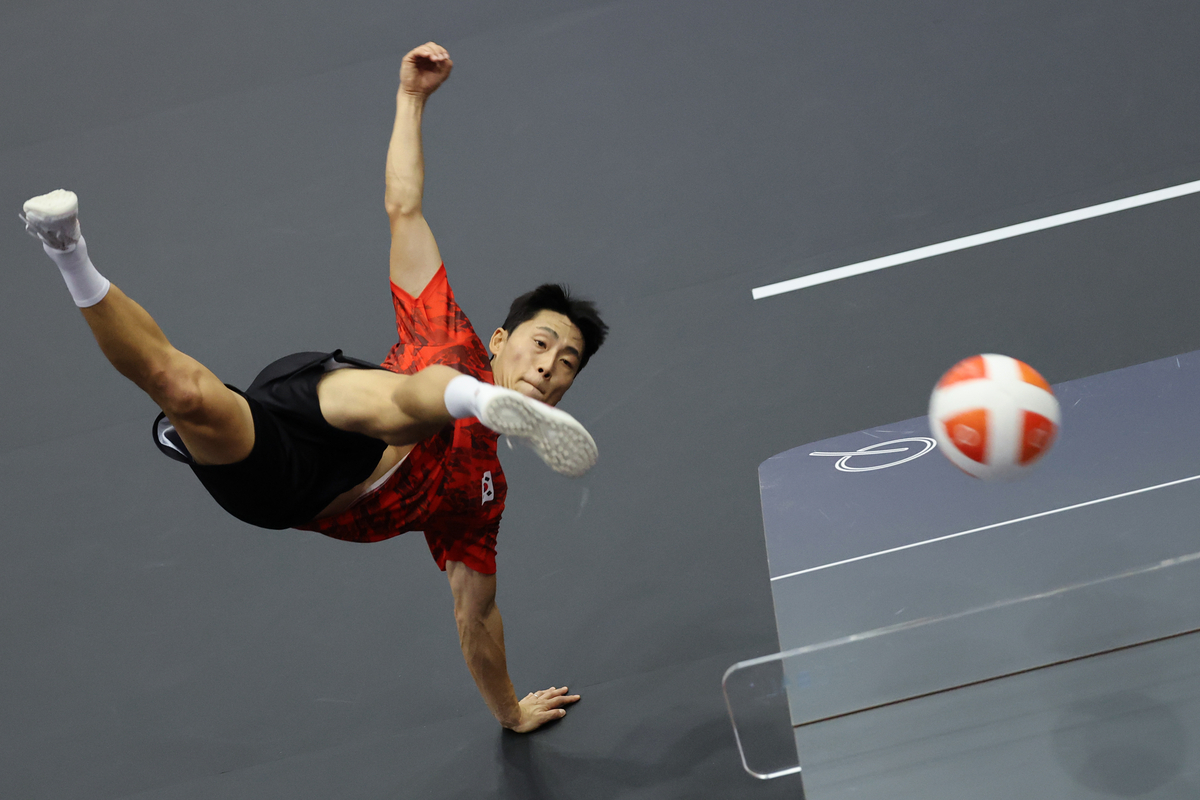
Teqball’s curved table was developed to overcome the limitations of conventional table-tennis tables for football play, directing a standard size-five football back toward players after it bounces.
Teqball made its Asian Games medal debut at the 2026 Aichi-Nagoya Games in Japan, but India's representatives stumbled out of the gate. Men's doubles pair Declan Gonsalves and Mohamed Anas Beg lost both their group stage matches and were eliminated from medal contention, according to India Sports Hub, Rediff, and Free Press Journal.
The sport—played on a curved table using only feet, knees, chest and head—arrives at the Games after rapid global expansion since its 1994 invention in Hungary. India's teqball community, however, remains small and underfunded, with players still working full-time jobs outside the sport.
A Curved Table Where Feet Replace Hands
Teqball is football reimagined for a table. Players bounce a regulation size-five soccer ball on a curved, waist-high surface—similar to ping-pong but designed specifically for footwork. Each team gets three touches per rally, and players must use different body parts in succession: a foot touch, then a knee, then a chest.
Doubles rules add another layer. Partners must exchange at least one pass before returning the ball across the net. Matches go best-of-three sets to 12 points. The sport governs itself through the International Teqball Federation, which now counts more than 150 member nations.
India's Teqball Players Work Day Jobs to Compete
India sent three teqball players to Aichi-Nagoya: Declan Gonsalves, Mohamed Anas Beg, and Quimcy Dsouza. None compete full-time. Gonsalves works in content for a sports betting company. Anas Beg is employed by a digital marketing agency. Dsouza works as a test engineer for sporting goods.
India's teqball community only began to organize recently. Before 2020, roughly 8 to 12 regular players practiced at a Mumbai club. Teqball India was formally established in 2020, and national tournaments launched the following year. Early international competition showed Indian players how far behind other nations they were.
South Korea Dominates Teqball's Asian Games Debut
While India struggled, South Korea excelled. Men's singles captain Lee Jun-seok won all five of his group stage matches without dropping a single set, according to Seoul Economic Daily. South Korean pairs also defeated India's men's doubles team in the group stage.
The disparity reflects how teqball developed unevenly across Asia. Some nations invested in infrastructure and full-time athletes early. India arrived with part-time players juggling careers outside the sport. That gap showed in every match.
Asia Games Stretch Logistics With Two New Sports
Adding teqball and padel to the 2026 Asian Games created extra strain on organizers. Both sports required new facilities, equipment, and coordination with continental and Japanese federations. Aichi-Nagoya organizing committee head Hideaki Ohmura acknowledged the logistical and funding challenges of integrating two unfamiliar sports on such a large stage.
The 2026 Games will broadcast on Sony Sports Network, with streaming on SonyLIV. India's full contingent of 496 athletes includes Olympic medalists Mirabai Chanu, P.V. Sindhu, Aman Sehrawat, and Manu Bhaker. Teqball's media presence remains tiny compared to traditional sports, reflecting how young the discipline still is.
Sentiment
Mostly NegativeNEGATIVENEUTRALPOSITIVE
Publishers
39
Articles
34
Reach
73
A
AnonymousAuthor